Other: Sound Devices E5 recorder/monitor starts shipping today

We are in a world of mutually exclusive choices: the PixE5 which can only capture 2 of 8 channels embedded audio, or the Atomos Shogun, which records all the audio, but can't record DCI 4K input. :( The first company that gives me both gets my business.

It appears from the data that Atomos as posted about the Shogun, you get "2 or 8 channels - camera dependent". I don't think you can get 8 channels of audio recorded directly into the FS7 at least at the present time.
 
Hi Mark - you can do 4 channels pre-synced within the picture. (Actually up to 8)

You could use 2 from the camera over HDMI and a further 2 from the PIX-LR inputs and if necessary, a further two from the 3.5mm line in for a total of 6.
All 6 channels would be pre-synced within a single ProRes QuickTime file.
The PIX-E includes a user-adjustable audio delay adjustment on each audio channel to allow you to compensate for any camera HDMI output delay.

The mic preamps of the PIX-LR are of similar design to those used in our Sound Devices mixers and recorders, so you need not be concerned about the quality of audio compared to what the FS7 delivers.

Does that answer your needs?

Paul

I need at least four channels that are pre-synched to picture. .
 
Hi Mark - you can do 4 channels pre-synced within the picture. (Actually up to 8)

You could use 2 from the camera over HDMI and a further 2 from the PIX-LR inputs and if necessary, a further two from the 3.5mm line in for a total of 6.
All 6 channels would be pre-synced within a single ProRes QuickTime file.
The PIX-E includes a user-adjustable audio delay adjustment on each audio channel to allow you to compensate for any camera HDMI output delay.

The mic preamps of the PIX-LR are of similar design to those used in our Sound Devices mixers and recorders, so you need not be concerned about the quality of audio compared to what the FS7 delivers.

Does that answer your needs?

Paul

Delay in the video channel was the stumbling block to using Shogun's internal audio recording capability (the audio was 3 frames advanced of the picture --and the FS7's own audio embedding). This COULD work, but it is a bit klunky and redundant, since the hardware for the FS7 exists to accept four XLR inputs and two input channels would be idled.

(Another weakness of the FS7 is it lacks sufficient internal attenuation to handle very loud sound levels. Even at -40dB ref level, it is easily overloaded. My EX3 could got to -11dB attenuation and 140+dB SPLs were no problem for it to handle.)

I'm not particularly thrilled with the FS7's deficient bass response (down 7.4dB @ 20Hz), but if your device is better, and as noise-free, I'd consider using it as the primary audio recorder and the FS7's first two channels as either surround or dialog wireless mic channels. And then, the 3.5mm minis could actually take the wireless receiver signal, if I have the right cable to go from the EW100 to 3.5mm. There are possibilities, there, but then I don't have total redundancy of audio between internal XAVC recording and external Prores. If I did all the audio at the FS7 and simply recorded all tracks off the HDMI, I'd have two identical audio copies, one of which has 'good' video quality and the other with 'high' video quality.

On the other hand, if the HDMI handled at least 4 channels of audio, I'd buy one in a heartbeat, no reservations.
 
Mark.. I just wonder.. do you all have cable up there..

Cable TV? It's available in the area, but we don't watch TV (don't even own a television) as there's nothing on that doesn't make my blood pressure skyrocket. We used to have Charter internet, but their rules were restrictive as to how we could use the connection and the weekly Wednesday night outages for six hours were a real problem. Two one-week back to back outages in Feb 2005 were the last straw and I jumped to DSL, which was twice the speeds on download and 4X the upload at the time (2005). Of course cable has improved a lot and DSL has remained unchanged, despite going from $12 to $35. :(
 
Delay in the video channel was the stumbling block to using Shogun's internal audio recording capability (the audio was 3 frames advanced of the picture --and the FS7's own audio embedding). This COULD work, but it is a bit klunky and redundant, since the hardware for the FS7 exists to accept four XLR inputs and two input channels would be idled.

(Another weakness of the FS7 is it lacks sufficient internal attenuation to handle very loud sound levels. Even at -40dB ref level, it is easily overloaded. My EX3 could got to -11dB attenuation and 140+dB SPLs were no problem for it to handle.)

I'm not particularly thrilled with the FS7's deficient bass response (down 7.4dB @ 20Hz), but if your device is better, and as noise-free, I'd consider using it as the primary audio recorder and the FS7's first two channels as either surround or dialog wireless mic channels. And then, the 3.5mm minis could actually take the wireless receiver signal, if I have the right cable to go from the EW100 to 3.5mm. There are possibilities, there, but then I don't have total redundancy of audio between internal XAVC recording and external Prores. If I did all the audio at the FS7 and simply recorded all tracks off the HDMI, I'd have two identical audio copies, one of which has 'good' video quality and the other with 'high' video quality.

On the other hand, if the HDMI handled at least 4 channels of audio, I'd buy one in a heartbeat, no reservations.

Mark - thanks for the suggestion for 4ch HDMI support. We appreciate the input.

FYI, the Sound Devices's mic/line inputs are flat from 10 Hz to 20 kHz (+/- 0.5dB) with EIN noise figures typically better than -128 dBv.
Also, the PIX-LR inputs can handle very loud signals, up to around + 40 dBu. I'm pretty confident there aren't any pro cameras out there that can match these specs.

Paul


It shouldn't be hard to implement the full 8-channels embedded in the stream from the camera. Atomos did it with the Shogun.

HDMI allows up to 8 channels of uncompressed audio at sample sizes of 16-bit, 20-bit and 24-bit, with sample rates of 32 kHz, 44.1 kHz, 48 kHz, 88.2 kHz, 96 kHz, 176.4 kHz and 192 kHz

The audio preamp specs sound about right. I record everything from pyrotechnics, to orchestras and pipe organs, to the sounds of nature. A wide dynamic range and broad frequency response is essential.

I do find it curious that your audio only products are priced at about 3X the price of this audio-video product though. To be frank, I would never spend four grand on a mic preamp for a camera, but $1500 for a recorder that does video at 4K plus audio, now that's a bargain I can't resist.
 
Mark - thanks for the suggestion for 4ch HDMI support. We appreciate the input.

FYI, the Sound Devices's mic/line inputs are flat from 10 Hz to 20 kHz (+/- 0.5dB) with EIN noise figures typically better than -128 dBv.
Also, the PIX-LR inputs can handle very loud signals, up to around + 40 dBu. I'm pretty confident there aren't any pro cameras out there that can match these specs.

Paul

"Typically better than -128 dbv" Ouch!

Paul, love and respect Sound Devices but please don't throw around specs without reference, ie: when quoting Equivalent Input Noise (EIN) this is refered to an input source impedence and I note also you refer your spec to DBv level.

Traditionally this was a figure refered to dbu (0.775v) with an input impedence of either 200 ohms or further back at 600 ohms where I suppose we all called it dbm, but now calling this "obselete". We are all confused.

Making it look better than it is in relation to the theoretical maximum of -128.5 across 200 ohms dbu (using Boltzman's Constant) at 20 degrees C was the standard. Manufacturers then often refered this to 100 ohms (typically those from further East) making their EIN look better than it really was or using the DBv level.

Getting just 0.5db of noise at 60 db of gain (across 200 ohms) is a heck of an ask. But likely, I am well out of date from my broadcast and product management days. But please provide us with the references then we can compare like for like.

However, most here (and here I am speaking personally and the people I know) judge a product by its performance by eye and ear, not by its spec. Specmanship is the bane of technology and tool.

Claire
 
Last edited:
Point taken Claire! I was trying to give a brief idea of low freq and noise performance to help Mark ... but, yes, maybe too brief!!

Here is the full EIN spec (subject to change come release - but close enough to give you an idea):
-126 dBu (-128dBv) measured with 200 ohm source impedance; 22 Hz - 22 kHz bandwidth; trim gain full up.

And I agree - a spec only gives limited insight into performance .... both a BMW and a Skoda can do 70 mph, but which feels better?!

Paul
 
Perhaps you meant to type dBm instead of dBu. The latter term is used in very small signal measurement in radio frequency work. For instance, the miniscule signals that FM receivers need to amplify. A city grade FM broadcast signal is 60dBu--that is, 60 decibels stronger than 1 microvolt measured on a 1 meter long receiving antenna. A 'fringe' signal is 34dBu.

In audio, we use dBm, which is decibels over 1 millivolt, a carry over from the Bell telco industry, where 1mV across 600Ω line was considered 0dBm.

A good preamplifier will have an EIN of at least -122dBm. Some Allen & Heath, Midas and Neve preamps are as good as -129dBm, A-weighted.

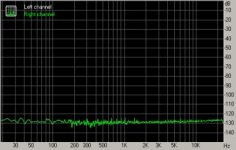
With that said, here is the measured noise of the PXW-FS7's mic preamplifier, unweighted. It is one of the quietest preamps I've ever measured that was part of a camera.

noise.jpg

When you get down in those ranges, the larger concern becomes the FET or vacuum tube in your condenser microphone, the best of which, like my Neumann U87As, only manage a -82dBm noise floor.
 
Perhaps you meant to type dBm instead of dBu. The latter term is used in very small signal measurement in radio frequency work. For instance, the miniscule signals that FM receivers need to amplify. A city grade FM broadcast signal is 60dBu--that is, 60 decibels stronger than 1 microvolt measured on a 1 meter long receiving antenna. A 'fringe' signal is 34dBu.

In audio, we use dBm, which is decibels over 1 millivolt, a carry over from the Bell telco industry, where 1mV across 600Ω line was considered 0dBm.

dBu is the correct modern terminology for "unloaded" (that is, level based on voltage instead of power) measurements. See http://www.soundonsound.com/sos/1994_articles/feb94/decibels.html:

While dBs express only general ratios, the dBm is a fixed value where 0dBm equates to 1 milliwatt of power. This is of little direct relevance in the world of modern audio, but was vitally important in the pioneering days of telephone when small amounts of electrical power needed to be transmitted over long distances. In the world of telephones and 600 ohm line impedances, 0 dBm tended to mean a signal of 0.775 Volts applied to a load of 600 ohms -- or 1mW.

Today, the term dBm is often abused to signify a signal level of 0.775 Volts, but unless the load impedance is exactly 600 ohms, this is incorrect. Because exact load impedances are less of an issue in modern audio systems, the new term dBu (u meaning unloaded) was introduced to signify a voltage level of 0.775 Volts, regardless of the load impedance. In other words, while the dBm is a measure of power, the dBu is a measure only of voltage. The term dBv (lower case v) also means the same thing as dBu, though the term dBu is more commonly used.

So far so good, but a reference voltage level of 0.775 Volts is pretty clumsy -- 1 Volt would be far easier to manage. And that's where the recently introduced dBV (note the upper case V) comes in. This simply signifies a signal level of 1V without regard to the load impedance.


Decibels relative to a microvolt (used extensively in radio, as you say) is expressed using the actual mu character, as in +60 dBµV, or, for the typewriter impaired, as dBuV.

- Greg
 
I may be getting out of my league here, but:

"In 1940, the phone company and radio networks agreed on standard levels for long-distance broadcast and telephone lines: zero decibels would match 1/1000 watt (one milliwatt); any audio power from the tiniest microphone signal to the biggest amplifier output could be described as a ratio in dBm (decibels referred to that milliwatt). Wattage is a function of voltage and impedance, but telephone lines always had 600 ohms impedance; at that impedance, 0 dBm --- or exactly one milliwatt --- equals 0.775 volts. If you're not sure why something with a zero has any voltage at all, go back and read about decibels in Chapter 2.

"The phone company developed meters calibrated to read zero at 0.775 volts, and added specific timing characteristics to make them respond the way we hear. They called them Volume Unit, or VU, meters. Broadcasters used them to measure program loudness and verify they were sending the phone company the right level. But they quickly discovered that the meters' internal rectifiers distorted the sound, something that didn't matter with phone calls. They reduced the distortion by isolating the meter with a resistor. But the resistor also reduced the voltage by 4 dB. Rather than design completely new VU meters, broadcasters decided that in their world, the standard line level would be +4 dBm, or 1.228 volts across 600 ohms. When a VU meter reads zero, that's the voltage it's seeing.

"Of course, Ohm's Law insists that +4 dBm --- a level in milliwatts --- can equal a precise voltage only at one impedance. So two other standards evolved. In the United States, the National Association of Broadcasters took just the voltage part of the phone company standard and called it 0 dBu --- the "u" stands for unterminated: an open circuit with no impedance."

--- Producing Great Sound for Digital Video, by Jay Rose

"While dBs express only general ratios, the dBm is a fixed value where 0dBm equates to 1 milliwatt of power. This is of little direct relevance in the world of modern audio, but was vitally important in the pioneering days of telephone when small amounts of electrical power needed to be transmitted over long distances. In the world of telephones and 600 ohm line impedances, 0 dBm tended to mean a signal of 0.775 Volts applied to a load of 600 ohms -- or 1mW.

"Today, the term dBm is often abused to signify a signal level of 0.775 Volts, but unless the load impedance is exactly 600 ohms, this is incorrect. Because exact load impedances are less of an issue in modern audio systems, the new term dBu (u meaning unloaded) was introduced to signify a voltage level of 0.775 Volts, regardless of the load impedance. In other words, while the dBm is a measure of power, the dBu is a measure only of voltage. The term dBv (lower case v) also means the same thing as dBu, though the term dBu is more commonly used."

--- "Decibels Explained," Sound on Sound

There is some discrepency in what exactly the u stands for: unterminated or unloaded. Regardless, both agree that in the world of audio, that's the reference, at least in the US.
 
Last edited:
Point taken Claire! I was trying to give a brief idea of low freq and noise performance to help Mark ... but, yes, maybe too brief!!

Here is the full EIN spec (subject to change come release - but close enough to give you an idea):
-126 dBu (-128dBv) measured with 200 ohm source impedance; 22 Hz - 22 kHz bandwidth; trim gain full up.

And I agree - a spec only gives limited insight into performance .... both a BMW and a Skoda can do 70 mph, but which feels better?!

Paul

Thanks Paul, that makes better sense. Thanks for the info... Still looking good.

LOL like your comparison. Nothing wrong with Skoda though - a heck of a lot better than in the 70s.

Claire
 
Hello,
I'm very interested by the Pix-E5 to use with GH4 / A7R ii.
I want to use the audio interface and Rode NTG3 mic, to have a complete rig for my works.

Could you tell me if the setup will be good enough or I'll need to add an extern audio recorder in order to have a good (pro) quality input in this 1 man setup.
(I was using the Zoom H4 but I wasn't happy with)

Thanks for your advices,
Guillaume
 
The PIX-E5 with the PIX-LR XLR audio interface will give you excellent audio quality. No need for an external audio recorder for your situation.

Hello,
I'm very interested by the Pix-E5 to use with GH4 / A7R ii.
I want to use the audio interface and Rode NTG3 mic, to have a complete rig for my works.

Could you tell me if the setup will be good enough or I'll need to add an extern audio recorder in order to have a good (pro) quality input in this 1 man setup.
(I was using the Zoom H4 but I wasn't happy with)

Thanks for your advices,
Guillaume
 
I read in another forum that the Sound Devices recorders don't accept record start/stop trigger via HDMI. Is this true or false?
 
I read in another forum that the Sound Devices recorders don't accept record start/stop trigger via HDMI. Is this true or false?

HDMI Start/Stop is not in the current firmware, but it is a very high priority item for future firmware revisions.
 
Back
Top