No Avid support at the moment and no commitment from Avid.
I played with an EX1 today and also went to a Sony presentation on the EX1 at GVExpo. The EX1 is some serious competition for the HVX--no question about that. I don't think there's a clear winner--both cameras have their strong points. The output of the EX1 looks very very sharp. Even with the gain cranked up to high, the image looked pretty clean. The focus ring felt nice and it's unquestionably nice to have rings for focus, zoom, and iris. It's smaller than the HVX, but damn--lots of tiny black buttons on a black camera. The HVX's buttons are much easier to find. The multi-color peaking controls and superior lcd are a striking improvement over the HVX--very useable for critical focus without the need for an outboard monitor.
Sony's presentation was a frustrating mix of technical details, half-truths, and outright misrepresentation. FWIW, they claimed that the sensor design's use of an AD converter for each column of pixels allows very fast offload of data and minimizes image warp/wobble. They also put on a vigorous defense of their codec and made the point that even though the sampling is 4:2:0 compared to DVCPro HD's 4:2:2, they're starting out with more luminance information than the HVX's sensors and they end up with equivalent (or more) final color information. They also claimed the camera has a large buffer and is able to look ahead and do a lot of intelligent processing/compression before the signal is laid down--making the codec harder to "break".
Spec wars aside, I'd like to sell how well the EX1 can pull a key, and have it's footage graded without breaking up. Sony said the gamma curves are optimized for maintaining maximum dynamic range data rather than achieving a film look, so grading will be important. I also like to see if the image geometry holds up enough to get good matchmoving solutions.


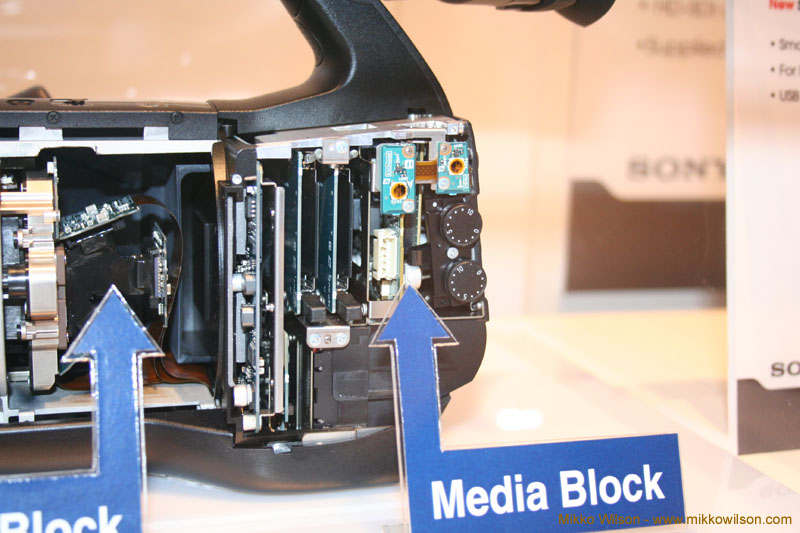
 You can see how a lot of those buttons are friggin small. My hands are pretty small and I still didn't like 'em much. If you've got big hands, you're gonna be cursing a lot with this camera.