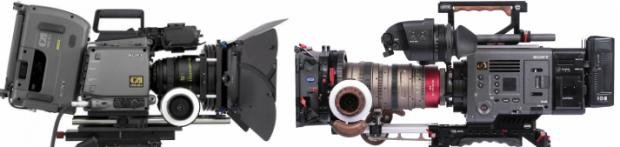
F35: Sony Venice VS Sony F35

starcentral

Veteran
tronsonycinealtaf35srw1_92.jpg

I wish I could say this is one of my facetious posts but actually with all seriousness anyone following the Venice less than impressed with it? Let's not forget $42k for body, $10k for viewfinder. You will need the AXS-R7 for $7k plus $2k media cards.

With licensing Venice will offer more in terms of formats (and even more possibilities to follow with it's interchangeable C̶C̶D̶ sensor block which I think is real exciting) but at 500 ISO and likely no "mojo" ala Genesis DNA, on the surface at least, image-wise to me the F35 would honestly give it a run for the money. A good run. It ticks the "4K" box for networks like Netflix, but with the F55 already filling that void, still struggling to see where Venice is going to fit.

Thoughts?
 
Last edited:
Tough to tell on these things.

I am seeing rental houses adopting the Venice. I'm not sure to what extent, but certainly seeing them out there.

On the one hand, it promises in terms of upgradability and a long-term investment platform. On the other hand, upon launch it has some limitations that keep it from fully competing with Alexa and Varicam...such as HFR, for example.

But again, as a rental item, I'm curious to see how much this lack of features will fair out for Venice's market penetration. I know for the F65, the lack of compressed codecs and established proxy and color workflow kept it from being adopted. These aren't the same features that are missing from the Venice, but it is an example of Sony coming to market missing key features.

As it relates to the F35, I'm not sure they really compare at all. F35 is a $10k investment, with no rental house support and is a niche item. It's a lovely camera, but not a real option for union shows and big-budget productions...which is what Venice is hoping to be. If you are speaking from the perspective of which camera you should get, as a someone who is renting their own gear to the productions that hire you for your services as well, then I suppose that's a different story.

As it relates to the F55, I think folks that are using F55 in drama work will happily switch to the Venice, since they are often used in scenarios where they would like to use the Alexa, but either need 4k, or can't afford Alexas...so if it's cheaper to rent Venice, that could swing it. I think the high-end sports market are mostly using Amiras, not the F55, so they likely won't be switching, due to lack of HFR.

I don't really know, all speculation, really. But F35 vs. Venice comparison is a peculiar comparison. What is driving your train of thought? You thinking of making an investment in either of these?
 
I think what started my thought is fact that F35 has 12.6 megapixels and at the same crop size on Venice even though Venice is 24 megapixel in super35mm 24.9x18.7mm it is 4096x3024 or 12.3 megapixels.

Well you know what that kind of means.
 
View attachment 129885

I wish I could say this is one of my facetious posts but actually with all seriousness anyone following the Venice less than impressed with it? Let's not forget $42k for body, $10k for viewfinder. You will need the AXS-R7 for $7k plus $2k media cards.

With licensing Venice will offer more in terms of formats (and even more possibilities to follow with it's interchangeable CCD block which I think is real exciting) but at 500 ISO and likely no "mojo" ala Genesis DNA, on the surface at least, image-wise to me the F35 would honestly give it a run for the money. A good run. It ticks the "4K" box for networks like Netflix, but with the F55 already filling that void, still struggling to see where Venice is going to fit.

Thoughts?

Hi Starcentral,

On thing to note, is that the Sony Venice will have a dual base iso mode (500 & 2500):

https://www.newsshooter.com/2018/02/03/last-minute-updates-to-sony-venice/
 
Actually I think Venice may have a lot of potential. I've heard reports that it may have greater dynamic range than any of the other cameras around. Obviously more tests will begin to surface soon to show how things compare. And it's the least expensive large format digital cinema camera available at about half the cost of RED or Arri's large format cameras...

It's a bit hard to compare a 6K VistaVision camera to a 2K S35 camera that's significantly larger and heavier and with a lot less dynamic range etc...
 
Hi Starcentral,

On thing to note, is that the Sony Venice will have a dual base iso mode (500 & 2500):

https://www.newsshooter.com/2018/02/03/last-minute-updates-to-sony-venice/


It's unknown right now how Sony will actually use dual ISO read on the Venice.

Some combination of the read (similar to how ARRI does it with the Alexa) would be ideal for having the ability to really wrangle highlights for smooth rolloff, but if ARRI holds patents on their "dual gain architecture" then we can not be sure what Sony has planned for their version of "dual ISO read". At this stage of the game it can honestly mean anything.

But back to the initial comparison, if Venice plans to use dual read for highlight handling well the F35 already is known to have very nice highlight handling and smooth rolloff.
 
From my understanding, it's not so much dual readout so you have larger DR that can be allocated to highlight roll-off, but more af a Varicam type of system where it routes it through separate circuitry paths so that it can be at either 500 or 2500, each at zero gain.

Sony's official number is 15 stops of DR. I haven't seen any real world tests, but would love to get my hands on a Venice sometime soon.

I'm not sure about the comparison between pixels in s35 mode between the Venice and F35, so I can't speak to that. But in terms of highlight roll-off, I don't think it rolls-off better than the Alexa. Just my opinion, based on my experience. Because of that, I do find the extra DR helpful for not clipping. Being that I'm more than happy with F65 colors through ACES pipeline, if Venice matches or improves it, I will be super happy. In other words, I never find myself unhappy with the colors I'm able to get on the footage of the F65, so I'm never wishing I had an F35. So with that said, I think that from DR and usability, I think that Venice surpasses F35. And for me, I don't think color will be a problem either, so the only other thing is cost...the F35 clearly winning, here.

But honestly, I'm looking forward to trying to work with the Venice, putting the Celere or Sigma EF mount lenses on a speedbooster and seeing what kind of low-light work can be done. Those are T1.4/5. With speedbooster, it will be focus hell, but awesome for low-light.
 
Just attended the Abel Cine Venice presentation yesterday.
As stated, it looks to have a lot of potential and I'll keep my eye on it.

It's got a license structure like ARRI, with everything (full frame + anamorphic) you're looking at $60k, before media.

Regarding the dual ISO, it's not ready. It'll be in firmware 2.0 over the summer. The footage they were displaying was very noisy, just like the Varicam LT pre-launch, so I'm sure they'll dial it in, but as displayed yesterday it's no big advantage as far as I can tell. The Canon C300 MKII is way cleaner at the same ISO of 2500 in my opinion.

They intimated there would be a lot of support and surprises with future firmware releases. I suppose higher frame rates will be down the line, but who know's what else.

It's a great form factor, but the look needs to mature as far as I'm concerned. The Sony rep stated Sony would be releasing a variety of LUT's to make the camera more film like.
It's all TBD at this point.

To be noted, it's a true 4K anamorphic camera at 6:5 4096 x 3432. It's also got what looks to be a very efficient compression codec in the X-OCN format. We'll see how that stacks up over time.

Pro's as I see it: Great layout, professional power management and connectors, ARRI like menus on asst and operator sides of camera. True anamorphic, ability to use all your legacy glass (spherical and anamorphic), full frame, and higher resolutions available, Sony e-mount. Small footprint. LUT's will travel to post as meta data.

Con's: Noise, color science not fully developed, currently tops out at 60fps, I'm not sure if wireless communication is fully developed yet (it may be, but wasn't promoted). No a/f.

That's all, hope I wasn't too harsh. I know the camera is new and will continue to develop over the next few years.
 
Why bring a flagship model to market when it's unfinished? Can't imagine Ferrari releasing a car with three wheels.
 
Why bring a flagship model to market when it's unfinished? Can't imagine Ferrari releasing a car with three wheels.

To secure pre-orders before the Arri LF dropped I suspect. Canon brought their C700 to market fully formed and ready to work (and it looks great), but it came so long after all the other players had been established, that I haven't even heard of a significant production that's used one.

I think the Venice looks like a terrific option for a large number of reasons. It appears to have addressed a lot of issues that other manufacturers haven't got around to yet, so in many ways it looks like the most modern and forward-thinking camera of the lot.

But until they can get the bulk of their basic features into the firmware, and give people a final answer as to what its final HFR capabilities will be (it's apparently still up in the air), I won't be particularly fussed about using it. I just don't have the patience for dealing with half-baked cameras anymore.

I'm looking forward to trying it out in 12 months time though, when it's a little more show-ready.
 
I have a friend on the west coast that bought a Venice, but right now it kind of sounds like if you don't NEED it right now, don't buy it right now. Wait a little while until newer firmware is released to "make it better". Sony did do a very "Sony thing" by marketing this as a "full frame" camera and then charging you extra to unlock what is one of THE primary selling features of it. But I think they bought a lot of trust and good will with their track record of what they did with the F55/F5 cameras and the continuous string of firmware updates that exponentially improved the camera, it's feature set and value. So, based on that, one would think that the Venice will eventually have a fully functioning feature set that will be at least as good as most of it's rivals.

Regarding the C700, yeah, Canon missed the boat. They took way too long getting it to market.
 
Hah yeah the C700 really makes everything else look so good. I don't know who Canon talked to that told them "yeah don't really improve the image quality, just make it bigger and heavier and more expensive". I really don't get that one.
 
From my understanding, it's not so much dual readout so you have larger DR that can be allocated to highlight roll-off, but more af a Varicam type of system where it routes it through separate circuitry paths so that it can be at either 500 or 2500, each at zero gain.

Sony's official number is 15 stops of DR. I haven't seen any real world tests, but would love to get my hands on a Venice sometime soon.

I'm not sure about the comparison between pixels in s35 mode between the Venice and F35, so I can't speak to that. But in terms of highlight roll-off, I don't think it rolls-off better than the Alexa. Just my opinion, based on my experience. Because of that, I do find the extra DR helpful for not clipping. Being that I'm more than happy with F65 colors through ACES pipeline, if Venice matches or improves it, I will be super happy. In other words, I never find myself unhappy with the colors I'm able to get on the footage of the F65, so I'm never wishing I had an F35. So with that said, I think that from DR and usability, I think that Venice surpasses F35. And for me, I don't think color will be a problem either, so the only other thing is cost...the F35 clearly winning, here.

But honestly, I'm looking forward to trying to work with the Venice, putting the Celere or Sigma EF mount lenses on a speedbooster and seeing what kind of low-light work can be done. Those are T1.4/5. With speedbooster, it will be focus hell, but awesome for low-light.

If sony is using dual ISO just for 15 DR without room for highlight wrangling I don't think that is very great. And I think Alexa and F35 will still have better highlight management. There's 2 ways to get more highlight wrangling - the one everyone immediately thinks of because it makes the most sense is to have more DR available to put towards it - the other way is a way that is not discussed by ARRI and I've always speculated that they've employed a type of "limiting" feature at the D/A process similar to how a limiter works on a compressor/limiter in the audio realm. It's not magical, even Red Giant software had what they called "auto shouldering" for highlight smoothening.

I would bet money Venice won't have it, and that both ARRI and F35/Genesis do..
\

Just attended the Abel Cine Venice presentation yesterday.
As stated, it looks to have a lot of potential and I'll keep my eye on it.

It's got a license structure like ARRI, with everything (full frame + anamorphic) you're looking at $60k, before media.

Regarding the dual ISO, it's not ready. It'll be in firmware 2.0 over the summer. The footage they were displaying was very noisy, just like the Varicam LT pre-launch, so I'm sure they'll dial it in, but as displayed yesterday it's no big advantage as far as I can tell. The Canon C300 MKII is way cleaner at the same ISO of 2500 in my opinion.

They intimated there would be a lot of support and surprises with future firmware releases. I suppose higher frame rates will be down the line, but who know's what else.

It's a great form factor, but the look needs to mature as far as I'm concerned. The Sony rep stated Sony would be releasing a variety of LUT's to make the camera more film like.
It's all TBD at this point.

To be noted, it's a true 4K anamorphic camera at 6:5 4096 x 3432. It's also got what looks to be a very efficient compression codec in the X-OCN format. We'll see how that stacks up over time.

Pro's as I see it: Great layout, professional power management and connectors, ARRI like menus on asst and operator sides of camera. True anamorphic, ability to use all your legacy glass (spherical and anamorphic), full frame, and higher resolutions available, Sony e-mount. Small footprint. LUT's will travel to post as meta data.

Con's: Noise, color science not fully developed, currently tops out at 60fps, I'm not sure if wireless communication is fully developed yet (it may be, but wasn't promoted). No a/f.

That's all, hope I wasn't too harsh. I know the camera is new and will continue to develop over the next few years.

Bill that is an honest assessment. No one is trying to beat it up or be negative about it but facts are facts and we are just discussing them. It sounds a bit like Sony is doing what they did with the F5/F55; announced at the end of 2012 and then took 5 years to reach full maturity. Let's hope Venice is much quicker but so far it sounds like it's coming to market half baked.

I do agree that having true anamorphic capability is awesome sauce! But Sony needs F35 highlight wrangling and F35 color science to really kill it.

I have a friend on the west coast that bought a Venice, but right now it kind of sounds like if you don't NEED it right now, don't buy it right now. Wait a little while until newer firmware is released to "make it better". Sony did do a very "Sony thing" by marketing this as a "full frame" camera and then charging you extra to unlock what is one of THE primary selling features of it. But I think they bought a lot of trust and good will with their track record of what they did with the F55/F5 cameras and the continuous string of firmware updates that exponentially improved the camera, it's feature set and value. So, based on that, one would think that the Venice will eventually have a fully functioning feature set that will be at least as good as most of it's rivals.

Regarding the C700, yeah, Canon missed the boat. They took way too long getting it to market.


I have a friend in USA who's selling two F55's and bought/buying Venice. I personally found that an interesting move for an independent owner/operator.
 
Last edited:
If sony is using dual ISO just for 15 DR without room for highlight wrangling I don't think that is very great. And I think Alexa and F35 will still have better highlight management. There's 2 ways to get more highlight wrangling - the one everyone immediately thinks of because it makes the most sense is to have more DR available to put towards it - the other way is a way that is not discussed by ARRI and I've always speculated that they've employed a type of "limiting" feature at the D/A process similar to how a limiter works on a compressor/limiter in the audio realm. It's not magical, even Red Giant software had what they called "auto shouldering" for highlight smoothening.

"Dual gain" and "Dual ISO" are different things. And Arri are pretty open about it (or at least they have been for the last couple of years), in their own words:

Arri said:
"The Dual Gain Architecture simultaneously provides two separate read-out paths from each pixel with different amplification. The first path contains the regular, highly amplified signal. The second path contains a signal with lower amplification, to capture the information that is clipped in the first path. Both paths feed into the camera's A/D converters, delivering a 14 bit image for each path. These images are then combined into a single 16 bit high dynamic range image. This method enhances low light performance and prevents the highlights from being clipped, thereby significantly extending the dynamic range of the image. "

Dual ISO is a separate process that provides the full latitude of the sensor at two different sensitivities without applying additional gain to the sensor (so the noise penalty is minimal - and should, at the very least, be considerably cleaner than 500 ISO gained up to 2500 ISO).

And even if native 2500 ISO is still too noisy for you, you can use it as a base level, rate the camera lower (at 1600 ISO for example) and get a cleaner image with a sensitivity that's still very high (you'd simply sacrifice a little bit of highlight latitude to do so, and that's less of an issue in low-light scenes).


Bill that is an honest assessment. No one is trying to beat it up or be negative about it but facts are facts and we are just discussing them. It sounds a bit like Sony is doing what they did with the F5/F55; announced at the end of 2012 and then took 5 years to reach full maturity. Let's hope Venice is much quicker but so far it sounds like it's coming to market half baked.

I do agree that having true anamorphic capability is awesome sauce! But Sony needs F35 highlight wrangling and F35 color science to really kill it.

I'm hopeful that we might actually be pleasantly surprised on that front. I'll take a bet on Venice's highlights beating out the F35 (if only by a little bit), and there has been a VERY interesting shift in the sort of language Sony have used to describe the new colour science on the Venice. Rather than talking about a wider, more accurate colour gamut (which has always been their pitch in the past) they're instead calling it 'beautiful' and 'painterly', and they're doubling down on Sgamut3.cine as well - which is a great sign, as the reason Sgamut3.cine always looks so much nicer than the much larger Sgamut2 or Sgamut3, is because it's actually a much more limited gamut, and the smaller gamut causes certain colours and hues to render in a more pleasing way than Sony's conventional nuclear greens and hyper reds.

So it sounds like Sony might have finally got the message (for the first time since the F35) that 'pretty' trumps 'accurate'.

That said, simply returning the F35's colour science would have been fine by me. We've just finished the grade on the Bollywood feature I shot over in India on the F35 a while back - and it sure does pretty things!
 
"Dual gain" and "Dual ISO" are different things. And Arri are pretty open about it (or at least they have been for the last couple of years), in their own words:

And even if native 2500 ISO is still too noisy for you, you can use it as a base level, rate the camera lower (at 1600 ISO for example) and get a cleaner image with a sensitivity that's still very high (you'd simply sacrifice a little bit of highlight latitude to do so, and that's less of an issue in low-light scenes).

Rating lower assumes you have the necessary light levels which could be contrary to the very reason you would be using the higher base, that being you don't.

I'm hopeful that we might actually be pleasantly surprised on that front. I'll take a bet on Venice's highlights beating out the F35 (if only by a little bit), and there has been a VERY interesting shift in the sort of language Sony have used to describe the new colour science on the Venice. Rather than talking about a wider, more accurate colour gamut (which has always been their pitch in the past) they're instead calling it 'beautiful' and 'painterly', and they're doubling down on Sgamut3.cine as well - which is a great sign, as the reason Sgamut3.cine always looks so much nicer than the much larger Sgamut2 or Sgamut3, is because it's actually a much more limited gamut, and the smaller gamut causes certain colours and hues to render in a more pleasing way than Sony's conventional nuclear greens and hyper reds.

So it sounds like Sony might have finally got the message (for the first time since the F35) that 'pretty' trumps 'accurate'.

I'm not sure I agree doubling down on Sgamut3.cine equates to beautiful and painterly; rather Sgamut3.cine could be just "accurate within a narrower gamut." And if it really was just a mathematical manipulation of a color table it could be replicated for any camera which I doubt. In other words, the new color science would need to extend into the dyes of the CFA where the actual color filtration happens.

Dual ISO is a separate process that provides the full latitude of the sensor at two different sensitivities without applying additional gain to the sensor (so the noise penalty is minimal - and should, at the very least, be considerably cleaner than 500 ISO gained up to 2500 ISO).

In operational amplifiers, gain is ratio of the feedback impedance R2 over input impedance R1, so it follows if the sensitivity changes without additional gain, the input impedance must be different between the two iso's. That presupposes there is a corresponding improvement in signal to noise in one of the two input paths. Who can say that's really true? Proof is in the pudding! It surely helps on some level but less than the Arri approach.

What's more important to me, is that you pointed out a key difference between Dual Gain and Dual ISO which I know myself and probably many others have confused as being the same due to clever marketing. Having Dual 14 bit gains combined together into one 16 bit image is clearly better and preferable than what Panasonic are marketing for their cinema series and lower end GH5s. That said, doesn't mean that Venice won't go a different route to DR and low noise.
 
I've said too much already, but would point out another distinction between Dual Gain and Dual ISO, that while dual gain lets you combine two signals to improve DR; and we were talking about the highlight handling for the Arri, it does nothing to improve low light sensitivity without adding noise. The Panasonic Dual ISO does nothing to improve DR but does improve low light sensitivity/noise reduction.

This is because the former is an "and" (high gain and low gain summed), the latter is an "or"; low ISO or High ISO exclusively.
 
Also worth noting that the entire purpose of dual gain pathways is to overcome a dynamic range limitation imposed by the ADC by feeding it two signals. The photosite and analog conversion elements in the sensor must still support that dynamic range. "Dual gain" can can conceivably be obsoleted by better single pathway ADC design. "Dual native ISO" on the other hand helps overcome a limitation in the analog conversion and it seems a lot of sensors use this technology without specifying or advertising so.
 
Last edited:
Rating lower assumes you have the necessary light levels which could be contrary to the very reason you would be using the higher base, that being you don't.

Sure. But none of this is arbitrary. No one's going to rate the camera lower if they don't have enough light to do so. And if 2500 ISO is needed, but too noisy for the job at hand, then you're going to choose another (more appropriate) camera for that job.
 
N̶o̶t̶ ̶t̶h̶a̶t̶ ̶i̶t̶ ̶m̶a̶t̶t̶e̶r̶s̶ ̶t̶o̶o̶ ̶m̶u̶c̶h̶,̶ ̶b̶u̶t̶ ̶e̶v̶e̶r̶y̶t̶h̶i̶n̶g̶ ̶I̶'̶v̶e̶ ̶r̶e̶a̶d̶ ̶s̶o̶ ̶f̶a̶r̶ ̶i̶n̶d̶i̶c̶a̶t̶e̶s̶ ̶d̶u̶a̶l̶ ̶i̶s̶o̶ ̶w̶o̶r̶k̶s̶ ̶t̶h̶e̶ ̶s̶a̶m̶e̶ ̶a̶s̶ ̶d̶u̶a̶l̶ ̶g̶a̶i̶n̶ ̶-̶ ̶i̶e̶.̶ ̶t̶w̶o̶ ̶g̶a̶i̶n̶ ̶a̶m̶p̶l̶i̶f̶i̶e̶r̶s̶ ̶a̶r̶e̶ ̶u̶s̶e̶d̶ ̶o̶f̶f̶ ̶e̶a̶c̶h̶ ̶p̶i̶x̶e̶l̶ ̶t̶o̶ ̶c̶r̶e̶a̶t̶e̶ ̶t̶w̶o̶ ̶s̶e̶p̶a̶r̶a̶t̶e̶ ̶r̶e̶a̶d̶ ̶p̶a̶t̶h̶s̶.̶

https://www.newsshooter.com/2014/11...native-iso-of-800-and-5000-how-do-they-do-it/
http://www.sansmirror.com/newsviews/dual-gain-becoming-the-norm.html
http://www.arri.com/camera/alexa/technology/arri_imaging_technology/alexas_sensor/
 
Last edited:
The terminology might sound the same, but only Arri is claiming to be combining the two 14 bit gains into a single 16 bit word. The Panasonic is switching between low and high. The difference as I would interpret that, is the Arri is stacking low and high to increase DR, the Panasonic is choosing whichever results in the lower noise.
 
Back
Top