Sony revolutionizes the sensor world?

samsara

Well-known member
The new Sony sensor design will bring the following advantages:

– Bigger pixels (higher Dynamic Range and Lower Noise level at all ISO’s)
– Possible to increase megapixel resolution further
– Less processing power needed (no interpolations between pixels needed and faster readout time)
– Increased color fidelity
– No anti aliasing filter needed. No moirè.

http://www.sonyalpharumors.com/sr4-...-makes-worlds-first-active-pixel-sensor-apcs/
 
Sony%2BIMX189AEG.jpg


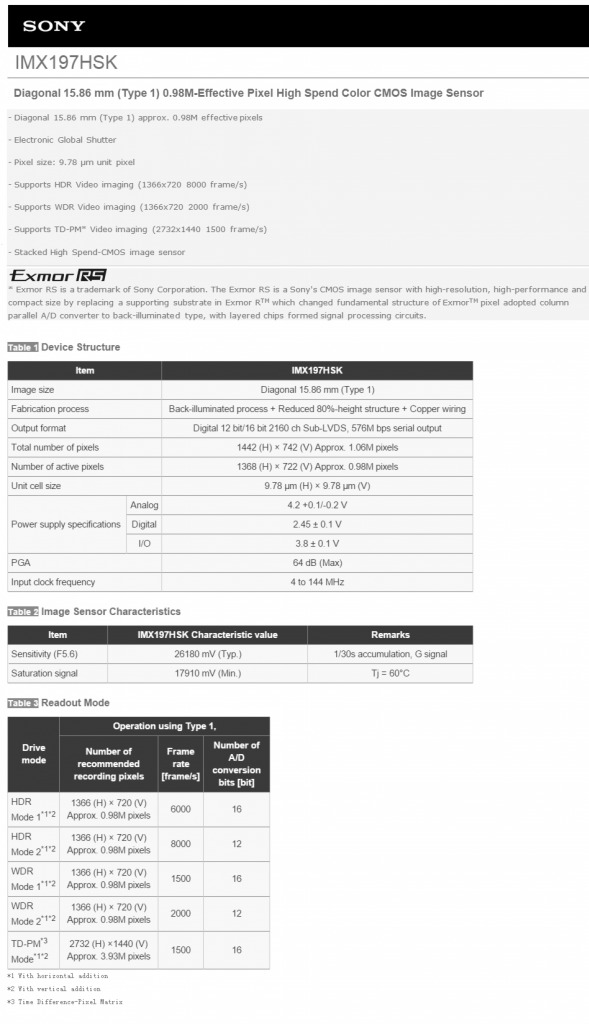
SONY%2BIMX197HSK.png
 
It could be fake but a lot of money goes into the research for the mobile/smart phone markets anyway. But this doesn't mean it's going to show up in pro cameras. The mobile market is so humongous, it has logic of its own.
 
Pretty awesome! I heard Sony sensors might be in some of the new Canon cameras.
No, that was related to one small sensor going into a Canon point-and-shoot. Also, if you remember, Canon showed off a 120MP chip at their once-every-five-years show in 2010. It was physically 6 times the size of the 5D's chip...and 2 years ago, they announced their see-in-negative-light chip that captured these very small fireflys that nobody has ever been able to even photograph. Next September will be there next show where I'd expect to see more of these incredible inventions.....maybe a monster chip that can see into a black hole!
"don't ya luv this modern technology"!

Jim Martin
 
You have to keep in mind that you never get anything for nothing, and all too often some "fantastic new improvement" comes at the expense of other factors. Peter being robbed to pay Paul.

I'm intrigued by what is meant by "Every single pixel can take the full color info with the help of an electrified moving color filter!
How this works in detail is yet not described on that paper. ......."

It seems that each pixel can capture R,G,B - which means that each can therefore be larger than in such as a Bayer design for a given resolution.

This is effectively what Foveon does - differing wavelengths corresponding to differing depths in the silicon.

But I wonder if "electrified moving color filter" means some way of capturing first R, then G, then B at the same location? It's plausible - but the downside is that because the colours are captured at different times, then movement is likely to be accompanied by colour fringing? From the sensor dimensions, it also seems unlikely the chip is destined for the sort of cameras of most interest to people on this board.
 
Interesting - it looks like I was right when I said "I wonder if "electrified moving color filter" means some way of capturing first R, then G, then B at the same location?", at least in principle. But even more interesting is the speed with which it seems to be working - exposures of 1/16ms for each colour - so theoretically it could go through about 100 cycles of all three colours in the time of a 1/50 sec full exposure? Which should satisfactorily answer my reservation about "....movement is likely to be accompanied by colour fringing?"

The link quotes a big advantage as "Having the full color info in one a single pixel allows to have larger pixel compared to modern RGB Bayer sensors (which means less noise or higher resolution possible at same noise level)." To an extent, true - but it does mean that although the photosites are larger, then they're only exposed to light for a third of the time for each colour.

One advantage I can see is that each photosite will produce directly it's own values for R,G, and B for that location - which means no deBayer processing. It remains to be seen how reliable a mechanism is that moves the filter array in such a fashion - but I suppose we are talking about very low masses.
 
I visit the Image Sensor World site often but a large portion of what is written there is above my knowledge of physics. At best, I may understand the general principles involved but not enough to offer any reasonable arguments pro or con.

That said, from the business and marketing perspective - where I am minutely more knowledgeable - I can see that there are a lot of various sensor/camera/filter designs that, in theory, could achieve a superior performance visavis the product currently on the market ... but that may never be sold in anything more than test packages.

This Sony design may be closer to fruition than many ... except the mobile market is far more unforgiving than camera's.
 
One advantage I can see is that each photosite will produce directly it's own values for R,G, and B for that location - which means no deBayer processing. It remains to be seen how reliable a mechanism is that moves the filter array in such a fashion - but I suppose we are talking about very low masses.
They will get better results if they deBayer each time slice because it would give them all three color values for each pixel in each time slice (one measured, two interpolated). That would also give the sensor better low light performance. However, their diagram suggests that they are only doing the A/D conversion on the final image, which means they will not be able to deBayer the time slices.
 
They will get better results if they deBayer each time slice because it would give them all three color values for each pixel in each time slice (one measured, two interpolated). That would also give the sensor better low light performance. However, their diagram suggests that they are only doing the A/D conversion on the final image, which means they will not be able to deBayer the time slices.
Not sure I agree. If the mechanism was true the whole point would be to get a REAL value for each colour at each photosite location. DeBayering each time would give interpolated figures for two out of three colours each sample, but they would serve to reduce the accuracy in each case, or effectively reduce the resolution. I'd also think the short time period to do each deBayer would require massively fast processing, so that alone would rule it out. Whereas simply accumulating three sets of charge during a frame is fairly simple.

I'd also think the overall low light performance is fundamentally determined by the overall absorption of the CFA and the basics of the chip (photosite size etc)?

The comments in the link Samuel H links to are interesting, especially regarding the calculation of power needed to do the CFA movement. I'd say the general principle is sound in theory - though I can't see how it would deliver the eye-watering results claimed - but I also am increasingly sceptical about the mechanism of actually moving the CFA. If I had to make a bet, my money would also be most likely on hoax.

(Aside from that, some on the rumour sites seem to be misunderstanding the mechanism even as described, thinking the time slice period can translate directly to frame rate. That's not the case - you need at least three time slices, and such would give terrible colour edge effects on motion. To avoid that you need a lot more, so much lower basic frame rates. That's assuming a practical method for shifting the CFA could be devised...... :) )
 
Yes, ideally you would get a real measurement for every point. BUT THEY CAN'T. So then the question is how to best interpolate the measured values into observed values, just like any other sensor with a Bayer color filter. And then it would be better to interpolate the missing colors in a given position for each time slice based on the observed colors in adjacent positions in the same time slice.

I don't think there will be terrible edge effects on motion because the sampling rate is so much higher than the shutter.
 
Last edited:
So, are they using a (pseudo) stacked/single color sensor because they can't improve the sensor height/width/size in a smartphone but can play with depth a little?

In that case, the spacial shortcomings of this approach are somewhat negated, considering that a smartphone photography is heavily into selfies and family snapshots (and, of course, the cats) without the requirement for fast motion.
 
I sincerely doubt this is intended as a cell phone sensor. It's 1.5" diagonal means that the lens has to be big. And its big claimed advantages -- global shutter with good low light performance -- are lost of most cell phone users.
 
I sincerely doubt this is intended as a cell phone sensor. It's 1.5" diagonal means that the lens has to be big. And its big claimed advantages -- global shutter with good low light performance -- are lost of most cell phone users.
1.5" diagonal is S35 basically?

In this instance, it's definitely not a smart phone type (unless, they have smaller versions too).
 
Back
Top