FS7: Sony FX9 v Canon C500 mkII

Just for fun, since most of all video content today is seen in the h.264 format, I chose to download that one, not the ProRes, and then pulled my frames from that. It's interesting how close everything really becomes once compression has it's way with the image. I will say, I find it odd that the C500 II is less saturated and has more green in the image. Because every Canon I've owned (5D II, 5D III, C300, C300 II, C200) does not swing green. They've always swung a tad magenta to my eye. And color saturation has never been an issue with Canon's in my opinion. If anything, I've often found Canons to be too saturated and shiny for my liking. So I'm not sure how much this test tells us, because the color in each image could have been impacted by anything, subtle shifts in white balance, the clouds changing, a street light turning on nearby, bounced light off a nearby car that wasn't there before, time of day, LUT interpretation, compression, etc.

However, I think the one thing we can definitely pull from these tests is that modern cinema cameras are all starting to look really, really good. Good enough that when properly used, not one regular viewer is going to tell a difference between them.

Full Frame Cinema Shootout.jpg
 
Just for fun, since most of all video content today is seen in the h.264 format, I chose to download that one, not the ProRes, and then pulled my frames from that. It's interesting how close everything really becomes once compression has it's way with the image. I will say, I find it odd that the C500 II is less saturated and has more green in the image. Because every Canon I've owned (5D II, 5D III, C300, C300 II, C200) does not swing green. They've always swung a tad magenta to my eye. And color saturation has never been an issue with Canon's in my opinion. If anything, I've often found Canons to be too saturated and shiny for my liking. So I'm not sure how much this test tells us, because the color in each image could have been impacted by anything, subtle shifts in white balance, the clouds changing, a street light turning on nearby, bounced light off a nearby car that wasn't there before, time of day, LUT interpretation, compression, etc.

However, I think the one thing we can definitely pull from these tests is that modern cinema cameras are all starting to look really, really good. Good enough that when properly used, not one regular viewer is going to tell a difference between them.

My old C300 MKI was a tad green. I haven't noticed a green bias on any of my C500 MKII footage so far. And I agree, if you can't make any of these cameras look good, maybe you are a soundie...
 
Yes it is top notch agreed. Sorry if I confused anyone by the post but isn't that fairly obvious from the page you go to in the link Liam that the DP is NOT Alister Chapman? I would have thought so as it is DP Khalid Mohtaseb's personalized page with a whole bunch of his clips?

Chris Young
 
Yes it is top notch agreed. Sorry if I confused anyone by the post but isn't that fairly obvious from the page you go to in the link Liam that the DP is NOT Alister Chapman? I would have thought so as it is DP Khalid Mohtaseb's personalized page with a whole bunch of his clips?

Chris Young
Haha, i still love Alister. Legend!
 
I'm starting to suspect that whilst the dynamic range of the C500ii is really wide, it doesn't quite have the latitude of the other cameras, you can't push and pull it around as much. I'm guessing the key is set your ISO (in intervals of 800, where it re-clocks itself at each stop) and make sure that you have you details within a suitable IRE% range for the final image.

This is the remaining question for me,
along with having a good go with the compressed files from the camera and Clog2 to find out how it renders colour, noise and tonality at the lowest and top stops.

In regards to this, I think it should be noted that the camera is the first in a good while that offers something quite different and possibly game-changing for owner-ops doing high end documentary style work. The possibility to rate the analogue gain on the sensor in single stops is really wonderful, and the luma to noise increase is minimal the first two stops and still small on the third. Under-rating (rating it lower) instead shifts the 18% on the gamma curve (Im only guessing that: you can shoot super clean low-key stuff). In tandem with the internal ND:s Im thinking exposure levels with a lens change from a T4 wide to a T1.5 50mm is possible just by means of the cameras own stuff. Maybe a fair test with this camera would be to do a bracket test based on what light levels the sensor can se in totality by its internal settings, it seems to be the design strategy canon have gone for; to make it easy to hit a well-exposed image, and have achieved to allow for small increments between +3 and -3 stops.

BUT, the high´s must look good as they go there in most images exposed for something else, and this test makes me think it has a rather sharp and un-even turn up there around 4-5 stops over?

The Fs7 looks good, highs go softly and the colour is there to wrangle into glory if you know how - so to change camera and pay up I need something real that would help me. The c500-2 is the first camera since fs7 to bring anything really different that would be worth it for both IQ and work-ability (the fx9 still has the crappy compression, ugh).

Example:
I recently went to Isle of Skye in Scotland to shoot landscapes for a documentary Im working on, bringing with me my trusty and rather rusty fs7. It was a pretty bulky thing to lug around the various mountain trails (before I told the producer that what we really wanted was pictures of parking lots). Its small things, but even for landscapes I cannot live without my FF on the fs7, requiring a small baseplate. On top of this, the small VF on the FS7 and un-custom-3d-lutted Slog2 sort of requires a monitor with a 1:1 punch-in and 3d-lut capability. The 2-stop ND up to 6 makes me forced to bring a extra 1 and 3-stop, and that makes me cry because I have to take of the lens-hugging rubber-mattebox and screw in a ND if I wanna keep a pro-mist or such in the lens-hugging rubber-mattebox :(

The c500-2 form-factor with the bigger on-board monitor would have be perfect for that gig, given it´s picture is at least as good as the fs7 (but with less compression, I cannot stress how much I have become a person with a constant low-key-irritation initiated by thinking about the slightly below-sweet-spot-compression-factor of the fs7 4k-XAVC). For landscapes I need to roll maybe 30-60 sec, so RAW would be fancy and doable, while filming a conversation that goes on forever their 4K-410-XACVCXF would be ideal. Let´s hope the highs are kind and graceful ...

Saturday rant over! :)

Cheers,
Ed
 
Last edited:
Yes it is top notch agreed. Sorry if I confused anyone by the post but isn't that fairly obvious from the page you go to in the link Liam that the DP is NOT Alister Chapman? I would have thought so as it is DP Khalid Mohtaseb's personalized page with a whole bunch of his clips?

Chris Young

Yes, but if you'd already seen the TVC, as I had, you might not click on the link, then you might think Alistair was the DoP based on what you wrote. Hence my pedantic post.
 
So, what is the sweet spot for 4K compression?

On the F55, 480mbs does well for everything except heavy heavy grading. The 1DC with it’s MJPEG was gorgeous for the time, but was rather crude for the data rate.

That 450-500mbp/s definitely feels like on of the zones, but if i am not grading beyond slight corrections, it feels overkill. 200mbs and below is all about effeciency, and looks rather good. So many artifacts under the surface.

Wondering how this ~280-320mbps range fares?

C500ii has a very interesting 410mbps? like, if you’re already rolling that kind of data, why not go 480mbps? And if trying to save space, why not go 350mbps? Or is it the Goldie locks?
 
So, what is the sweet spot for 4K compression?

I can definetly see the weaving pattern of XAVC in my UHD 25 I-XAVC from FS7 in alot of situations. Annoys me to no end when i see it, as its such a distinct pattern, and it looks like a silly Windows 95 filter applied to the whole image.

Isnt the FS7 around 400mbps?


seamless-geometric-abstract-weave-pattern-seamless-geometric-abstract-weave-pattern-background-1.jpg
 
Holy crap, that is annoying.

Assuming that is the case for CBR and VBR?

I’ve only steadicamed for fs7, or “jumped on sticks”. But never used it personally. I’ve edited footage shot on it. May have done some green screen for it, but can’t recall for sure.
Basically, i’ve not used the fs7 in any meaningful ways that would make me understand it’s image quality in a way that would bother me. I’ve thought the straight from camera profiles were a bit neutral-dead feeling, but at the time, the fs7 was ahead of the game, so i figured people just graded around it in post or made their own luts if they were serious about it.

The Fs7 has bitrate restrictions based on frame rate it seems.
EDIT: for example, 4K 60fps has up to 600mbps, but 23.98fps only does 240mbps? Is that right?


after using the 1DC, Red, and F55, i really like having the option for some hefty bitrates on a diet.
 
Last edited:
in 4k/uhd, fs7 xavc-i:
23.98p is 240mbps,
29.98p is 300mbps

slog3 is to flat for the skies sometimes, making them crack easily if you grade with transforms a bit more complex (which is to me what the makes most cameras colour science a non-issue as long as the sensor and gamut is decent enough). I have matched fs7 and alexa mini very closely, and it seemed to work slightly better in slog2 and sgamut with my particular transforms based on ACES and tweaked film print emulations. In the end, fs7 only indicates to some degree how the fx9 files will look, no idea what under-the-hood changes could ifluence these things.
 
supposedly there is an entirely new encoder in the FX9 that is getting better results at the same bit rate. This is just what I have heard from Alister Chapman not from a direct Sony rep. My experience so far with my FX9 though is that it does not have any problems grading pretty hard. This shot has secondaries and added contrast in the sky. and it seems to be holding up well. its graded below the s709 LUT then with a film emulation LUT on top of that before pulling secondaries and contrast in sky.
 

Attachments

  • test03.jpg
    test03.jpg
    43.1 KB · Views: 0
Grading contrast in doesn’t stress a codec as much as digging into the shadows for more roll off.

Adding contrast to me doesn’t count as heavy grading as a verb, but more of heavy grading as an adjective. Haha, if that makes sense.


Also, jumping in and trying to make selective colour and luminance selections and a all the weird arttifacts that make it more annoying than it already can be.

Very cool to here the Fx9 is most likely much improved from the Fs7. And i like your grade better than Dingo’s ;)
 
Last edited:
So, what is the sweet spot for 4K compression?

That 450-500mbp/s definitely feels like on of the zones, but if i am not grading beyond slight corrections, it feels overkill. 200mbs and below is all about effeciency, and looks rather good. So many artifacts under the surface.

Wondering how this ~280-320mbps range fares?

C500ii has a very interesting 410mbps? like, if you’re already rolling that kind of data, why not go 480mbps? And if trying to save space, why not go 350mbps? Or is it the Goldie locks?

There was a bit of a discussion on codecs, bit rates, types of codecs etc a while back. http://www.dvxuser.com/V6/showthread.php?365190-XAVC-Long-GOP-4K-10Bit-4-2-2-200Mbps-ANNOUNCED

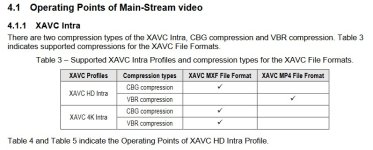
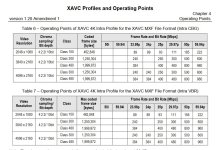
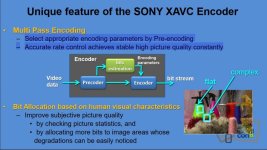
As I said then it's a bit disingenuous comparing bit rate for bit rat unless you know how the encoding is done. With Sony you have Intra CBG and Intra VBR so it does depend on which implementation of Intra you are talking about. In 4K for example you have both modes. See table below. Also the fact that Sony are the only ones using multi pass encoding in real time within the time frame of a frame with their own proprietary pre-coding technique. This allows them to use lower bit rates vis a vis encoding without pre-coding and that is why they developed this encoding process after looking at both approaches. Sony's XAVC is to the best of my knowledge the only codec doing the following and is one of the main reasons is has had widespread acceptance in the broadcast arena since it's adoption by SMPTE as a ratified format that delivers quality with reasonable file sizes.

"In the XAVC stream, a PPS (Picture Parameter Set) is allocated to each frame and an SPS (Sequence Parameter Set) is attached to each GOP. This allows the recording device to dynamically optimize the image quality within each picture frame and ensure that the optimized image setting value remains attached to the picture file after editing. It also helps to optimize the image quality during random access playback.

This encoding process is especially suited for HDR recordings, using an optimized bit assignment to suit each OETF characteristic. This unique encoding process ensures the highest picture quality in both SDR and HDR at an easy-to-handle data rates. Also, it should be noted that this coding optimization process is carried out on the encoding stage alone and it does not affect the decoding process, since it generates compliant bit streams with the standardized decoding syntax and semantics of the H.264 compression system"

I have heard it said though not substantiated it yet that this is one of the reasons others are using higher bit rates to match the quality that Sony have been able to achieve with their own proprietary hardware XAVC encoder. XAVC Class 480 does allow 4K 60p to have bit rates up to 960Mbps. Highly unlikely to see this though as I'm not aware of any standard H.264 decoder that has been released to decode bit rates at this level. Much of what is available in cameras today is dependent on what is out there to decode the various files produced by these cameras. Remember the wait for Panasonic's 400Mbps codec to be universally accepted by NLEs as there was no decoder to handle these files until such time as one was developed. Also I believe the much higher bit rates we see today are much more suitable for RAW and higher end workflows than the general cut and thrust of everyday TV, corporate and event coverage. These latter areas require a good well balanced quality vs size vs real time workflow bit rates and that Class 300 range of 200 to 600Mbps seems to suit most every day requirements.

Chris Young

4.1 Operating Points of Main-Stream video.jpgXAVC Profiles and opertaing points.jpgSony XAVC precoder.jpg
 
Back
Top