FS7: Sony FX9 v Canon C500 mkII

Agreed. Worth noting, not quite the same price as an Alexa though.

The highlight handling was the clearest difference, with Alexa showing a clear one-stop advantage. What I’m really interested to see, is whether (using the full width of the C500ii’s sensor) the noise will be fine grained enough, that you can underexpose it a stop (to gain an extra stop in the highlights), then pull it up without too much of a hit to IQ.
 
The highlight handling was the clearest difference, with Alexa showing a clear one-stop advantage. What I’m really interested to see, is whether (using the full width of the C500ii’s sensor) the noise will be fine grained enough, that you can underexpose it a stop (to gain an extra stop in the highlights), then pull it up without too much of a hit to IQ.

From this video it's not so clear to me there is any difference much less a clear one stop advantage. Here's why:

There is no highlight handling in the grayscale of Arri Log C, same for Canon Log and Sony, no rolloff, no highlight curve; the highlights are the most linear part of the range. When they clip, they clip, and any 10 bit code value of 1023 has reached this threshold, so the white clipping point is easily determined. (Linked is Arri white paper.) Dynamic range is a ratiometric measurement of brightness to dark in scenes that contain detail at each end. Counting stops from white clipping down is easy until you reach the toe of the curve. Then you're looking at how far you can see dark details. All three cameras have white clipping and this point has some log variance such that middle gray is not in the exact same place which also means the dark point has variance too. But whether the dark point is brighter or darker, there are no significant details that you can make out in one and not another. The more stops claimed, the harder it is to prove those stops! The minimum speed of the new Corvette is 0 kph as before, and 100 kph is somewhere in its midrange, but you can't infer what it's top speed is by looking at 100 kph, and you can't infer DR by looking at the tonality of skin. It's just one stop along the way.

I am by no means challenging the beliefs held sacred of Arri supremacy, and although I see distinguishing features related to tonality, I don't know what it is that you are seeing that is so clearly one stop; for heaven sakes there is banding on the screen under the headphones, that dark shade alone could represent a full stop meaning there is not even enough tonality in the YouTube presentation to be making conclusions about DR with.

https://www.arri.com/resource/blob/...483e/2017-03-alexa-logc-curve-in-vfx-data.pdf
 
The highlight handling was the clearest difference, with Alexa showing a clear one-stop advantage. What I’m really interested to see, is whether (using the full width of the C500ii’s sensor) the noise will be fine grained enough, that you can underexpose it a stop (to gain an extra stop in the highlights), then pull it up without too much of a hit to IQ.

I suspect this might be the case. However, this highlights again why it is so nice to use the Arri cameras. You don't need to do this, your footage comes out of the camera 1 stop brighter and with better skin tones. This makes the post process faster and with less hassle. Everyone is happy.

I must admit the versatile form factor of the C500 MKII is very tempting over the heft of my Amira. Power consumption in RAW of the C500 mkII is also bit higher but lower in XF-AVC. The autofocus seems worse than the FX9 (CVP test) but there is a lot to like about the camera.

It really comes down to if production companies will accept it in the same league is the arri cameras... otherwise I can see the FX9 taking the lower end of the market and I don't see in which price tier the C500 mkII will fit in...
 
Last edited:
The highlight handling was the clearest difference, with Alexa showing a clear one-stop advantage. What I’m really interested to see, is whether (using the full width of the C500ii’s sensor) the noise will be fine grained enough, that you can underexpose it a stop (to gain an extra stop in the highlights), then pull it up without too much of a hit to IQ.

Yep I liked the way it held the EXT clock.. but it didnt.

No mention of the methodology or if the Canons have the same optimal base ISO or what curves/grading methodolody was used.
The sky seemed white in all shots from all cameras.

Having a white sky kind of ruins it.

Methodology should be stop down until the sky is held. and then check the shadow detail.

No on seems to know how to use raw!


==

Checking out A B and C - check the dark colour checker. Arri I can see fewer patches than the C500. Implictation is the 500 has a higher base Iso and was over exposed rendereing judgement of highlights.. useless. How would the c500 been if you stopped down until you could see 3 rather than 5 dark patches.
 
Last edited:
Yep I liked the way it held the EXT clock.. but it didnt.

Actually, I think it did.

They mention in the video that the frame heights between the Canons and the Arri are different because of the different camera builds. You can actually just make out the very top of the clocktower in the Canon footage, but it's just the very top (you can see it just poking out from behind the monitor).

Have a look at the rooftops and blinds in the bottom-left corner of the image, you can see the shift in vertical perspective more clearly there.

The overexposure tests on the man's face are a much more useful test of highlight latitude. The Canons start clipping out on his skin at 5 stops over, the Arri (to a similar extent) at 6 stops over.


Checking out A B and C - check the dark colour checker. Arri I can see fewer patches than the C500. Implictation is the 500 has a higher base Iso and was over exposed rendereing judgement of highlights.. useless. How would the c500 been if you stopped down until you could see 3 rather than 5 dark patches.

I'm not sure about that either. Both the Mini and C500ii have very comparable dynamic range at their 800 ISO bases (according to the specs at least), but as the overexposure test does clearly show - the Arri is holding approximately a stop more in the highlights, it would follow then, that with a comparable total dynamic range, the Canon should see a stop further into the shadows than the Arri - which would appear to be bared out by the comparison of the underexposed colour chart.

So the difference lies in where middle grey is placed in each camera's respective gamma curve (it's lower in the Arri, and higher in the Canon).

For me, that leaves the big question being how well the Canon's midtones will hold up when pushed a stop (assuming you want to match the highlight latitude of the Arri - which as a general rule, I always do). If the larger format of the Canon will allow that push-processing without the midtones getting too noisy, the camera will then genuinely match the highlight handling of the Arri (which I've always found adequate for any lighting situation). That would be a fantastic development.
 
I sould have said "I like the way it held the ext clock while the others didnt"

The clock dissapeared in the canon shots because of a framing error, not due to a lack of a bility to hold highlights

"have very comparable dynamic range at their 800 ISO bases (according to the specs at least),"

Yes indeed that is indeed somewhat my point. Cameras vary hugely in 'what ISO is' and my suggesttion from the burned highlights in canon (maybe) and holding more dark patches shows and effectively higher ISO for the canon - It does not show less DR as we dont have in this image a clip point to pin it to - it just show that the exposure was brighter.

Such a test is way too varied to show DR to a One stop (out of 15) difference - its not accurate enough - yes you could demonstrate an alexa being better than a phone, but not a C500

Maybe Alexa is better.. but this 'test' doesnt show you that.

I prelit a a shoot for the ("800") BMUrsa using my nikon D600 - very quickly it became apparent that BM '800' is about 2 stops slower than the nikon '800'. Varied or misrepresented ISO between camera brands is not a myth it is a reality.

Another blooper on the test is no mention of any LUTs or corrections used. Without seeing the raw/log image unprocessed one is actually completely blind :)
 
Arri Log C white paper said:
The (Arri) Log C curve actually is a set of curves for different exposure indices. Each curve maps the sensor signal corresponding to 18% gray to the Log C value of 0.391, which is 400/1023.

Looking at the set, you see that that white clip point for the curve varies depending on the selected ISO. For ISO 200, white clip is 10 bit code value 850. For ISO 1600, it's 1023. There are more display stops above middle gray at higher ISO than lower ISO. Makes sense because higher ISO is more noise, hence fewer stops below middle gray. Arri uses a different curve for each ISO, 200,400,800,1600,3200. BMD sensor likewise has more stops above middle gray but just one curve for all exposure indices. Sony SLog/2/3 is one curve for one exposure indices because Cine-IE doesn't change actual ISO.
 
The FX9 definitely looks like it has a great image, and a lot of great updates in it, but I'm at a loss on how to make any more money with this camera over an FS7.

In my situation, I work as a freelance DP and Cam Op and the FS7 is my primary camera. Rent for higher end jobs.

Raw
FS7 -> Never done it, wouldn't do it with the mess of cables and bad reviews on it. Rent a Red.
FX9 -> Exact same mess to make raw work - will be very difficult to use. Rent a Red (and at the price of firmware cost, recorder, xcda, raw license on recorder, you could just buy Red Gemini)

Autofocus
I already manual focus, so I'm not losing any jobs by not having autofocus. Would auto focus be nice to have? Absolutely, but it would be at the cost of swapping my EF lenses over to E lenses. Can I charge more having autofocus? No.

4K / HFR
Both do it. FX9 doesn't offer anything in terms of resolution or framerates. Can't charge more (although if I'm honest, I have never been asked for more than 4K).

Full Frame
Again, nice to have, but speedbooster + EF glass looks decent as well. Can I charge any more money with an FX9 because the full frame? No.

Better Viewfinder
Same situation - would love to have it, can't charge anything for it.

Colour Science
This is the biggest one IMO. I'm not losing jobs because the 'look' of the FS7 isn't there. It can certainly be made to good. I'd DEFINITELY want the better colour science -> I dont think I'd be able to 'educate' or 'convince' a producer that the FX9 is worth paying Red/Arri prices for though.


All told, there are a ton of 'nice to haves', and if you don't already have a camera, or are upgrading from the A7 line or similar, this would make sense.
As an FS7 owner, I don't see how this camera makes me any more money unfortunately. It would make my life easier or more enjoyable, sure, but it certainly wouldn't be cheap to swap bodies and still make the same rate! :(

It's funny, I own the C200 and I posted a VERY similar post to this one on the Canon thread about if it was a smart business decision to sell the C200 for the C500 MKII. I come to the same conclusion, would be nice but clients won't care and won't pay any additional for the C500 MKII.
 
Last edited:
In CRL, 128GB card gets you 15 mins, 256GB gets 30 mins, and a 512GB gets you 1 hour.....that is on the C200.

To be more precise Jim, 256GB CFast cards give me 34 minutes of record time in CRL with the C200, 68 minutes with the 512GB cards.
 
Last edited:
Apparently, some people like it! I used to have a C300 and never used the rear VF. On the C300 mkII it's marginally better but still largely unusable.

Easy to rig an alternate VF in the right pposition though.

IMHO, the rear EVF is fine on tripod, so so on handheld cradled and useless for shoulder obviously. I'm considering a Kameleon or Gratical Eye if I keep getting these BTS shoots where I have to be on shoulder for hours at a time.
 
It works tremendously well. Because it's not trying to guess at the motion like a warp stabiliser does - it KNOWS what the motion was, so can compensate accordingly.

24fps @ 180 shutter has a lot of motion blur though. And stabilised footage with motion blur stretching out in directions that (once stabilised) are no longer apparent, can look very strange.


That's exactly what it is, stabilisation implemented through gyroscopic measurements recorded as metadata.

Was hoping to revisit this... does the c500 mII only record gyroscopic stabilization metadata that can then be read by software or is it stabilized in camera?

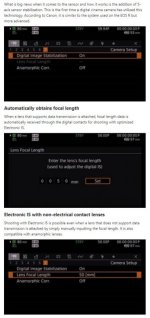
I thought I had read that entirely manual prime lenses (no electronic connection) can also be stabilized. How does this work, and if it does does it work well? This is all pretty new to me but if I can get my Leica R prime set to stabilize in camera, in an attractive manner, this is a pretty big selling point.

The stabilisation data is processed and applied to the footage in-camera. You can manually input the focal length of your Leicas into the camera, and it will calculate how to stabilise each lens accordingly.
 
The demo that I've seen(from CVP and posted/linked in the Canon forum) did not impress me. Didn't look nearly as good as optical stabilization in the lens. Granted, it's just one short test on what's probably a pre-pro camera with early software/firmware, but still...
 
The demo that I've seen(from CVP and posted/linked in the Canon forum) did not impress me. Didn't look nearly as good as optical stabilization in the lens. Granted, it's just one short test on what's probably a pre-pro camera with early software/firmware, but still...

Right... and I assume it will work differently with different manual prime lenses. But I am very interested in the prospect of using a 50 or 85mm vintage lens and having it stabilized in camera. I wonder how it compares to stabilization in post, for example are you using the entire sensor of the camera or is it zooming in a bit in order to acheive the stabilization.
 
Right... and I assume it will work differently with different manual prime lenses. But I am very interested in the prospect of using a 50 or 85mm vintage lens and having it stabilized in camera. I wonder how it compares to stabilization in post, for example are you using the entire sensor of the camera or is it zooming in a bit in order to acheive the stabilization.

It has to zoom in, it's the extra sensor real estate outside of the frame that allows the stabilisation to compensate.

And it should be vastly superior to stabilising in post, as it's not guessing at the camera shake, it literally knows (from the gyroscopic data) how far the image moved frame-to-frame in 5 separate axis of movement.

Right, but this would only be for lenses with electronic communication that relay the gyroscopic metadata from the lens, correct? Or does the gyroscopic data represent movement of the sensor, and is recorded by the camera? So it would work the same for a manual lens assuming the focal length that you set is accurate?

Thanks for taking the time to answer these questions I haven't found much info on this feature online.

The gyroscopic sensors are in the camera. Lenses that communicate with the camera electronically will automatically tell the camera the relevant focal length they're set to (so that the stabilisation can compensate accordingly).

Lenses that can't communicate electronically, will have to have their focal length entered manually into the camera, so that it knows what it's compensating for.

One area you will probably have to compensate for good results with the stabilisation, is using a faster shutter speed. Reducing/eliminating motion blur is important for good results with this kind of digital stabilisation.

Have a look into the SteadXP (a fascinating little widget that I unfortunately wasted $400 on) it was basically the genesis of this concept.
 
That doesn’t make any sense, why would anyone speedboost a lens onto the S35mm crop of a full frame sensor? It would be merely be duplicating the look of the same lens mounted in front of the full frame sensor anyway. The stop of light you’d gain won’t offer you anything more than the reduced noise level of the full frame sensor in the first place.

Sometimes crop modes offer other benefits, such as super slow motion, or very very fast rolling shutter (nearly global shutter, a "sports mode" for fast moving action).
 
Ok that all makes complete sense! Thanks for taking the time to explain.

I'm surprised more people aren't discussing this feature as a + selling point for the Canon v the Fx9... if this technology is good it would be pretty significant for the type of work I do. Love using primes handheld for doc/branded work. For me IS is even more of a selling factor than AF would be.
 
Back
Top