
Navigation
Install the app
How to install the app on iOS
Follow along with the video below to see how to install our site as a web app on your home screen.
Note: This feature may not be available in some browsers.
More options
You are using an out of date browser. It may not display this or other websites correctly.
You should upgrade or use an alternative browser.
You should upgrade or use an alternative browser.
FS7: Sony FX9 v Canon C500 mkII
- Thread starter Liam Hall
- Start date

dmitrizigany
Veteran
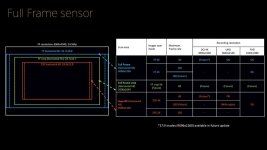
That is one of my big issues with the FX9.Sony says that when recording 4K at 60P the FX9 uses a 83% crop of the sensor. It sounds like it might be processing limitation.
It might not be an issue for most shooters but if you are switching between 24P/30P and 60P in the same setup it could make it difficult to match shots.
But I wonder if they’ll manage to fix that in future updates?
With the Venice they’ve pushed the frame rates quite a lot from what they first announced.
As it’s a brand new sensor they might be very conservative with what they say it can do. One can always hope at least


cyvideo
Veteran
With the Venice they’ve pushed the frame rates quite a lot from what they first announced.
As it’s a brand new sensor they might be very conservative with what they say it can do. One can always hope at least
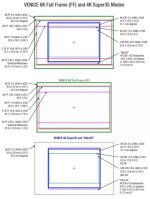
"...conservative with what they say it can do." is an interesting observation. When you look at the total size of the FX9 sensor it is actually 6064 x 4040. Compare this to the The Venice sensor which is 6048 x 4032. Contrast this with the Canon C500 Mark II sensor. It is 17×9 and is 5.9K at 5952 x 3140. That’s 48 lines short of a full 6K sensor. Nobody is quibbling over 48 lines. It is in effect a 6K sensor. Where I see a BIG difference is in the depth of the Canon sensor where it comes in at a height of 3140. It is by definition a 17x9 sensor. Look at both Sony sensors and it becomes patently obvious that they are both 3:2 sensors. Look at the Venice firmware updates. v4.0 offered amongst other things 120fps at 4K 2.39:1, 60fps at 6K 3:2 or 110fps at 4K 17:9. v5.0 is adding up to 90fps at 6K 2.39:1 and 72fps at 6K 17:9.
The big thing that a 3 x 2 sensor can offer which cannot be offered on a shorter 17 x 9 sensor without a significant drop in resolution is 2 x squeeze FF Anamorphic which requires about 28 x 24 mm in sensor area. The Venice can and does offer this within its 35.9 x 24 mm (1.50:1) sensor. Seeing as that the FX9 sensor has a very similar aspect ratio and pixel specs on its sensor to the Venice I would suggest it's not beyond Sony's capability to offer full Anamorphic later if they felt they needed to. Or full frame 6K 50/60p for that matter if marketing wise they feel it necessary. Sony have a habit of chucking in specification upgrades over time. Look at the original FS7 it's now on v4.3, Venice now v5.0. This is not knocking Canon but if their past track record is anything to go by what you buy originally doesn't get many "feature" upgrades. Their upgrades are more in the way of improvements and fixes as it the case with the latest C300 firmware v1.1.2.1 00. Not major changes to frame rates and frame aspect ratios. You may recall when the Sony F5 came out it was HD only. It then had a major feature upgrade to 4K. Albeit Sony was pushed ahead of their roadmap with that upgrade as somebody found a hack to bump the FS5 up to 4K. It will be interesting to see where Sony go with this FX9. If they have a four to five year roadmap for this FX9 camera like they are demonstrating with the FS7, F5 and F55 I can see no way that the FX9 will not evolve over time. Time will tell I guess.
Chris Young
This is an amazing camera thats really cheap.. I really dont see what's not to love.. the ext is a horrible lump.. but now with TC in on the camera just dont buy it.. 3rd part V mount.. .. got to be a winner.. presuming all the millions of Fs7 owners have made a fortune on their camera.s they will nearly all buy this one too..
Canon Examples
Canon Examples
While I mostly agree with you about camera "mojo" (the Alexa is definitely the easiest route to getting a cinematic image for sure) there are plenty of examples out there where Canon steps up and represents. Blue Ruin was shot entirely on a C300 MK I. I saw that on the big screen and it looked so good I ended up tracking down the colorist and calling him up to ask him how hard he had to work to make that footage look so cinematic. He said it was shot so well he didn't have to do much to it at all. And that was all in 8 bit, with 10 stops of dynamic range and Canon L glass.
If you want something recent, there's this article over at Newsshooter where a C300 MK II was used to shoot an up-coming Showtime series. The stuff looks really great and definitely has that mojo going for it. Jeff Hutchens DP - Murder on the Bayou - C300 MK II.




Does the Alexa or the Red look more "cinematic" right out of the box, hell yeah they do. And I'm currently where you were at a little while ago, where I'm thinking of just buying an old Alexa to get me there quicker. I've shot with everything, Scarlet, Dragon, Monstro, C300, C200, FS7, Alexa Studo, XT, Mini, Amira, etc. The Alexa and the Red definitely have the most "mojo" like you said. Just looking at an Arri or Red image on the director's monitor makes you smile, which isn't something I totally get from a Canon or a Sony right out of the box. But the Canon can definitely get there and it's certainly getting easier to make that mojo happen by pushing a couple of sliders in post.
I seriously think Arri and Red are in big trouble and will have no choice but to drop their prices. The gap is now thinner than ever before. I think 2020 will be the last decade where they can get away with charging an arm and a leg for a cinema camera. I've seen people argue that there will always be a demand for expensive cinema cameras. Maybe they're right, but the first computer developed for small businesses was Hewlett Packard's HP 3000 back in 1972. That computer cost $95,000 at the time and adjusted for inflation, that's like $541,209, lol. Technology doesn't stop, no matter how much the big companies fight it.
Canon Examples
...as good as the Canon looks in specs I have never really seen anything from a Canon C300, C200 or C500 which had a cinema mojo in the way the Alexa or F35 do. So I'm not sure I would go with the 500 MKII for cinematic stuff. Unless it looks considerably better and more mojoey than the other Canons. Haven't seen anything yet.
While I mostly agree with you about camera "mojo" (the Alexa is definitely the easiest route to getting a cinematic image for sure) there are plenty of examples out there where Canon steps up and represents. Blue Ruin was shot entirely on a C300 MK I. I saw that on the big screen and it looked so good I ended up tracking down the colorist and calling him up to ask him how hard he had to work to make that footage look so cinematic. He said it was shot so well he didn't have to do much to it at all. And that was all in 8 bit, with 10 stops of dynamic range and Canon L glass.
If you want something recent, there's this article over at Newsshooter where a C300 MK II was used to shoot an up-coming Showtime series. The stuff looks really great and definitely has that mojo going for it. Jeff Hutchens DP - Murder on the Bayou - C300 MK II.
Does the Alexa or the Red look more "cinematic" right out of the box, hell yeah they do. And I'm currently where you were at a little while ago, where I'm thinking of just buying an old Alexa to get me there quicker. I've shot with everything, Scarlet, Dragon, Monstro, C300, C200, FS7, Alexa Studo, XT, Mini, Amira, etc. The Alexa and the Red definitely have the most "mojo" like you said. Just looking at an Arri or Red image on the director's monitor makes you smile, which isn't something I totally get from a Canon or a Sony right out of the box. But the Canon can definitely get there and it's certainly getting easier to make that mojo happen by pushing a couple of sliders in post.
I seriously think Arri and Red are in big trouble and will have no choice but to drop their prices. The gap is now thinner than ever before. I think 2020 will be the last decade where they can get away with charging an arm and a leg for a cinema camera. I've seen people argue that there will always be a demand for expensive cinema cameras. Maybe they're right, but the first computer developed for small businesses was Hewlett Packard's HP 3000 back in 1972. That computer cost $95,000 at the time and adjusted for inflation, that's like $541,209, lol. Technology doesn't stop, no matter how much the big companies fight it.
Last edited:
there's this article over at Newsshooter where a C300 MK II was used to shoot an up-coming Showtime series. The stuff looks really great and definitely has that mojo going for it.
In the NewsShooter comments Jeff Hutchens mentions that he shot 1920x1080 12-bit RGB 4:4:4 CLog3 / Cine Gamut with the Canon C300 Mk2. Shooting 12-bit RGB 4:4:4 probably has a fair bit to do with the look of his footage.
In the NYC market I predict the FX9 will far outsell the C500Mk2.
RAW is great, but virtually NO client wants to deal with RAW, even compressed RAW. Fast turnaround is what everyone wants.
If productions have the budget for RAW it's Arri, or maybe Panavision, Venice or Red.
FWIW I'm a former C500 Mk1/Odyssey 7Q owner, and current C300Mk2 owner. I shoot more FS7 jobs than C300m2 jobs. Because a number of clients actually own multiple FS7 rigs.
As usual, some of the FS7 owners I know kinda wish they went C300M2, so you know what they say about greener grass...
I suspect the C500M2 will bury any potential C700FF sales.
Arri IS NOT IN TROUBLE. They sold out their entire planned 2019 run of Alexa Mini LF's in a matter of hours. What other camera company, other than Blackmagic, does that? No one.
Red on the other hand...

JPNola
Veteran
In the NYC market I predict the FX9 will far outsell the C500Mk2.
RAW is great, but virtually NO client wants to deal with RAW, even compressed RAW. Fast turnaround is what everyone wants..
This ^.
If you are an individual or a production company, why would you spend 32% more over the Fx9 to get the C500MkII? For internal raw? And even if you decided that internal raw is worth paying 32% more for the C500MkII over the Fx9, you give up the electronic ND, dual ISO, greater lens compatibility, and other features of the Fx9 in order to get internal raw. You'll spend 32% more and you won't even get an eyepiece without paying even more on top of that 32% greater price tag.
I suspect that some folks over at Canon had a "well, F me." reaction when they learned the Fx9 is $5000 under the price of the C500MkII. Five thousand dollars less. Think about what other gear you could buy with that $5000 to go with your Fx9. Lights. A monitor. Microphones. A 5-lens Rokinon bundle. A decent tripod.
Sony undercut Canon rather significantly here. And in that put the C500MkII at risk of being another C700, a camera that is admittedly better than other cameras but was priced out of reach for most. Say you were about to pull the trigger on a C500MkII. In order to step up to the C500MkII you'll have to spend another $7000. On the other hand, if you were about to pull the trigger on a Sony Fs7M2 the Fx9 is only $2000 more. That's more "do-able" financially. Sony excels at getting the pricing just right. $16k is a gulp of a price for many. Whereas $11k is a more manageable price tag for many. Sony knows the target market well and has calculated that in this mid-range market the lack of internal raw isn't going to be a deal-breaker for most.
Maybe I am way off the mark here. And I confess to having a pro-Sony bias given that I've been shooting on Sony professional cameras for 36 years now. Regardless of where your preferences fall, we are spoiled to have so many options today.
While I mostly agree with you about camera "mojo" (the Alexa is definitely the easiest route to getting a cinematic image for sure) there are plenty of examples out there where Canon steps up and represents.
I guess we just have different ideas of what mojo is.

I saw no mojo in neither example you mentioned. They look good. But mojo? Nope. Not IMO.
The Alexa and the Red definitely have the most "mojo" like you said.
Who said anything about Red? Never mentioned it. I said F35.
For mojo give me a F35 any day over any Red. Over any Panasonic, Canon, Blackmagic or whatever too. For mojo there is Alexa and F35 and then there is the rest IMO. Sure. You can try your best in grading spending a lot of time and money to try to come close. But what's the point? Like Vinyl. They spent a lot of time and work and in the end could have just grabbed an Alexa or F35 and made it much better and easier. But the childish 4K thing fom Netflix meant they had to set for the stupid way rather than the way which made more sense. And Vinyl still looked video-ish in the end.
And I'm currently where you were at a little while ago, where I'm thinking of just buying an old Alexa to get me there quicker.
Do it! You will never regret or look back.
Unless you are shooting things which don't need mojo. Like weddings, corporate, interviews, live events, wild life, news, broadcast etc. It's not worth it working so hard trying to make something like a FS7, EVA1 or C300 look like a cinema camera, when the real cinema cameras are so cheap now. :happy:

Grug
Veteran
This ^.
If you are an individual or a production company, why would you spend 32% more over the Fx9 to get the C500MkII? For internal raw? And even if you decided that internal raw is worth paying 32% more for the C500MkII over the Fx9, you give up the electronic ND, dual ISO, greater lens compatibility, and other features of the Fx9 in order to get internal raw. You'll spend 32% more and you won't even get an eyepiece without paying even more on top of that 32% greater price tag.
I suspect that some folks over at Canon had a "well, F me." reaction when they learned the Fx9 is $5000 under the price of the C500MkII. Five thousand dollars less. Think about what other gear you could buy with that $5000 to go with your Fx9. Lights. A monitor. Microphones. A 5-lens Rokinon bundle. A decent tripod.
Sony undercut Canon rather significantly here. And in that put the C500MkII at risk of being another C700, a camera that is admittedly better than other cameras but was priced out of reach for most. Say you were about to pull the trigger on a C500MkII. In order to step up to the C500MkII you'll have to spend another $7000. On the other hand, if you were about to pull the trigger on a Sony Fs7M2 the Fx9 is only $2000 more. That's more "do-able" financially. Sony excels at getting the pricing just right. $16k is a gulp of a price for many. Whereas $11k is a more manageable price tag for many. Sony knows the target market well and has calculated that in this mid-range market the lack of internal raw isn't going to be a deal-breaker for most.
Maybe I am way off the mark here. And I confess to having a pro-Sony bias given that I've been shooting on Sony professional cameras for 36 years now. Regardless of where your preferences fall, we are spoiled to have so many options today.
The prices are so close between the two, that the comparisons are inevitable. But the cameras really are playing in different ballparks.
One is a 10-bit 300Mbps 4k camera (that at some point will have an external raw-recording option). The other is a 12-bit 2.1Gbps 6k camera, with internal raw recording and anamorphic shooting modes.
They take slightly different approaches with similar feature sets otherwise, but the differences in recording specs and capabilities puts an ocean between them.
What's nice about the C500 Mkii is that it can also do the nice, manageable 10-bit 410Mbps downsampled 4k thing, for those fast turnaround jobs where beefier files aren't on the table.

Liam Hall
Veteran
I swithced from the C300 to the FS7 five years ago. It's very much in the balance if I switch back or remain with Sony.
For me, the only benefit the FX9 has over the Canon is Cinetone and dual ISO. If the Canon can produce a great image SOOC and has great low light performance it will be the best choice. No question about it. The price difference is negligible when I factor in changing all my lenses to E-mount and adding extra batteries for the increased power draw on the FX9.
I'll make that call after trying both cameras next month.
Grug
Veteran
I swithced from the C300 to the FS7 five years ago. It's very much in the balance if I switch back or remain with Sony.
For me, the only benefit the FX9 has over the Canon is Cinetone and dual ISO. If the Canon can produce a great image SOOC and has great low light performance it will be the best choice. No question about it. The price difference is negligible when I factor in changing all my lenses to E-mount and adding extra batteries for the increased power draw on the FX9.
I'll make that call after trying both cameras next month.
I'm really intrigued by how easy it will be control the AF on the FX9 via the joystick. Canon seem to have a good thing going with their touchscreen interface, it'll be interesting to see how easy the Sony version is to control.
I think the lenses people already own, might have a big impact on the decisions with these cameras. If I were to get the Canon, and the AF is as genuinely useful as it appears to be, it might actually be enough incentive to buy the locking EF mount for the camera and convert my cinema lenses to EF mounts - so that you could rapid switch to AF glass when needed.
Liam Hall
Veteran
I'm really intrigued by how easy it will be control the AF on the FX9 via the joystick. Canon seem to have a good thing going with their touchscreen interface, it'll be interesting to see how easy the Sony version is to control.
If it's like my A7III it should be easy to navigate around using the joystick, though, not as easy as a touch screen.
The prices are so close between the two, that the comparisons are inevitable. But the cameras really are playing in different ballparks.
One is a 10-bit 300Mbps 4k camera (that at some point will have an external raw-recording option). The other is a 12-bit 2.1Gbps 6k camera, with internal raw recording and anamorphic shooting modes.
They take slightly different approaches with similar feature sets otherwise, but the differences in recording specs and capabilities puts an ocean between them.
What's nice about the C500 Mkii is that it can also do the nice, manageable 10-bit 410Mbps downsampled 4k thing, for those fast turnaround jobs where beefier files aren't on the table.
Grug, is your interest in the C500 II to replace your Arri? Because the way I see it the C500 II is a "poor man's" Alexa. It's interesting as a cinema camera. But I would rather have the Alexa. Unless I was pressured for 4K, which I'm not. Keeping the Alexa and adding the C500 II would make little sense for me. Even if thinking about it as a second camera. I would probably go smaller or something for that. If not for a cinema camera I would rather go FX9 as you don't need RAW or none of that. So it would be interesting to know your application for it, since you have an Alexa too.
I think the lenses people already own, might have a big impact on the decisions with these cameras. If I were to get the Canon, and the AF is as genuinely useful as it appears to be, it might actually be enough incentive to buy the locking EF mount for the camera and convert my cinema lenses to EF mounts - so that you could rapid switch to AF glass when needed.
That's the beauty of PL lenses. It's basically universal. I own only a zoom lens in E-mount for the low ball jobs.
Although this FF thing is slowly throwing a wrench in the PL mount practicality. Reason I'm in no hurry to join the FF bandwagon.
JPNola
Veteran
I swithced from the C300 to the FS7 five years ago. It's very much in the balance if I switch back or remain with Sony.
For me, the only benefit the FX9 has over the Canon is Cinetone and dual ISO. If the Canon can produce a great image SOOC and has great low light performance it will be the best choice. No question about it. The price difference is negligible when I factor in changing all my lenses to E-mount and adding extra batteries for the increased power draw on the FX9.
I'll make that call after trying both cameras next month.
Another consideration is having to invest in CF express cards if you go with the C500 MkII. Whereas with the Fx9 you can use the cards you own for use with your Fs7.
You only have to swap to e-mount if you want to use the AF. Granted, AF is one reason to upgrade to the Fx9. But it isn't necessary to gain FF, dual ISO, and other features outside of AF.
The C500MkII is reported to have increased power draw over both the C300's and the Fs7, so you'll need to add extra batteries regardless. I already own 5 230wh batteries, 2 150wh batteries, and at least 7 90-98wh batteries. So I already have plenty of battery power for any upgrade to a more power hungry camera. I'm used to cameras like the Sony PMW500 that were power hungry. Not a big deal for me. If doing an interview you are on shore power most times. Running around doing run & gun it is rare that you run for a stint longer than a 150wh battery lasts.
Liam Hall
Veteran
Another consideration is having to invest in CF express cards if you go with the C500 MkII. Whereas with the Fx9 you can use the cards you own for use with your Fs7.
It comes with a 512GB card.
You only have to swap to e-mount if you want to use the AF. Granted, AF is one reason to upgrade to the Fx9. But it isn't necessary to gain FF, dual ISO, and other features outside of AF.
True.
The C500MkII is reported to have increased power draw over both the C300's and the Fs7, so you'll need to add extra batteries regardless. I already own 5 230wh batteries, 2 150wh batteries, and at least 7 90-98wh batteries. So I already have plenty of battery power for any upgrade to a more power hungry camera. I'm used to cameras like the Sony PMW500 that were power hungry. Not a big deal for me. If doing an interview you are on shore power most times. Running around doing run & gun it is rare that you run for a stint longer than a 150wh battery lasts.
Power's not really an issue for me. But good points.
Liam Hall
Veteran
You only have to swap to e-mount if you want to use the AF.
And image stabilisation via metadata.
JPNola
Veteran
It comes with a 512GB card..
I was not aware of that. I'd want more than one card, however. At least 4. If shooting Cinema RAW Light a 512gb card has only a 30 minute capacity.
Liam Hall
Veteran
I was not aware of that. I'd want more than one card, however. At least 4. If shooting Cinema RAW Light a 512gb card has only a 30 minute capacity.
Yes, so would I. But the cost of that would still be less than an XDCA, recorder and additional V-lock batts.