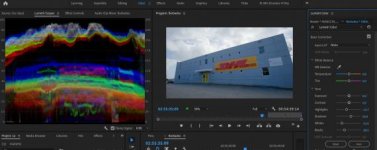
FS7: Sony FX9 v Canon C500 mkII

I think that once you want to compare camera's you should test them in a laboratory with controlled light, with calibrated instruments and standard conditions and standard test methods.
All other tests are useless, except for amusement or raging discussions about personal taste and opinions.

Old photo magazines used to have this. Reliable and objective.
Or is there still a place were camera's are tested this way?

Of course the argument against this type of testing has always been, cameras aren’t used in laboratories.. but in the real world with non standard lighting, a myriad of lens coloration etc. there is specialized equipment that tests various aspects like DR, although the more specific the test, the less information it gives you. Geoff Boyle cmltests.net does the most comprehensive set of real world tests, although his methodology is always being tinkered with, so from year to year, the test parameters change. It’s rare though to see as many high end cameras in one room, at the same time, as he’s Been able to wrangle, year after year.
 
At least in FCPX, applying a LUT will hard clip the color values and the information can't be recovered by secondary color corrections. Canon's V1 REC709 LUT's all had the problem of transforming the image in a way that would cause color channels to either clip or be crushed. The V2 LUT's appear to roll off the saturation so that you maintain some color definition, but you still have the problem if desaturating the superwhites and blacks.
I’ve taken to using the Custom LUT setting in fcpx instead of applying it in the info panel (the normal way).. I’m not sure if it’s reacting differently or not, but it helps me keep track, and also test two instances of a clip with and without the LUT. (Reversing the order was using the custom LUT feature...not sure what cvp’s methodology was, but it looks about the same as that).
 
I’ve taken to using the Custom LUT setting in fcpx instead of applying it in the info panel (the normal way).. I’m not sure if it’s reacting differently or not, but it helps me keep track, and also test two instances of a clip with and without the LUT. (Reversing the order was using the custom LUT feature...not sure what cvp’s methodology was, but it looks about the same as that).

If CVP used the method of applying one of the preinstalled Apple LUT's through the info panel, then the test is useless. Those LUT's are horrible.

I actually think CVP may have just turned off the picture profile setting if that option is available in the C500 II like it is in the C300 II. In that case, the camera seems to just apply a standard REC709 profile.
 
Great post Barry. I completely agree. Applying the LUT before adjusting exposure is something I've seen editors get wrong with log footage countless times over the years.

Hi Liam, you made an interesting point there. I am going to see what this effect had on some of my video's.

This video has a different answer:

https://nofilmschool.com/2016/08/should-you-adjust-your-footages-color-or-after-applying-lut

Working on exposure before or after applying a LUT gives another result but if it is the right result depends...

When you think of it it seems logic, it is the same principle when using a limiter on audio before or after normalising.

Certainly in this case, when you are testing a series of overexposures, the canon LUT is applying a roll-off in the highlights, which is very effective if the exposure is near where it should be, but the overexposure is pushing more and more of the image into that roll-off, compressing the range and lowering saturation, applying a correction after that is deadly. If your intention is to adjust exposure, while applying (and maintaining the look of that LUT, it’s best to apply the adjustment before applying the LUT.
 
If CVP used the method of applying one of the preinstalled Apple LUT's through the info panel, then the test is useless. Those LUT's are horrible.

I actually think CVP may have just turned off the picture profile setting if that option is available in the C500 II like it is in the C300 II. In that case, the camera seems to just apply a standard REC709 profile.
That was another problem with that test, the Sony clip processing is fully documented, the canon’s aren’t.

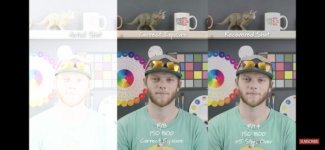
That said, when the dust clears, there is enough information out there to indicate that the Venice chip holds color better than every other chip in the market. The fx9 appears to have inherited that. The CVP misrepresents the canon image, but it will likely sit somewhere below the Sony’s (as every other camera on the market does) relative to this one metric. I think that the canon will shine in other areas, like retained detail, color noise and low light response. And personally, I think the skin tones look more neutral, and pleasing across the range of usable latitude of the camera.
 
Your post-production workflow and the way you order your manipulation is more important than the camera you're using.

I have personally limited dynamic range in cameras with my own ignorance over the years. But after tedious testing and getting to know many cameras, you learn a lot about what they like and do not like, and how they generally function in post.

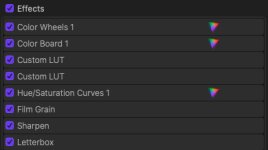
Here's what a typical grade could look like for me in FCP X. Rest-assured that if I flipped around one of these 'effects', my footage could change dramatically. And there is no shadow of a doubt that if you apply any heavy exposure adjustments AFTER applying your LUTs, you have ruined your footage. You can brighten it up a bit after everything is done, but any major exposure recovery needs to be done on the LOG footage BEFORE anything else. (Along with WB.)

FCPX_Sample Effects.jpg
 
Interesting stuff. Will keep me behind Davinci for a while.

I think slog3 and slog2 will show different outcomes here.

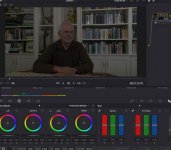
I just tested this. Had an underexposed clip, first one
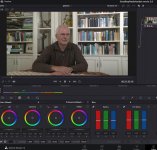
1- Sony slog2 LUT, corrections
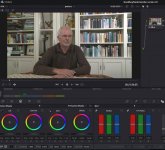
2- corrections, slog2 LUT

The second time I had to adjust the exposure twice, before and after the LUT.

Kept the settings the same.

1 no lut.jpg
LUT then exposuer Lut exposure.jpg
exposure, then LUT 3 exposure LUT.jpg
 
^Doesn't matter as much for underexposed clips besides watching for any addition of unnecessary noise, contrast, crushing of blacks, etc. based on what you're doing.

The combined effect of LUTs and exposure adjustments mainly apply to overexposed footage.

The order of LUTs, however, do apply to everything.
 
I always keep my RGB parade up whenever I'm working on color. It gives you a good way of telling whether you are inadvertently clipping color channels.
 
As I suggested earlier. When presented with evidence, you find a way to ignore it, and then head off and find some irrelevant “proof” of what you already know from years of experience with “canon color science”. Let me clear things up for you. The image I posted, while hastily prepared, imperfect, and not final, clearly illustrates there’s something very wrong going on in the CVP test that you seem to think is the holy grail. If you fail to see that, I can’t really help you. (I’ve also come to the insane conclusion that I really don’t need to change your mind on this, and that letting you continue to spout convoluted misinformation about cameras, unchallenged, is gonna be ok.). Nice chatting with you.

Well, then don’t post hastily prepared tests when “the sun is in and out of clouds”. You are doing a good job of shooting good images. And i think those go a good way. But don’t post a hasty test as evidence, and expect to stop misinformation, as a hasty test can actually cause misinformation.
 
As I suggested earlier. When presented with evidence, you find a way to ignore it, and then head off and find some irrelevant “proof” of what you already know from years of experience with “canon color science”. Let me clear things up for you. The image I posted, while hastily prepared, imperfect, and not final, clearly illustrates there’s something very wrong going on in the CVP test that you seem to think is the holy grail. If you fail to see that, I can’t really help you. (I’ve also come to the insane conclusion that I really don’t need to change your mind on this, and that letting you continue to spout convoluted misinformation about cameras, unchallenged, is gonna be ok.). Nice chatting with you.

Your test shows color chips holding color; the CVP chips are holding color too. Try +5 with skintones (a live person).
 
Arri - top end is desaturated; 'so cliever' 'so filmic'

Canon - top end is desaturated; 'major fail'
2C5F4D8D-E152-444C-A38C-4176E72C7E86.jpg
https://youtu.be/ogv2geoQsWI

ARRI at +5 with ProRes. Raw on both cameras should do even better. Note in the SOOC shot color hasn’t ghosted. Tapering saturation near white clip is different than ghosting skin well below that.

Shooting raw should help (giant files though) or perhaps different LUTs and/or camera settings will help. Else perhaps a FW update can address.
 
Hi Liam, you made an interesting point there. I am going to see what this effect had on some of my video's.

This video has a different answer:

https://nofilmschool.com/2016/08/should-you-adjust-your-footages-color-or-after-applying-lut

Working on exposure before or after applying a LUT gives another result but if it is the right result depends...

When you think of it it seems logic, it is the same principle when using a limiter on audio before or after normalising.

That video is trying to sell grading LUT packs. Ignore it. We are concerned with straight technical converting LUTs, ie a LUT that converts from Log to 709 accurately. Before you apply a technical LUT you need your exposure and white balance to be where you need them otherwise you may clip part of the signal.
 
  • Like
Reactions: jcs
Hi Liam,

Your statement seems logic. But... How can you explain my little test then? That is not what happened with the underexposed clip I posted here. I adjusted the exposure before assigning the Sony Slog2 to 709 LUT. After I used the LUT it resulted in a clipped image that I had to correct again.

Or is the underexposed clip the problem as Barry said?


The end result is (almost) the same as the other clip. And so are the settings in Davinci.
 
49465161776_a58fe74891_n.jpg

Everbody!
 
Hi Liam,

Your statement seems logic. But... How can you explain my little test then? That is not what happened with the underexposed clip I posted here. I adjusted the exposure before assigning the Sony Slog2 to 709 LUT. After I used the LUT it resulted in a clipped image that I had to correct again.

Or is the underexposed clip the problem as Barry said?


The end result is (almost) the same as the other clip. And so are the settings in Davinci.

Give me 5 mins I'll post an example.
 
  • Like
Reactions: jcs
Here's an example of a shot with a lot of dynamic range where the highlights need to be brought down to retain detail.

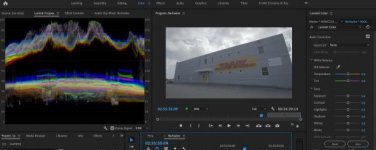
First shot is how it appears in-camera. Nothing applied.

Screenshot 2020-01-30 at 18.32.13.jpg

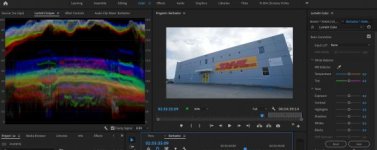
Second shot is with a technical LUT applied BEFORE exposure adjustment. Note the highlight clipping.

Screenshot 2020-01-30 at 18.32.29.jpg

Next we see the highlights brought down. Again, note the highlights and the lack of detail due to clipping.

Screenshot 2020-01-30 at 18.33.17.jpg

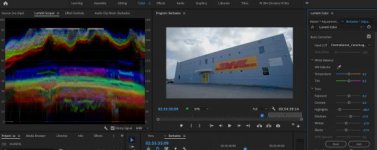
Finally, here's what it looks like with an exposure adjustment BEFORE the LUT is applied. It makes it a breeze to get a pleasing image with no clipping.

Screenshot 2020-01-30 at 18.33.56.jpg
 
Your test shows color chips holding color; the CVP chips are holding color too. Try +5 with skintones (a live person).

How ‘bout you conduct whatever test you need, I’m done trying to make you happy. The CVP test uses a chart that was developed for printing. The chart i’m using is designed for video, has known skin tone values, and is a better test of what happens to those known colors during exposure changes. A live model doesn’t have known values, and so is only valuable when performing a comparison of two or more cameras, so we can see if there are variations in response. If you want to hire a model with the kind of skin you want to see, and send her my way, I’ll be happy to shoot her.

I shot those charts, quickly, to confirm to myself that the CVP test was flawed in the way I thought it was. I’m really not that interested in how you feel about it. If you don’t see the difference between my flawed test, and cvp’s flawed test, then you don’t. I have no interest in changing your perception.

I’m shooting skin tones with this camera every day, never overexposing them beyond the latitude of the camera, and they look terrific, to me, and to my clients. I’m quite sure they won’t pass your muster. If you think a camera that clips at 4-5 stops over is clipping early, there’s not much I can say....but I’m not going to waste my or my models time shooting a test for you, when you’ll just say you see green in the shadows on your iPhone. Green that’s not there, but is somehow something wrong with the camera, not your display.
 
Liam, thanks for your time. I wonder what kind of person downvotes this. Is it controversial? Or do you have a hidden enemy here? :-)

I am making a documentary with lots of highlight (clouds) in it, this will have effect on my grading for sure.
 
Back
Top