
ChristopherA
Well-known member
We purchased and just took delivery of an FX9. Just playing around with it, It's a pretty amazing camera. As a previous FS7 owner, you can really see how Sony learned and improved.
There are definitely some weird quirks. The LUT system is bad. There's no support for custom LUTs. I can't send a LUT to the viewfinder but not to my outputs. If you choose to put a LUT on the viewfinder, EVERYTHING is post-LUT. All outputs, all scopes, zebras... everything. It's not possible for me to expose white at 64%, because there isn't any way to measure the actual SLOG3, just the post-lut levels. Further, MLUT status isn't assignable to a custom button. Changing Base ISO from 800 to 4000 is super easy, but changing your image sensor scan isn't mappable to an assignable button. So if I'm shooting 6K FF and I need to pop into S&Q 60fps or I want a tighter shot (4k S35), I have to dive into menus. Face tracking works surprisingly well. People have talked about it breaking in profile shots, but I find it holds well. What's more, when it loses the face, the focus doesn't go hunting, it stays put.
We tested the internal ND yesterday. There's a slight color shift between the clear and the lowest level of ND, but it's so slight we couldn't see it on the scopes. As you dial in more of the ND, the reds and yellows get more saturated, but again, only visible on the scopes. One surprise we found is that the auto variable ND (which is AWESOME) is controlled by the auto-exposure settings in the shooting menu. From there, you can change the exposure level and the speed. We did find that the Auto ND appears to operate at 1/30 of a second. What that means is that ND moves are smooth at 24 and 30, but if you're shooting at 60fps, fast ND transitions will definitely create an exposure stutter.
I'm going to setup my studio to shoot some tests. If anybody has anything they're curious about with the camera, just let me know, and I'll build it in to the tests I shoot.
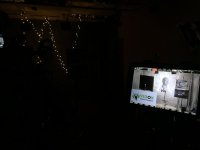
I will quickly note, that this camera is insane in low-light. Take a look at the attached picture. In a completely dark studio, I was able to get a relatively low-noise exposure.
There are definitely some weird quirks. The LUT system is bad. There's no support for custom LUTs. I can't send a LUT to the viewfinder but not to my outputs. If you choose to put a LUT on the viewfinder, EVERYTHING is post-LUT. All outputs, all scopes, zebras... everything. It's not possible for me to expose white at 64%, because there isn't any way to measure the actual SLOG3, just the post-lut levels. Further, MLUT status isn't assignable to a custom button. Changing Base ISO from 800 to 4000 is super easy, but changing your image sensor scan isn't mappable to an assignable button. So if I'm shooting 6K FF and I need to pop into S&Q 60fps or I want a tighter shot (4k S35), I have to dive into menus. Face tracking works surprisingly well. People have talked about it breaking in profile shots, but I find it holds well. What's more, when it loses the face, the focus doesn't go hunting, it stays put.
We tested the internal ND yesterday. There's a slight color shift between the clear and the lowest level of ND, but it's so slight we couldn't see it on the scopes. As you dial in more of the ND, the reds and yellows get more saturated, but again, only visible on the scopes. One surprise we found is that the auto variable ND (which is AWESOME) is controlled by the auto-exposure settings in the shooting menu. From there, you can change the exposure level and the speed. We did find that the Auto ND appears to operate at 1/30 of a second. What that means is that ND moves are smooth at 24 and 30, but if you're shooting at 60fps, fast ND transitions will definitely create an exposure stutter.
I'm going to setup my studio to shoot some tests. If anybody has anything they're curious about with the camera, just let me know, and I'll build it in to the tests I shoot.
I will quickly note, that this camera is insane in low-light. Take a look at the attached picture. In a completely dark studio, I was able to get a relatively low-noise exposure.
