Sony Cinema Line & FX6

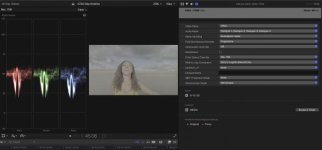
White balance is greyed out and ISO and exposure controls are nowhere to be seen (with these three clips).

Attached are the current ProRes RAW controls in FCP 10.4.9 and 10.5 for the Panasonic S1H and Sony A7SIII, as recorded by an Atomos Ninja V. They both have exposure offset and ISO controls, but the Sony material does not yet expose white balance, I believe waiting on a firmware update from Atomos and Sony. To achieve the existing ProRes RAW controls for A7SIII material requires Atomos firmware 10.54 or higher.
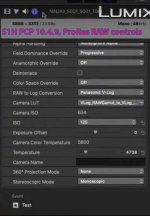
 

Attachments

  • S1H_FCP_10_4_9_ProResRAW_Controls.jpg
    S1H_FCP_10_4_9_ProResRAW_Controls.jpg
    62.6 KB · Views: 0
  • A7S3_FCP_10_5_ProResRAW_Controls.jpg
    A7S3_FCP_10_5_ProResRAW_Controls.jpg
    74.9 KB · Views: 0
Attached are the current ProRes RAW controls in FCP 10.4.9 and 10.5 for the Panasonic S1H and Sony A7SIII, as recorded by an Atomos Ninja V. They both have exposure offset and ISO controls, but the Sony material does not yet expose white balance, I believe waiting on a firmware update from Atomos and Sony. To achieve the existing ProRes RAW controls for A7SIII material requires Atomos firmware 10.54 or higher.

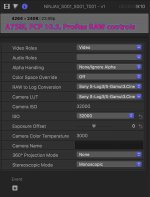
Here's all I'm getting with these clips in 10.5:

o3CEvuM.png
 

Attachments

  • Screen Shot 2020-12-07 at 11.04.44 am.jpg
    Screen Shot 2020-12-07 at 11.04.44 am.jpg
    18.2 KB · Views: 0
Just tried pulling CVP's FX6 sample raw clips into FCPX, and they give me ISO and Exposure Offset control, no WB though.
 
It's possible the Ninja V wasn't on the right version of firmware. You could also verify you are on the latest version of Apple Pro Video Formats. That is updated in System Preferences>Software Update. You can verify the version by running About this Mac>System Report>Software>Installations, and scrolling down to the highest numbered Pro Video Format. The current version on Catalina is 2.2.0.

Another possibility (maybe hard to believe) is he wasn't recording ProRes RAW but regular ProRes. The A7SIII must be put in a certain mode, and the Ninja V must have been previously registered and activated for ProRes RAW, else it only records ProRes. However your screen cap does say "Raw to Log Conversion" and it normally only does that for ProRes RAW material.
 
I just don't see it...I really, truly want to see it and I see it in the FX9 all of the time (from Day 1), but something is so off about this video for me.

The talent and effort and production is of course beyond great, but the IQ and motion is not working for my brain.

I agree. I don't see that same "look" the FX9 has in any of the FX6 footage. Yes, they look similar, but that extra bit of "sheen" in the FX9 image isn't in the FX6. The difference can't really be described in words, but the FX6 definitely has that "A7" series "Alpha camera" look to the image. Just something about the FX9 that puts it over the top in an intangible way. Maybe its the extra chroma resolution from the 6K downsampling, or the extra bit of resolved detail? Hard to describe.
 
I'm not sure...but just for the record I haven't watched a single FX6 video after that comment (not that I gave up on it after one viewing but just not interested in the system).

The comment above was strictly about that launch video or whatever it was back then that people seemed to love but I just couldn't see why.
 
My view on the 'history of cameras'

F3 vs C300 - F3 did not have 50mbs codec to meet broadcast standards .. C300 won

Fs7 vs C300 - Fs7 was cheaper and had more than 50mbs.. FS7 won

Somewhere here AF100 and JVC got 10bit.. but we were set up thanks.

C300ii, FS7 was cheaper and still exceeded 50mbs .. FS7 won

C300iii vs FS7 - FS7 was cheaper and still exceeded 50mbs .. FS7 won.. but AF on the competitor and raw was beginging to bite the FS7 at a higher level

FX9 vs C300iii - FX9 big, worse AF no 4k60.. C300iii won.. FS7 starting to look long in tooth but still does above 50mbs and the new corporate fave, 4k50/60

FX6 vs FS7 - AF, smaller, raw out FS7 starting to look very compromised

PAnny - ha - nice cameras years late still dont 4k60(?)
F55 and Varicam bubbing along at $20g set up, owned by a few who thought $20g was cheap vs thier old 2/3 cam and had clients who were in the same old position of thinking a $5g cam 'must be bad'

Yeah the Varicam cameras are way overhyped. Got into an argument on a forum with a Panasonic rep who swore the Varicam LT was better than the FX9, even though even AFTER the massive price drop of the LT camera body, after buying everything you need to get it going, it STILL costs roughly $5000 more than an FX9 with the kit lens. The guy swore the less capable Varicam LT, with the nearly 7 year old Varicam sensor from 2014, was worth the money over the FX9, with the cleaner dual ISO performance, much better autofocus, etc.

If the Varicam LT is so damn great, why's Panasonic have to drop the price from $16,000 to just under $10,000, and its STILL overpriced.
 
I agree. I don't see that same "look" the FX9 has in any of the FX6 footage. Yes, they look similar, but that extra bit of "sheen" in the FX9 image isn't in the FX6. The difference can't really be described in words, but the FX6 definitely has that "A7" series "Alpha camera" look to the image. Just something about the FX9 that puts it over the top in an intangible way. Maybe its the extra chroma resolution from the 6K downsampling, or the extra bit of resolved detail? Hard to describe.

For almost twice the money, it had better have something over the FX-6 ;-) I shot a few projects with the FX9 and it was the best Sony camera I have shot with in years. Really made the FS7 look not look very appealing.
 
Has anyone done blind comparisons of the FX6 and FX9? I don't doubt there's a difference—given the hardware and software differences—but I'm curious how many people (pros or otherwise) could tell which is which. It's easy to have preference when you know what camera was used for certain footage, but I'm increasingly skeptical of differences in image past a certain quality threshold. Or at least, differences that allow us to easily identify camera A or camera B.

That said, I recognize my eye is nowhere near as developed as some others'. While I can often suspect a film was shot on, say, a Sony F900, I certainly can't say if it was film or an Arri Alexa. And I'm pretty confident I'd do no better than chance if I were forced to identify footage from the FX6, FX9, and a7sIII together.

Image alone is far from the only consideration when buying a camera, of course; I'm just deeply skeptical of our ability to make these kinds of judgments.

To extrapolate this. I think there is a sliding scale of image recognition. At the bottom is the average consumer. At the top are Roger Deakins, top directors like Scorsese, you know, people who eat, drink and breathe cinematic imagery. Between those two poles are all of us.
The logical way to approach your supposition is with scientific, controlled A/B blind testing carried out in a controlled environment. Find me a test that compares cameras, any cameras at any level performed by anyone, and I can find you 100 people who can punch
holes in the testing methodology. One of the challenges is that we exist at the intersection of art and engineering from a purely camera POV. Add in the variables by environment, past perception, how well your eye is trained (I worked in a recording studio and top sound engineers ears
are so attuned to variances that their skills seem sort of supernatural) so this leads me to the conclusion that there are people who possess the same tools of perception when it comes to images, colorimetry, sensitivity to video noise, perceived sharpness or softness, etc.

I would posit that there are so many variables in our equation that absolute pronouncements of whether one camera "looks" better or worse than another is almost moot. I think you can say that the reason that Hollywood and mass media has generally conceded that the Arri ALEV imager has
looked the "best" for the past decade or so must mean that objectively, most humans perceive most Arri images, that are shot well, to look superior to most other cameras. But there are a lot of other factors why audiences and users flock to Arri cameras besides pure image. There are reputation,
reliability, cachet of brand, tradition (I shot and owned Arri film cameras so heck yes, I am brand biased!) reliability, insurability (ever research how using an Arri camera factors into completion bond underwriting?)

As far as the my experience, I thought the FX9 looked great. I've never shot with or used the FX6 so I can't say anything about how they compare. I can say that I owned the C100 MKI and I can instantly tell, on my reel, when shots switch between C100, 200, 300 MKII but then again, I shot them all and know
what was shot on what but I can desribe easily visible markers between perceived sharpness, detail, resolution and colorimetry between those three cams that make them pretty easy to identify between, at least for me. But that doesn't mean if I gave you all three cameras and you went out and shot
with them and purposely tried to obfuscate the results with bias that you couldn't fool me or anyone else. You probably could.

So in the end, I somewhat both agree and disagree with your conclusion. I've seen Arri footage look like sludge and iPhone 12 footage look amazingly good and high end. Even with charts and measurements, in the end, the other variables
(mainly lighting) but also composition and how the image is manipulated in post - (straight out of camera images in the age of Log, LUTs and RAW are somewhat meaningless in a way) apart from sensors and DSP themselves affect our perception more in most cases.
I've had good colorists take a pass of my material that looked meh to me and they make it look amazing! It was good looking all along, I'm just not a talented enough colorist to make it sing!
 
Last edited:

I'm no that Martin Scorsese dude but I'd bet most movie goers would find the above clip sufficiently visually pleasing.

PS. I like none of their color, shot framing /selection or editing ... but it's not camera's fault.
 
To extrapolate this. I think there is a sliding scale of image recognition. At the bottom is the average consumer. At the top are Roger Deakins, top directors like Scorsese, you know, people who eat, drink and breathe cinematic imagery. Between those two poles are all of us.

Did you see the promo Deakins shot with the FX6? It looked amazing
 
I would posit that there are so many variables in our equation that absolute pronouncements of whether one camera "looks" better or worse than another is almost moot. I think you can say that the reason that Hollywood and mass media has generally conceded that the Arri ALEV imager has
looked the "best" for the past decade or so must mean that objectively, most humans perceive most Arri images, that are shot well, to look superior to most other cameras. But there are a lot of other factors why audiences and users flock to Arri cameras besides pure image. There are reputation,
reliability, cachet of brand, tradition (I shot and owned Arri film cameras so heck yes, I am brand biased!) reliability, insurability (ever research how using an Arri camera factors into completion bond underwriting?)

I'd agree with most (or all) of what you're saying, but I think people tend to gloss over this aspect that you raise (or ignore it completely): i.e., that things completely unrelated to the image quality, per se, can have a profound effect on what the finished image looks like. Qualitative judgments aside, different camera systems can look very different based on the physical realities of using them: i.e., are you limited by a 400' film magazine, are you shooting on a phone that can go places a bigger camera can't, do you need to be tethered to a hard drive, etc. etc. And of course (as you note) there's the whole ecosystem that comes with certain cameras (like Arri).

Even if we limit ourselves to just the FX6 and FX9 there are physical elements that I think can impact the final image in the real world, regardless of how close the images would be in a vacuum (e.g., shoulder mounted vs handheld).

All that being said, I tend to be very suspicious when people—at any level of expertise!—attribute certain vague, indescribable qualities or benefits to specific cameras or formats. The worst examples are appeals to some sort of "organic" element in film. When it comes to cameras like the FX6 and FX9 I think the "je ne sais quoi" quality that people respond to is simply knowing that one camera cost ~$5000 more :smile:

On a related note, I'm not sure if you've seen the ARRI LF and Alexa comparison making the rounds recently, in which the operators used a rig that sends the exact same image to both cameras simultaneously. They controlled for FOV and DOF via lens/aperture, and (surprise! surprise!) there was no notable difference between the two, at least not in terms of perspective or compression or whatever other vague terms are thrown around to argue for Large Format cameras. This isn't surprising to anyone who knows how lenses and sensors work but it's amazing how often I hear (from very smart people! way smarter than me) that LF cameras offer some mystical "look" that can't be replicated by a S35 sensor. Of course, going back to your point about how lots of other things affect image quality means using a LF camera might result in a different image, but not necessarily for the reasons people think...
 
Back
Top