Sony announces FX9 4K camcorder with 6K fullframe sensor

The A7S III will likely have IBIS (and no eVND), no XLR or TC etc. so will Sony give it at least 10-bit 420 for X-T3 parity (or 10-bit 422 for S1H parity)?

It is most unlikely Sony will ever offer 420 10-bit H.265 going by their white paper on the release of the new H.264 based XAVC-L 200 Mbps codec. Also for Sony to offer 422 10-bit 4K @ 60p sounds like an impossible task trying to jamb a 600Mbps codec into their current tiny A7 series bodies. I honestly don't think an A7SIII will ever come about no matter how much wishful thinking there is on our part. Look at what Panasonic had to with the S1 series. Make a much larger body and put a fan in the S1H. Even the S1H isn't capable of recording FF 422 10-bit 60p internally. As Panasonic have mentioned that camera also comes with the caveat that it may still shut down to protect the camera should over heating issues arise. If Sony do bring out an A7SIII I think it would be a given that it would have the latest in BSI sensors but as I said I think 422 10-bit 60p is a stretch too far... as great as it would be:)

Chris Young

https://pro.sony/s3/2019/04/3016172...point-for-advanced-media-architectures-EN.pdf
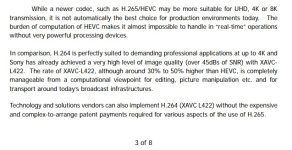
Sony XAVC 200.jpg
 
The industry is evolving. First it was resolution. Then demand for better bits, data rate etc. With faster computers it is easier to process raw. If you have to milk a camera for a long time it is better to buy one with internal raw. Some clients are waking up to raw.

There are certain places where you can't put a long camera. So additional raw modules would become tough.

Nevertheless the inertia of staying with Sony may lead to some people buying the FX9.

The newsshooter article https://www.newsshooter.com/2019/09...w-support-for-the-sony-fx9-prores-raw-update/ says that Atomos will support raw in their Neon recorder priced at $3999 USD. By the way that is a 17 inch monitor recorder. Not sure where will you place this 17 inch beast? While shooting handheld hang it on your bum? I think they had not expected C500 II to be so capable. So they took chances with not providing internal raw recording and just as an afterthought trying to create something. I may be wrong though. If so, some Sony execs should be taken to task for such sloppy planning.

Anyway, so overall cost of shooting raw in FX9 is 11k (body) + 2.5k (attachment) + 4k (neon recorder) = 17.5K USD

For Canon it would be easier to pack extra mounts at a discounted rate. And people don't realise that Canon is giving one 512GB CFExpress card free. As they say 2020 vision is good.
 
According to a friend at IBC, Atomos are saying that the Shogun 7 will support FX9 raw. And that's like €1600? So a bit cheaper and more portable at least.

I'm going to IBC tomorrow, so if anyone have any specific questions regarding the FX9 I will do my best to ask them!
 
The newsshooter article https://www.newsshooter.com/2019/09...w-support-for-the-sony-fx9-prores-raw-update/ says that Atomos will support raw in their Neon recorder priced at $3999 USD. By the way that is a 17 inch monitor recorder. Not sure where will you place this 17 inch beast? While shooting handheld hang it on your bum? I think they had not expected C500 II to be so capable. So they took chances with not providing internal raw recording and just as an afterthought trying to create something. I may be wrong though. If so, some Sony execs should be taken to task for such sloppy planning.

The Neon monitor line includes recorders because Atomos is using the same OS and hardware platform as in the Shogun under the hood, just connected to newer displays. That the Neon is the one mentioned in the press release doesn't imply that it's the only Atomos recorder that will be able to record FX9 raw.
 
The sensor in the FX9 is NOT the same sensor as the one in the VENICE. The chip in the Venice is not an EXMOR R. It could be an excellent sensor, just different from the Venice. Maybe it is the same sensor they will use in the "A7SIII" or whatever their flagship video/photo hybrid is going to be. From nofilmschool:

"Under the hood, the Sony FXW-FX9 has a back-illuminated full-frame 6K Exmor R image sensor that oversamples 6008 x 3168 resolution to create its 4K images capable of full HDR. For those keeping tabs the VENICE oversamples its 6K at 6048 x 4032. Sony says the Exmor R sensor provides 15+ stops of dynamic range and has a dual base ISO at 800 and 4000. (VENICE dual base ISO 500 and 2500)".
 
The really sad part (at least for me) is I have been waiting for a mirrorless camera with 4K/60p, great AF and LOG for 5 years.

It's perfectly uncanny how one is still not available, but there are at least 8 cameras that do 2 out of those 3 things really well.

The 1DX II has good 4K60; I think I've got a good CLog emulation working on it (developed on the EOS R first). The point being that I can shoot the same scene with both cameras (EOS R in CLog and 1DX II with Filmic Skin: CLog) and apply the exact same grade in post and have them match. CLog on the EOS R will likely have a touch more color retention near highlight clipping (e.g. blue sky). That was the case on the EOS R with CLog vs. the custom profile (unless the 1DX II has more usable hardware DR). Yeah, the 1DX II isn't mirrorless and it's much larger & heavier (flies fine on e.g. the Crane 2 however will put extra load on the arms and low back).

It's pretty clear the market is controlled to generate revenue as people move back and forth between brands as features are ping-ponged.
 
Just for reference purposes.

ARRI didn't hold back, makes good industrial designs that are simple and easy to use, and still produces the best images. They hire excellent creatives for their promo content. CartelOrama doesn't do this, instead slow dribbling features over time, crippling and making things complex and hard to use, producing lower quality images, especially for the general case of real-world and mixed lighting, and producing weak promo content that leaves one puzzled why they didn't do like ARRI.

ARRI charge a lot more, because they can.

The small cameras are now close enough to the mid range cameras in terms of IQ to not bother with the bigger cameras (when only IQ matters). For top IQ, Alexa LF or Venice still hold the lead.
 
It is most unlikely Sony will ever offer 420 10-bit H.265 going by their white paper on the release of the new H.264 based XAVC-L 200 Mbps codec. Also for Sony to offer 422 10-bit 4K @ 60p sounds like an impossible task trying to jamb a 600Mbps codec into their current tiny A7 series bodies. I honestly don't think an A7SIII will ever come about no matter how much wishful thinking there is on our part. Look at what Panasonic had to with the S1 series. Make a much larger body and put a fan in the S1H. Even the S1H isn't capable of recording FF 422 10-bit 60p internally. As Panasonic have mentioned that camera also comes with the caveat that it may still shut down to protect the camera should over heating issues arise. If Sony do bring out an A7SIII I think it would be a given that it would have the latest in BSI sensors but as I said I think 422 10-bit 60p is a stretch too far... as great as it would be:)

Chris Young

https://pro.sony/s3/2019/04/3016172...point-for-advanced-media-architectures-EN.pdf

View attachment 136873

My iPhone-X shoots H.265 4K60 without overheating. Doesn't the X-T3 use a Sony IMX571 sensor for 4K60- does it overheat or have a fan? Sony could easily do 4K60 on the A7S III (if their Cartel managers allowed it). Fans are only required when using older less efficient chips. Apple's new A13 phone built on a 7nm process can shoot with all 3 cameras at the same time!
 
Has any site explained what the S cinetone profile is? The FS5 mk ii came with a standard “Venice-like” color profile, but no other profile had those colors. I assume it’s the same in the FX-9 when using this profile. If it has a large dynamic range and behaves somewhat like a Hypergamma then it may be a good option.
 
Has any site explained what the S cinetone profile is? The FS5 mk ii came with a standard “Venice-like” color profile, but no other profile had those colors. I assume it’s the same in the FX-9 when using this profile. If it has a large dynamic range and behaves somewhat like a Hypergamma then it may be a good option.

It's a gamma curve. Looks nice from what i've seen. Roll your own if you prefer.
 
Has any site explained what the S cinetone profile is? The FS5 mk ii came with a standard “Venice-like” color profile, but no other profile had those colors. I assume it’s the same in the FX-9 when using this profile. If it has a large dynamic range and behaves somewhat like a Hypergamma then it may be a good option.

My favorite setting on the A7S II was SLog2 with SGamut3.cine (+ ~16 sat). I’d expect S Cinetone to be a Canon-like Wide DR gamma with an SGamut.venice colorspace. So you could change gamma to suite your needs and still get the nice new colorspace.
 
The Neon monitor line includes recorders because Atomos is using the same OS and hardware platform as in the Shogun under the hood, just connected to newer displays. That the Neon is the one mentioned in the press release doesn't imply that it's the only Atomos recorder that will be able to record FX9 raw.
The Atomos Neon monitors have a replaceable Master Control Unit (MCU) which is the part of the monitor that processes the input signals and does the actual recording. The stock MCU that Atomos has announced for the NEON can record up to 4K 60p and 12-bit RAW. This allows for upgrading the recorder on these models without replacing the screen. The initial MCU appears to be similar to Ninja V (essentially the back of the Ninja V with the processor and disk slot that somehow connects to he larger Neon screen), but they are also planning to come out with an updated MCU for the Neon that can record up to 8K 60:
https://www.cinema5d.com/atomos-neon-records-8k-prores-raw-with-the-new-master-control-unit/

So the fact that Atomos has announced FX9 RAW support for the Neon family of monitors may actually mean that the base MCU (which are the guts around which their existing smaller monitor/recorders are based) might not be capable of recording the 16-bit RAW output from the FX9. It is entirely possible when all is said and done, that you will need the upgraded 8K MCU (or some other more powerful MCU that doesn't exist yet) to be able to record 16-bit RAW from the FX9.

In the Newsshooter interview with Atomos CEO, Jeromy Young, he indicated that they are working on 16-bit RAW at up to 4K 120fps from the FX9: https://vimeo.com/359806797
To record this continuously could very well require a more powerful processor than their existing small recorders (which can only do 4K 60fps continuous).

And indeed according to the Atomos announcement, the new 8K MCU for the Neon will be needed to record 16-bit RAW from the FX9:
https://s3.amazonaws.com/atomos-web-uploads/press/Press-Release-SONY_ATOMOS_IBC2019.pdf
 
Last edited:
The industry is evolving. First it was resolution. Then demand for better bits, data rate etc. With faster computers it is easier to process raw. If you have to milk a camera for a long time it is better to buy one with internal raw. Some clients are waking up to raw.

There are certain places where you can't put a long camera. So additional raw modules would become tough.

Nevertheless the inertia of staying with Sony may lead to some people buying the FX9.

The newsshooter article https://www.newsshooter.com/2019/09...w-support-for-the-sony-fx9-prores-raw-update/ says that Atomos will support raw in their Neon recorder priced at $3999 USD. By the way that is a 17 inch monitor recorder. Not sure where will you place this 17 inch beast? While shooting handheld hang it on your bum? I think they had not expected C500 II to be so capable. So they took chances with not providing internal raw recording and just as an afterthought trying to create something. I may be wrong though. If so, some Sony execs should be taken to task for such sloppy planning.

Anyway, so overall cost of shooting raw in FX9 is 11k (body) + 2.5k (attachment) + 4k (neon recorder) = 17.5K USD

For Canon it would be easier to pack extra mounts at a discounted rate. And people don't realise that Canon is giving one 512GB CFExpress card free. As they say 2020 vision is good.

All this makes me think another rear attachment will become available next year, or they'll announce another model as the F55 replacement with internal raw, global shutter, and higher frame rates. Who knows?
 
Last edited:
According to a friend at IBC, Atomos are saying that the Shogun 7 will support FX9 raw. And that's like €1600? So a bit cheaper and more portable at least.

I'm going to IBC tomorrow, so if anyone have any specific questions regarding the FX9 I will do my best to ask them!

Ask them what their anamorphic plans are (if this hasn't already been asked and answered). Thanks.
 
According to a friend at IBC, Atomos are saying that the Shogun 7 will support FX9 raw. And that's like €1600? So a bit cheaper and more portable at least.

I'm going to IBC tomorrow, so if anyone have any specific questions regarding the FX9 I will do my best to ask them!

Please ask them about their upgrade plans for the Shogun Inferno. It captures 5.7K RAW from the EVA1 so I'm hopeful it will get an firmware update to handle the FX9, S1H and other 6Kish cameras in the pipeline.

Thanks!
 
My iPhone-X shoots H.265 4K60 without overheating.

Last time I checked the iPhone X has a sensor capture area of 5.6 x 4.2 mm, so it's a fair bit smaller than MFT / APS-C / FF sensors.


Doesn't the X-T3 use a Sony IMX571 sensor for 4K60- does it overheat or have a fan?

But it does have a 4K 60p recording time limit of 20 minutes. I bet if you keep pressing record every 20 minutes the X-T3 will overheat in an hour or so.


Sony could easily do 4K60 on the A7S III (if their Cartel managers allowed it). Fans are only required when using older less efficient chips.

A fan enables the S1H to shoot with 52 profiles for an unlimited amount of time. Currently the Sony A7III camera will overheat when recording 4K 8-bit for less than 2 hours in a hot environment.
 
@TheDingo: the sensor size doesn't appear to be the limiting factor in heat- it's the electronics for recording. Live view runs constantly, no heat issues. Attach Sony's latest BSI sensor to iPhone-level 7nm hardware and heat won't be an issue. 3D/VR video games + AI running on these phones is far more computationally expensive and they don't overheat (they do throttle framerate when the devices gets too hot). Phones can now record H.265 video while the game plays with no slowdown: the 7nm process (soon 5nm, then 3) is very thermally efficient re: ops-sec per Watt (e.g. >1GOPs in < 1W continuous). Drones have similar computing power per Watt (e.g. Intel Movidius). The camera companies are choosing to use older less efficient technology- must be more profitable for them at this point. E.g. letting the device overheat and shutdown or adding a cheap fan is more profitable than using a smaller process (which is currently more expensive for them). Since Samsung makes chips and phones, they could produce a profitable small process dedicated camera however they rightly saw the phone market as much more profitable and left the dedicated camera market.
 
@TheDingo: the sensor size doesn't appear to be the limiting factor in heat- it's the electronics for recording. Live view runs constantly, no heat issues. Attach Sony's latest BSI sensor to iPhone-level 7nm hardware and heat won't be an issue. 3D/VR video games + AI running on these phones is far more computationally expensive and they don't overheat (they do throttle framerate when the devices gets too hot). Phones can now record H.265 video while the game plays with no slowdown: the 7nm process (soon 5nm, then 3) is very thermally efficient re: ops-sec per Watt (e.g. >1GOPs in < 1W continuous). Drones have similar computing power per Watt (e.g. Intel Movidius). The camera companies are choosing to use older less efficient technology- must be more profitable for them at this point. E.g. letting the device overheat and shutdown or adding a cheap fan is more profitable than using a smaller process (which is currently more expensive for them). Since Samsung makes chips and phones, they could produce a profitable small process dedicated camera however they rightly saw the phone market as much more profitable and left the dedicated camera market.

Each process shrink is an order of magnitude more expensive, to the point where only companies like Qualcomm, Apple, AMD, Intel, ect. Can afford to do it. I wouldn't be surprised if most cameras ran on much older processes, even most sensors are made with larger older lithography processes, Canon especially.
 
Back
Top