
Navigation
Install the app
How to install the app on iOS
Follow along with the video below to see how to install our site as a web app on your home screen.
Note: This feature may not be available in some browsers.
More options
You are using an out of date browser. It may not display this or other websites correctly.
You should upgrade or use an alternative browser.
You should upgrade or use an alternative browser.
Sony about to launch 4K TV
- Thread starter evilthought
- Start date

androbot2084
Carbonite Member
I hope they broadcast 4K over the air for free.
Morton Molyneux
Active member
no HD mon's in the 80's,
d
Canada's CBC tv shot Chasing Rainbows in 1988 using Sony's HDVS system which came out in the mid 80's. I remember seeing the monitors in thier mobile unit and wondering when I'd ever get that kind of image at home. It took a while.
cheers
Morton
Really? Sony is releasing a $30,000 4K TV set and that implies that they will 'now extensively switch to
4K for $300 consumer cameras'? I think I am missing something here.....(aside from the fact that ANYONE
could be foolish enough to pay 30 grand for a FREAKING TV SET!!)
People with high end home theaters won't even blink at putting down 30K, because 4K projectors are still going from 70 to 100K for now. You can get very good 1080p projectors for under 2K and show on a 110" screen.
But I think the general population is going to revolt against this. 4K in the theater, yes, in the home, forget about it. I think 4K in the home is going to go the way of Quadrofonic sound did in the 70's. The space requirements alone, to take full advantage of the resolution, will be too much for most families.
androbot2084
Carbonite Member
People are saying that 4K is the best invention since sliced bread. I think 8K will be for theaters and 4K will be for the home.
Bruce Watson
Veteran
Great... now my cable bill is going to go up again!
Regardless of 4k or 8k, your cable bill is going up. Each and every year, no exceptions. You know it, I know it; the cable companies are certain of it.
The antidote is called an OTA antenna. An antenna has two distinct advantages. First is the cost, broadcast reception is still free. Given the high cost of cable, even a fairly elaborate antenna installation pays for itself in months.
Second is the excellent image quality. No crushed blacks, less compression artifacting. The few people (beyond my wife and me) who've seen a broadcast show on my (plasma) TV usually have been astounded at the image and sound quality. And wondering why they can't get that over cable. Hmmm.....
Being into image quality as much as the next guy on this board, I can say that I think HDTV gets us about 80% of the way there. IOW, it's plenty good for 80% of the people. The other 20% might want more. I suspect that 4k (roughly equivalent of S35 film) would get us 95+% of the way there. How we'd ever justify 8k is quite frankly beyond me at this point.
I mean really -- we don't even need 4k for most theater work (people don't sit close enough to the screen to be able to resolve the extra detail). So 8K is overkill even for theaters. Not too many home theaters would need it. :grin:
So rather than 8k, I'd like to see a new broadcast standard that gave us a minimum of 10 bit 4:2:2 (12 bit 4:4:4 would be nicer), a minimum of 35 Mbps (or whatever eliminates 98% of motion artifacts like microblocking, which will be CODEC dependent of course), lossless 7.1 audio, native frame rates (progressive only, no interlacing) from 24 to 72 fps, no drop frames (goodbye 23.976! Artifacting on analog B&W TV sets is, um, not so much of a problem with a digital signal people!), all wrapped in a modern CODEC designed for it, but at least better than MPEG4.
I'd rather see all this at 2k. I'd rather have this than 4k or 8k. For that matter, all this information should be broadcast in a stream header (say, attached to every I frame) so the TV can decide what CODEC to use to decode, what resolution, what aspect ratio, what sound, etc. This would give us both backward compatibility (existing HD content) and a growth path (future higher quality formats).
That's what I want. What I'm going to have though is what I've got right now, full HDTV. I'll probably be long dead before we get the rest of it.

joy new media
Active member
So rather than 8k, I'd like to see a new broadcast standard that gave us a minimum of 10 bit 4:2:2 (12 bit 4:4:4 would be nicer), a minimum of 35 Mbps (or whatever eliminates 98% of motion artifacts like microblocking, which will be CODEC dependent of course), lossless 7.1 audio, native frame rates (progressive only, no interlacing) from 24 to 72 fps, no drop frames (goodbye 23.976! Artifacting on analog B&W TV sets is, um, not so much of a problem with a digital signal people!), all wrapped in a modern CODEC designed for it, but at least better than MPEG4.
I'd rather see all this at 2k. I'd rather have this than 4k or 8k. For that matter, all this information should be broadcast in a stream header (say, attached to every I frame) so the TV can decide what CODEC to use to decode, what resolution, what aspect ratio, what sound, etc. This would give us both backward compatibility (existing HD content) and a growth path (future higher quality formats).
That's what I want. What I'm going to have though is what I've got right now, full HDTV. I'll probably be long dead before we get the rest of it.
+1 and I think at least some of this is more likely since broadcasters are not too far removed from spending billions moving to HD, they're going to squeeze every bit out of that investment before adopting something new. And the current capacity is not being fully utilized, its very do-able.
+1 again on free reception, the NFL has never looked better after dropping the dish because of service issues. I'm not going back.
4k is a gimmick that's going to make the next Playstation even costlier than the current one - and it's going to get crushed again by Wii and Xbox because its not a must have feature that people will be willing to pay more to get, Sony will again lost money, it just will never learn....
androbot2084
Carbonite Member
But with 4K and 8K you can always down sample to get a higher quality 1080p picture. If you stick with regular HD the broadcasters will always give you more interlacing, 8 bit 4:2:0 color and they will compress the hell out of the picture and reduce the pixel raster.

Postmaster
Dark Side of the Camera
So rather than 8k, I'd like to see a new broadcast standard that gave us a minimum of 10 bit 4:2:2 (12 bit 4:4:4 would be nicer), a minimum of 35 Mbps (or whatever eliminates 98% of motion artifacts like microblocking, which will be CODEC dependent of course), lossless 7.1 audio, native frame rates (progressive only, no interlacing) from 24 to 72 fps, no drop frames (goodbye 23.976! Artifacting on analog B&W TV sets is, um, not so much of a problem with a digital signal people!), all wrapped in a modern CODEC designed for it, but at least better than MPEG4.
Can you please chisel that in stone and hang it over the entrance of every TV station?
Frank
androbot2084
Carbonite Member
The Olympics offers only 2 choices, 1080i interlace or 8K progressive.
evilthought
Well-known member
Brilliant analysis, I'm sure it will be every bit as successful as 3D. I find your trickle-up theory of $300 4k cameras especially insightful since Sony doesn't have a 4k camera under $10,000 right now. The FS700 doesn't count since we can actually buy the supposed 4k capability yet.
.
Thus says the village expert. We know there are no 4K cheap cameras right now, but that doesn't mean tons of these cameras aren't coming to market within an year and 2.
http://www.sony.co.jp/Products/SC-HP/cxpal/vol93/imx144/index.html
That's a sensor for $300-$400 cameras. S100/S95/LX3/LX5/EX1 etc used sensors like that size. All these were cheap under $500 p&s cameras.
You will notice that in the newer version of the sensor, Sony is empahizing that the sensor is capable of 4K video.
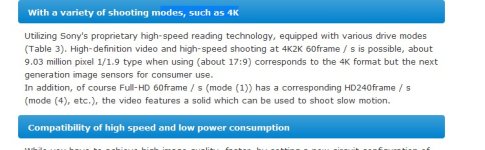
Yes, 4K will be coming soon to cheap p&s cameras.
Sony will want to sell their 4K TVs and Playstation 4 and Blue ray players. One way to do that is to bring 4K to consumer p&s cameras
Last edited:
joy new media
Active member
:facepalm:
4k video is only 8.4mp, so in theory its possible with pretty much any digicam sensor on the market right now - sensor resolution is not the issue - the issue is data processing and storage as the sheer size of the files are enormous - 4k eats up more than 1TB for each hour of video. Good luck finding a SD card with the write speed to handle that ... *hint* ... it doesn't exist. 4k is 4x larger than 1080p, which few P&S cameras do with any competence right now, and the best have issues with heat from the image data processors. My 5n and my wife's RX100 get awfully hot when recording 1080p video, they'd melt with 4k. The imaging power needed to process and compress 4k video is still years from making it to a P&S or any consumer level camera - if ever - because of the pipeline required to actually record and watch 4k video. Its a level of complexity P&S buyers aren't interested in, no to mention P&S sales are plunging because of cell phones. It'll be a sales gimmick with a price premium - like 3D. And it will fall just as flat.
So what if Sony is making the PS4 (with a vague coming in 2013 release date) 4k capable, that means nothing if consumers don't actually use that capability, and since there are no affordable 4k TV's and as it stands right now you can't even fit a 4k movie on a bluray - its still years off at the earliest - if ever. Sony is pushing the technology in a desperate effort to spurn sales from it TV/DVD division - which if you read its 10-Q report - is the arguably the worst performing division in the company. Its so bad there are whispers that Sony is close to shuttering its consumer TV division as it just can't sell TV's at a profit that compete with the best of the Koreans (Samsung) and the Chinese (LG). Its too soon for another wholesale TV/Bluray cycle upgrade on the mass consumer level. Sony finally realizes this - that's why imaging, mobile and gaming are the top priorities as Sony tries to slow the massive amount of red-ink its bleeding. Sony is already dropping its optical drive production because of losses - more will follow.
Another truly brilliant analysis. Sony should hire you to help with its turnaround. Feel free to continue to unsuccessfully prove me wrong, but I would read the 10-Q and shareholder reports first, as it tells you where Sony is putting its money and the direction its divisions are going in the future.
Last edited:
evilthought
Well-known member
:facepalm:
4k video is only 8.4mp, so in theory its possible with pretty much any digicam sensor on the market right now - sensor resolution is not the issue -
That's not true. The sensor has to have read out speed to handle 4K data. It's not true that any "sensor" can do 4K video. The older 1/1.17" CCD sensor certainly wasn't capable of doing 4K video. The newer one is.
As for storage and memory requirement, maybe you haven't read the memo that they are getting cheaper, larger, and faster ...
Another truly brilliant analysis.
That was not "analysis" from me. That was factual information on what is coming and where the market is moving in the next two years. As for whether it's good or bad marketing, no one cares about your "advice". That's not the topic. Why are you worried about Sony's fiances? Who appointed you for that role? That's not your business. Stick to the topic.
Last edited:
joy new media
Active member
Why are you worried about Sony's fiances? Who appointed you for that role? That's not your business. Stick to the topic.
What?!?!? Now that's funny, as a publicly traded company Sony's finances is my business - along with a few hundred thousand other shareholders - pure comedy, thanks for the laugh. That's the funniest thing I've read all day.
I'm out of this ridiculous thread, and hitting *ignore* with you.
Thanks again for the laugh.
evilthought
Well-known member
What?!?!? Now that's funny, as a publicly traded company Sony's finances is my business - along with a few hundred thousand other shareholders - pure comedy, thanks for the laugh..
Oh, so now you own Sony's shares and are worried about Sony's finances? LOL Hilarious. Even if true, if you are not happy, sell the shares and get on with your life, instead of whining about Sony's finances in this thread. That's not the topic in this thread. The topic is factual facts that 4K tvs and cameras are coming to consumer market, in a big way. That's the topic. Factual facts.
:facepalm:
4k video is only 8.4mp, so in theory its possible with pretty much any digicam sensor on the market right now - sensor resolution is not the issue - the issue is data processing and storage as the sheer size of the files are enormous - 4k eats up more than 1TB for each hour of video. Good luck finding a SD card with the write speed to handle that ... *hint* ... it doesn't exist.
If that was true, FullHD would eat at least 256GB (1/4th) for each hour of video, maybe it does in RAW but not with actual consumer cameras. In reality 1080p60 looks great on my camera at "up to" 28 Mbps, so 4K should do well in "up to" 4*28 = 112 Mbps meaning any UHS-I card (minimum 50MB/s = 400 Mbit/s) should be more than enough and a 64GB SDXC card you can get for $50 will give you 1.25 hours of video. Storage is not the problem, processing power is a challenge but not an impossible one. Already there's "pro" 4K video cameras for $5000 (JVC GY-HMQ10), I expect that in a year or two prosumer cameras in the $1000-1500 range will appear.
joy new media
Active member
If that was true, FullHD would eat at least 256GB (1/4th) for each hour of video, maybe it does in RAW but not with actual consumer cameras. In reality 1080p60 looks great on my camera at "up to" 28 Mbps, so 4K should do well in "up to" 4*28 = 112 Mbps meaning any UHS-I card (minimum 50MB/s = 400 Mbit/s) should be more than enough and a 64GB SDXC card you can get for $50 will give you 1.25 hours of video. Storage is not the problem, processing power is a challenge but not an impossible one. Already there's "pro" 4K video cameras for $5000 (JVC GY-HMQ10), I expect that in a year or two prosumer cameras in the $1000-1500 range will appear.
The JVC records 4 separate 1080p images to 4 separate cards, then you stitch it together in post, which can then only be seen on $25,000 TV's or projected ... hardly what I would call a mass consumer option. Sony hasn't even released the 4k option on the FS700 and now there are going to be $1000 4k cameras with no place to watch them, please. We're years from "affordable" 4k - if ever - but its not happening in 2013.
So you signed up for DVX user just to post in this thread? Sounds like the other idiot trying to get around my ignore list, and your logic is just as moronic. You've been ignored too.

MattDavis
Well-known member
Another take on this is that we've had a really good go at 3d TV. We've really tried. 3D cinema has established its self, but 3d TV isn't quite working out as we need glasses-free, we need good acceptance (some people find 3d uncomfortable), and we need high production values (3d is actually harder to do well than many think).
4K is a bit of an easier sell.
So we're transitioning to a 4k world where screens HAVE to be bigger to see the difference (most European screens in 2010/2011 don't see much difference between 720p and 1080p).
HD TV sets have been commoditised, and so how do we sell the high end? Promote the 'beyond HD' message - be ready for the next HD revolution. 4K is coming, 4K is coming.
Just keeps customer expectations churning. Meanwhile, the tail is only now catching up with 'digital' TV and 16:9.