Sony 8K coming in an A99 style body ?

joe1946

Veteran
Innovation never stops and 4K is just one step into the future. The camera you see on top is the Arri Alexa 65 which already records 6K. And how is Sony going to answer Arri’s move?
One of our sources told us Sony did show a new 8K camera prototype to the BBC studio. The source present at the event said the camera looked like the current Sony A99 but had a built-in vertical grip. Sony told them they could start to sell that kind of camera as early as 2016.
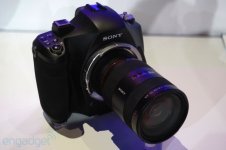
http://www.sonyalpharumors.com/sr4-...alike-cameras-to-be-released-in-2016-at-best/

Sony-Prototype-4K-DSLR-NAB-2013.jpg

Sony has put the A mount cameras on the back burner since coming out with the E mount full frame A7 series so I don't know how true this rumor is. I would think an FS7 upgrade in 2016 (FS8 ?) would make more sense than the A99 IMHO.
 
Last edited:
I think the reason why we will eventually see 8k cameras is not so much to display 8k but to have a perfect clean 4k video. As same rules that apply to converting 4k to HD for a quality boost also apply to converting 8k to 4k for a quality boost.

Single sensors are far from perfect when it comes to resolving detail and capturing true color detail. The best way around it is to shoot at 4x the resolution and down convert. This is where I could see a big use for 8k cameras. When we start getting into heavier 4k distribution on TV and in theaters.
 
In regards to 8K cameras, the Astro Design Cube prototype is already working, with production slated to start in 2016.

Or, for the serious pixel-peeper, the Forza 18k camera might be available, if one has the bucks.

By the way, in regards to available 6K cameras, the Alexa 65 is not the only offering -- the Red Epic Dragon has been available for about a year. Not sure on the Kinefinity.
 
8K will be marketed to photographers to video capture a picture and selecting a good frame. I don't think any one really wants 8k video any time soon.
 
I can't imagine what the rolling-shutter skew would look like. It's going to take a lot of processing power to handle 8K images.
 
I think the reason why we will eventually see 8k cameras is not so much to display 8k but to have a perfect clean 4k video. As same rules that apply to converting 4k to HD for a quality boost also apply to converting 8k to 4k for a quality boost.
Exactly so. Sensors have come a long way in a relatively short space of time, and likewise the in-camera processing with them. But optimisation for video/still use is still an issue.

I've long said that something along what you suggest goes a long way to answer that. Make the active sensor dimensions (2x3840)x(2x2160) and you have more than enough for totally uncompromised stills use (33.2 megapixel), yet can easily derive 4k with simple processing - each output pixel is a direct read from a 2x2 Bayer block. Similarly excellent 1080 by binning in 4x4 blocks - a block exactly corresponds to a 1080 pixel.

And such outputs will be full resolution, and "4:4:4" colour. The simple processing (no deBayering as such) should likewise mean not too bad rolling shutter. And simple processing should lessen processing requirements, and that should help heat/power issues as well.

Never say never, but I don't see any point in 8k video for anything other than very specialist applications (scientific, medical, military etc) for the foreseeable future - an 8k chip for uncompromised 8k stills, and uncompromised 4k video is a very different matter and makes me feel this rumour may have weight behind it - if simply because it would make huge sense from an engineering point of view. For similar reasons it also makes sense to see it in a body most associated with still photography.
 
Next Olympics in Japan 2020 (?) are slated for 8k live broadcast. So the push is on and it ain't going to go away.
 
Seriously? :shocked:
Absolutely - http://www.hdtvtest.co.uk/news/8k-olympics-201309133322.htm

It's NHK that are prime movers behind 8k, and with the Olympics in Japan the momentum must be there. There were 8k trials at the 2012 Olympics and the BBC had various demos at selected venues in the UK. It was certainly impressive - but I just wonder how much advantage there will really be for general broadcast, especially with 4k as a UHD alternative? (Even more so since most current 4k means a 4k chip - not full 4k resolution.)

Outside of Japan I think most people are even wondering whether 4k is justified most of the time over 1080 HD, but we'll see.
Is Japan's broadcast all 4K? It seems like it's completely different world if so. I'm just wondering how this all works when 4K TV's started shipping seriously only this year (not talking about super expensive models). Do Japanease brands have completely different line for domestic market?

Anyway, increasing resolution may sell for the last time with 4K. Why would you want 8K TV if you are not physically able to notice any difference from certain distance? Unless all TV's will just happen to have 8K. I think increase in bit depth is the way to go, where end customers will see a true difference.
 
Last edited:
I think increase in bit depth is the way to go, where end customers will see a true difference.
Even there the question has to be asked just how much real advantage there is in going above 8 bit. If you doubt it, try - http://www.xrite.com/online-color-test-challenge . And afterwards it's interesting to see how much difference (R,G,B values in bits) there is between blocks which seemed pretty similar to the eye.

By and large, 8 bit imaging is normally more than good enough for what the human eye can perceive. All too often, banding may be seen on an image and put down to bit depth issues when it's actually due to too high compression. When higher bit depths do come into their own is when manipulation is to be done on the image, and that's especially true when log profiles are involved. Even then a lot depends on a very noise free image.
 
Is Japan's broadcast all 4K? It seems like it's completely different world if so. I'm just wondering how this all works when 4K TV's started shipping seriously only this year (not talking about super expensive models). Do Japanease brands have completely different line for domestic market?

Anyway, increasing resolution may sell for the last time with 4K. Why would you want 8K TV if you are not physically able to notice any difference from certain distance? Unless all TV's will just happen to have 8K. I think increase in bit depth is the way to go, where end customers will see a true difference.

I don't know about TVs specifically, but they definitely have their own internal brands for laptops and other gadgets, things that aren't sold outside of Japan. There are even companies that have setup in order to specially ship these products outside of Japan (and China and South Korea).
 
Yeah, I don't see anyone actually receiving 8K broadcasts at home for many, many years.

That said, I definitely see 8K+ cameras becoming the norm for high-end productions. Downscaling to pristine 4K broadcasts and additional room for stabilization. I truly believe that 4K reaches the "good enough" category for pretty much any viewing scenario, be it at home or in theaters (other than perhaps IMAX-sized screens). But for acquisition, 8K and beyond can only help.
 
Is Japan's broadcast all 4K? It seems like it's completely different world if so. I'm just wondering how this all works when 4K TV's started shipping seriously only this year (not talking about super expensive models). Do Japanease brands have completely different line for domestic market?

Anyway, increasing resolution may sell for the last time with 4K. Why would you want 8K TV if you are not physically able to notice any difference from certain distance? Unless all TV's will just happen to have 8K. I think increase in bit depth is the way to go, where end customers will see a true difference.

Not broadcasting 4K yet, but it will surely come through NHK on some special programs as soon as next year. That was the vibe at the last Interbee.
Next month Interbee 2014 is on and i bet we'll learn more about that and also see more of 8k.

Olympics are such a big deal here, they are determined to break some tech boundaries.
After all 1964 Tokyo olympic was kind of the kickstarter of Japanese broadcast system in color and the first rush to buy TV sets.

(interesting read : http://www.nhk.or.jp/strl/aboutstrl/evolution-of-tv-en/p10/)
 
Ten years ago, Japan had 50Mbps connections for $35/month. Today, Sony has a subsidiary that sells 2Gbps-down/1Gbps-up connections for $50/month. So yes, it's dumb (I can't even see 4K with a normal-size TV), but they are going for it.

Now, 8K on such a small body, in two years? Maybe, but I wouldn't hold my breath.
 
I assume the file size of the videos will be huge for 8K video. Not sure I would have room on my home editing system.
 
Ten years ago, Japan had 50Mbps connections for $35/month. Today, Sony has a subsidiary that sells 2Gbps-down/1Gbps-up connections for $50/month. So yes, it's dumb (I can't even see 4K with a normal-size TV), but they are going for it.

Now, 8K on such a small body, in two years? Maybe, but I wouldn't hold my breath.

Ahah i hear you! I've been using a 1gbps/45$ month connection for couple years now, but there is no real practical use to it...

Maybe in a couple years we'll consider 8K as we do 4K until recently, it's going so fast
 
Could be something like Sony's response to the C-series from Canon.
That was probably FS7 (matched up against both C300 and C500)

I would assume that, when 8K comes out, it will be across the entire high end Sony lineup, perhaps even including an MDF tier camera to compete against Arri 6K. From a computational standpoint, Samsung NX1 is kind of, sort of getting there already with the simultaneous readout of their 27 MPX sensor and they're doing it inside a fairly small "DSLR style" body too. With the slew of the 14 nm (Intel) and 20 nm (ARM/Qualcomm) chips about to hit the market, the need to curtail the heat buildup will be lessened as well.
 
Back
Top