Sony 4K camera coming under $5,000 ?

Matt, how is the light sensitivity? Anything to be said that stands out? How does it compare to an EX-1 for light gathering? Thanks
 
I suspect that Sony's sensor spec of 8.3 million pixels from a total of 18.9 million is a typo. A total of 8.9 is more plausible and would be similar to JVC's 4K 1/2.3" sensor. Sony doesn't mention high resolution stills or electronic stabilization so why would they need an extra 10 million pixels?
No, don't think so - 3840x2160 is 8,294,400 which is pretty close to 8.3 million. :)

For the Z100 I think it's cinema 4k capable (not only quad-HD, as the lesser model) so that presumably uses 4096x2160 photosites in that mode - 8,847,360.

As far as why needing the extra 10 million, I commented in another thread is that my guess is that they wanted to use their existing 1/3" lens, and already had production of this 1/2.3" chip - put the two together and the lens covers the central area which is 3840x2160 as required. Quite a sensible use of using existing hardware to keep costs and development time down. Just my guess, but it would make sense.
 
I guess that three chip solutions aren't really needed these days?
They're definitely preferred. The standard has been three chips forever, for good reasons. The single chip in a broadcast camera is the odd duckling (Panasonic HPX600 and now Sony Z100 being the first examples I can think of).

I suspect that Sony's sensor spec of 8.3 million pixels from a total of 18.9 million is a typo. A total of 8.9 is more plausible and would be similar to JVC's 4K 1/2.3" sensor. Sony doesn't mention high resolution stills or electronic stabilization so why would they need an extra 10 million pixels?
I don't think it's a typo at all. I think it's Sony repurposing an existing sensor; they may have already had this 1/2.3" sensor used in something else, and figured "hey, if we throw away the sides and just focus on the center 1/3", we could get 4K video out of this"...
 
As far as why needing the extra 10 million, I commented in another thread is that my guess is that they wanted to use their existing 1/3" lens, and already had production of this 1/2.3" chip - put the two together and the lens covers the central area which is 3840x2160 as required. Quite a sensible use of using existing hardware to keep costs and development time down. Just my guess, but it would make sense.
Agreed that this is probably exactly what drove their decision-making process. It seems obvious.
 
I just checked JVC's HMQ10 manual for their sensor spec:

1/2.3" 12,760,000 pixels (CMOS)

I wonder how the two cameras compare with respect to dynamic range?

If Sony's sensor has so many spare pixels, they should add electronic stabilization to their optical stabilization. My Panasonic Z10000 3D camera does this in 2D mode and not only improves stability in the usual pitch and yaw axis, but also adds roll stability.

David
 
It's not that the Sony has "spare" pixels, it's that it simply ignores about half of the chip. It is, for all intents and purposes, a 1/3" chip. The field of view of what it sees from the lens, is that of a 1/3" chip camera. They can't use those spare pixels, because as far as the Sony processing is concerned, it wouldn't even know they exist.
 
Matt, how is the light sensitivity? Anything to be said that stands out? How does it compare to an EX-1 for light gathering? Thanks

With the usual caveat that my loaner is not the final machine, and the picture quality isn't up for discussion, I noted that it was about a stop down on my EX1. Now, whether one can chuck in 6dB of gain to bring it back, without too much of a noise penalty, is yet to be seen.

BTW - 3x NDs - 2, 4 and 6 stops.

BTW2 - There's an OIS setting for 'Wide' so I assume there will be a bayonet-fit wide-angle adaptor sometime soon (if not already with the NX5 Wide Angle Conversion Kit & Matte Box)
 
My Sony HX30VB has interestingly a 1/2.3 sensor with 18.9MP takes lovely video 1920x1080 at 60P and stills 16x9 ( 4896x2752 ). In good light easy matches my other HD cameras, suffers a little compared to CX700 or NX30U in low light but of course has a tiny 20x zoom lens. Has optical image stabilization as well as the Active EIS. It has been my understanding for a long time that ALL the picture elements for Sony Exmor are interpolated by the processor from the sensor array. None are exactly 1:1 aligned with the sensor array in location and/or size as the sensor array elements are either smaller or larger than the resulting pixels for still or video. The HX30VB will take still while shooting video so there is no optical changes and must be electronic processing to get video and stills from the same sensor at the same time. Not enough processing power to get 60P and stills but 60i and stills is fine. I expect to do 60P and stills might drain the battery quick and make it too hot to hold !!!! The lens in this new camera certainly looks like my NX5U so could be the same with a 4K LP filter. The ultimate target for the NX5U lens was 3x 1/3 sensors but the lens target was the splitter prism not the sensors though ! We will have to await more information.
 
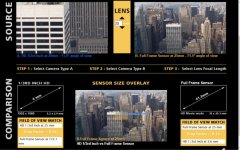
The Sony FDR-AX1 has a 4.1 - 82 mm 20x zoom that is a 35mm full frame equivalent focal length of 31.5 - 630 mm so Barry is correct in that it's like a 1/3" chip.

9694428165_f9d43d66c0_b.jpg
 
Of interest I am sure is that one set of Sony specs ( Global information)for the FDR-AX1 quotes 31.5 to 630 and another 29.5 to 590 ( US Sony site ) !!

Ron Evans
 
Back
Top