GH4 Shutter angle instead of shutter speed. Life changing!

There's a huge difference between film and digital. In film the frame is only shown for part of the time. The other part is black space when the film is moved and the disk blurs over the film.

With digital media, the frame is shown for the full 1/frame rate duration with no black space. In 24p you get 24 frames shown for the full 1/24th of a second each. In 30p you get each frame for the full 1/30th of a second. With film there is a black space between frames and each frame is not seen for the full 1/24th of a second.

This is why 30p (not 60i) footage looks more like film when shot at 1/50 or 1/40th of a second shutter. Film at 24p is actually only shown for a little over 1/30th of a second per frame. The lack of black space between frames is a major contributing factor as to why digital systems are so much more light sensitive than film as well.

Cheers,
Pete
 
Is there a way to lock the dial so you don't accidentally knock the setting out its 180 degree sweet spot?

You can assign the GH4 rear dial to adjust the F stop (aperture) and the front dial to shutter speed in the menus. I'm less annoyed about accidentally changing the aperture of the lens than shooting with the wrong shutter speed! I followed this handy guide: http://suggestionofmotion.com/blog/panasonic-gh4-setup-quick-start/

Scroll down to page 7 of the custom menu in the article.
 
Last edited:
In film the frame is only shown for part of the time. The other part is black space when the film is moved and the disk blurs over the film.


Boy, doesn't THAT sound archaic and inefficient! Hopefully someday someone will come up with something that is better than that..... ... oh wait. :D
Now, if we would just learn to accept the improvement....
 
Now, if we would just learn to accept the improvement....

Well, I have...

Throughout "film" history attempts to improve sharpness and detail rendition took place. VistaVision, Panavision, and other formats involved larger negative/frame sizes to get there just as sheet film sizes, and medium format rollfilm sizes used larger negatives than 35mm film to improve detail rendition with still photography.

24fps was accepted as a frame rate standard (along with 1/48th second shutter speed) through much of film history, but most modern (film) projection equipment began projecting each frame twice to reduce the "flicker" some folks could percieve at 24fps, so now we really were viewing 48fps which smoothed things out quite a bit.

Now with film in motion pictures almost dead we have digital acquisition and digital projection changing things some. For myself, always having been a "sharpness nut", I like and appreciate the improvements.
 
There's a huge difference between film and digital. In film the frame is only shown for part of the time. The other part is black space when the film is moved and the disk blurs over the film.

With digital media, the frame is shown for the full 1/frame rate duration with no black space. In 24p you get 24 frames shown for the full 1/24th of a second each. In 30p you get each frame for the full 1/30th of a second. With film there is a black space between frames and each frame is not seen for the full 1/24th of a second.

This is why 30p (not 60i) footage looks more like film when shot at 1/50 or 1/40th of a second shutter. Film at 24p is actually only shown for a little over 1/30th of a second per frame. The lack of black space between frames is a major contributing factor as to why digital systems are so much more light sensitive than film as well.

Cheers,
Pete

So you're saying that the difference between classic mechanical film projection and digital projection/display affects how the eye perceives the motion blur in each frame? Interesting. I would think that the gap between frames would just affect the perceived brightness of the image.

And don't most modern film projectors run at 48fps anyways (showing each frame twice)? Are there any digital projectors that mimic the pause between frames?

And what about monitors/TV's, and refresh rates? I have my monitors set to 72hz, as that's about as fast as they'll go, and it seems to be the best compromise between displaying 24p, 30p, and 60p files smoothly (ideally I would like to get 120hz monitors next). I do definitely notice a more skippy/jittery look when I watch 24p files with the monitors at 60hz, I'm guessing just because of the uneven pull down conversion.

Do you think setting a computer to run at, say, 48hz, but display a black frame between each frame of a 24p file, would mimic a classic film projector?
 
Last edited:
And don't most modern film projectors run at 48fps anyways (showing each frame twice)? Are there any digital projectors that mimic the pause between frames?
Modern film projectors most definitely don't run at 48fps (or 72fps), they run at 24 fps. They utilize a two-bladed or three-bladed shutter, which flashes each frame twice (or three times), but the film is held in place while that shutter flashes it. So you get 24fps motion rendition.

The multi-bladed shutter has nothing to do with motion rendition. It's designed to minimize flicker. A single-bladed projector would show the film for almost 1/24th of a second, and then briefly black out while the film was advanced. That causes a very noticeable and distracting flicker. A three-bladed shutter blacks the film out three times for every frame, making for a higher frequency of light/dark transitions, thus smoothing out the flicker. But again, this has nothing whatsoever to do with motion rendition.
 
I remember using a 5 blade shutter for telecine work before I got my scanner.

I know people are bitching and moaning, but I'm so glad I don't have to work with film anymore.
 
What I find Wheird is that Nolan films Interstellar in IMAX.... "IMAX" for crying out loud! Best detail in film ever... ... because, well maybe there IS more detail in it?? Yet film people claim digital is TOO CLEAR and DETAILED.... ...just like Nolan is filming with IMAX: clear detail? Am I missing something here?

I even read a long technical article about HOW the film shutter deal "Sweeps" across the film with a slight angle, creating a curve of light when writing light to the film, and similar during playback.... why are we analyzing such old techniques anyway? Time to move on: higher frames per second, BETTER detail, easier everything, there is no down side!

back to shutters and angle and speeds.... does anyone know if the DEGREES relates back to the available shutter SPEEDS? Like, Shutter Speeds are 30 40 50 60... so at 180, is it REALLY 48 instead of 50 speed when shooting 24p?
 
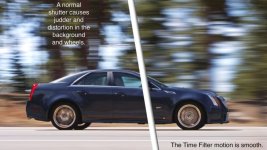
One of the most straight forward explanations of why the motion blur created by the digital shutters in today's cameras don't look like filmic motion blur, even when using the same shutter speed, came from this company, Tessive that made a $14,000 adapter to put on your camera to give it a more film-like blur. Here's a graphic that very simply explains the difference between a normal electronic shutter and their adapter (which very closely mimics film):
CGE11Tessive.png

About 2/3 the way down this page there is a very good writeup of the technology by a guy who attended Cine Gear Expo LA 2011 where they first showed off their device.

Here is a good example image from their website of the difference. It's plain to see. Also, if you go to their website and view some of their example footage, you can really see the difference.
static.squarespace.com.jpg
And an example video:
You watch the stuff with their filter and it just looks much more film-like in its motion. I'll never (well, maybe I should never say never) be able to justify buying one of these, but the results are hard to argue with, and I would expect that as camera technology continues to get better, and the Sony A7s can get such a light sensitive 4K sensor without noise, that this will be a logical next step for professional cinema cameras to incorporate into their designs.

Back to the discussion of shutter angles/speeds, many who say that a slightly slower shutter speed gives better motion are in many instances correct, as a little more blur better hides the harshness of electronic shutter motion blur. Of course other times with lots of motion in the whole scene, it just makes everything too blury. But the ultimate conclusion is that we won't be able to get motion blur that looks just like film without a ramping shuttter. The good news is, if we're really careful, we can fake it well enough that no one will ever notice exept us.
 
Last edited:
I'll lower my shutter speed (or widen my "angle") and save $14,000 thank you! :D
Interesting stuff. Or we can simply accept the newer look of stuff.

if you pause the above video in both choices, you can easily see that the time filter one has more blur in the moving parts than the non filtered one. Maybe it does a lot more for $14,000 but yea, regular folk aren't going to notice, and I can get $7,000 closer with lower shutter speed. :)
 
So am I using 180 degree shutter or shutter speed?? Lol
"Natural" motion blur, 180 degree shutter angle, or 1/48 of a second for 24 fps, is said to be about the same amount of motion blur as the human eye sees, and is in part why mechanical shutters on old film cameras used 180 degrees of the shutter wheel to expose. They could have used more to get more light I to the camera, or less to reduce motion blur, but 180 degrees was the consensus for the sweet spot.

if you're shooting 60p that you will be slowing down to 24p and you want it to have the correct 180 degree type motion blur when you slow it down, you use a shutter speed of 120, but your shutter angle would remain 180 degrees (open for half the duration of the frame.)
 
"Natural" motion blur, 180 degree shutter angle, or 1/48 of a second for 24 fps, is said to be about the same amount of motion blur as the human eye sees, and is in part why mechanical shutters on old film cameras used 180 degrees of the shutter wheel to expose. They could have used more to get more light I to the camera, or less to reduce motion blur, but 180 degrees was the consensus for the sweet spot.

I'm sorry but this is not true at all. First of all, 24fps was an arbitrary frame rate that was standardized when talking pictures arrived in the late 1920's. It was the slowest (and therefore least expensive) frame rate that could still have good sound on the optical stripe running down the edge of the film print.
A 180 degree shutter was not designed for the aesthetic of motion blur, it was an engineering requirement of how mechanical shutters and film cameras worked. The shutter HAS to be closed for at least HALF the duration of a frame so that the next frame of film can be advanced and locked into place in front of the lens.
I'm a huge fan of 24fps and 1/48th motion blur, but let's not mislead people into thinking it was invented because it looks how the human eye perceives motion and motion blur, because it certainly doesn't.
 
"The human eye and its brain interface, the human visual system, can process 10 to 12 separate images per second, perceiving them individually.[SUP][1][/SUP] The threshold of human visual perception varies depending on what is being measured. When looking at a lighted display, people begin to notice a brief interruption of darkness if it is about 16 milliseconds or longer.[SUP][2][/SUP]Observers can recall one specific image in an unbroken series of different images, each of which lasts as little as 13 milliseconds.[SUP][3][/SUP] When given very short single-millisecond visual stimulus people report a duration of between 100 ms and 400 ms due to persistence of vision in the visual cortex. This may cause images perceived in this duration to appear as one stimulus, such as a 10 ms green flash of light immediately followed by a 10 ms red flash of light perceived as a single yellow flash of light.[SUP][4][/SUP] Persistence of vision may also create an illusion of continuity, allowing a sequence of still images to give the impression of motion.
Early silent films had stated frame rates anywhere from 16 to 24 FPS,[SUP][5][/SUP] but since the cameras were hand-cranked, the rate often changed during the scene to fit the mood. Projectionists could also change the frame rate in the theater by adjusting a rheostat controlling the voltage powering the film-carrying mechanism in the projector.[SUP][6][/SUP] Silent films were often intended to be shown at higher frame rates than those used during filming.[SUP][7][/SUP] These frame rates were enough for the sense of motion, but it was perceived as jerky motion. By using projectors with dual- and triple-blade shutters, the rate was multiplied two or three times as seen by the audience. Thomas Edison said that 46 frames per second was the minimum need by the visual cortex: "Anything less will strain the eye."[SUP][8][/SUP][SUP][9][/SUP] In the mid to late 1920s, the frame rate for silent films increased to between 20 and 26 FPS.[SUP][8][/SUP]
When sound film was introduced in 1926, variations in film speed were no longer tolerated as the human ear is more sensitive to changes in audio frequency. Many theaters had shown silent films at 22 to 26 FPS which is why 24 FPS was chosen for sound. From 1927 to 1930, as various studios updated equipment, the rate of 24 FPS became standard for 35 mm sound film.[SUP][1][/SUP] At 24 FPS the film travels through the projector at a rate of 456 millimetres (18.0 in) per second. This allowed for simple two-blade shutters to give a projected series of images at 48 per second, satisfying Edison's recommendation. Many modern 35 mm film projectors use three-blade shutters to give 72 images per second—each frame is flashed on screen three times.[SUP][8]"

http://en.m.wikipedia.org/wiki/Frame_rate
[/SUP]
 
Good info ya'll.

While I try not to think of wikipedia as an "authority" on anything, this seems like pretty legit info.

But regardless of the reason for why 24fps @ 180 degree shutter angle, I find it does actually resemble the blur we see when looking at fast moving objects with our eyes. And in this case, adds to the cinematic quality of the image.

While our eyes can fire up to 1,000 distinct signals to our brains every second, at a velocity of 200 miles per hour, I believe that sitting in the dark for almost two thirds of a film is a key component to the suspension of disbelief associated with the "cinematic" feel. With higher frame-rates, we get more information from the "scene", and thus, are better able to see the artificiality of the props, the acting, etc... The less of the "scene" we see, a-la-24fps, the less we pick up on the artificiality of sets and the actors on the screen. That's why, for example, acting for 60I is nearly impossible to do convincingly, while acting for 24p can be magical. I guess the point is that more reality isn't always more better...haha.

I know that's a little off topic, but just to complement the shutter angle discussion and the way our eyes see.
 
This discussion makes it sound like we should shoot at 48P, with a 1/48 or (1/50) shutter, and then use software to replace every second frame with black ...
 
Back
Top