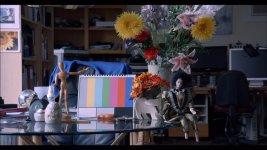
Screens on the Odyssey 7Q in action

We see high dynamic range footage squeezed into REC709 all the time on TV. It's a creative decision as to how you bend the range into the more limited 709 standards. You can crush/clip the top or bottom to preserve more detail in the mids or you can roll off the highlights and shadows to compression. Same as audio compression. For monitoring purposes what the 7Q is offering probably makes more sense. But for deliverables you'd need to be making those kind of decisions on a scene by scene basis.

A LUT is a simple look up table between source value and destination value. A 3D LUT is more complicated because it can look data up differently depending on colour values too.

A LUT could solarise an image if needs be, or be a steep gamma adjustment, or roll off the top and bottom differently - the beauty is that it's not a curve or mathematical adjustment.

I guess a relevant question would be does the O7Q support user defined LUTS for monitoring? That would be neat!

cheers
Paul
 
Look at film, 16 stops and it doesnt look at all grey or washed out when exposed normally.

Film negatives have 16 stops and they do look washed out until you process them. They have low contrast and high DR so you have room for colour correction (timing) when transferring onto film positives which are high contrast and have low DR (about 8 stops I think) - although film has a lot of extra hidden DR in the top end due to its chemical nature - but these are gravy stops that give nice highlight roll-off, you can't rely on them for retaining key detail. The point is that not all of the negative DR is retained in the film positive on transfer.

You can't magically cram 16 stops (or 12) into a display medium that only displays 7 without making some form of sacrifice - which usually means dramatically lowering the contrast (and hence losing some of the detail) in some area of the image: shadows and/or highlights. Which is what all the various gammas do - but the more you're trying to cram in to a limited data range the more you're going to have to lose detail in key areas (which is why slog2 is a bit risky in 8 bit!).

Rec 709 is a display standard, albeit one that nobody seems to use for displays anymore, but it is useful to check how the key mid-range data will look once processed. It's not for use as a strict recording medium anymore, but as a reference that most professional users are familiar with and understand.

What you want is a setting that retains as much of the native DR, but still looks good (a high contrast mid-range with nice roll-off in the shadows and highlights). Some improved version of the cinemagammas we've all been using for a while.

As I understand it, these are coming down the line, as is the ability to load user defined LUTs (at least I seem to recall this being on the road map) - although Mitch can confirm/deny this. But at present there's two options: SLog2, to retain the data, and Rec709 to stop the client freaking out.
.
 
So do you believe we should be clipping out our DR in anticipation of low contrast displays? Or are you just trying to poke holes in my film comparison? Nowadays it's more common to scan film negatives and grade the way you want from there without losing any highlight or shadow detail like your link illustrates, but there is no reason to clip out detail. Yes increasing contrast can require compressing the ends of the range with something like an S-Curve, but it's hardly necessary to clip the image to make it look right on any display.

If display contrast is so important shouldn't we be releasing differently graded versions for LEDs and OLEDs? Wouldn't all our content look wrong on one if it looks right on the other? I'm not saying you can non-destructively increase contrast without altering the gamma of different parts of the image, I'm just saying there is no reason to ever use a workflow where any part of monitoring or recording or grading it clips your images and that clipping will always be undesirable compared to compressing the ends of the range. There is no reason to use a LUT that clips if there is one that does not. Perhaps someone can refute that point and I'd be interested to hear it.
As I understand it, these are coming down the line, as is the ability to load user defined LUTs (at least I seem to recall this being on the road map) - although Mitch can confirm/deny this. But at present there's two options: SLog2, to retain the data, and Rec709 to stop the client freaking out.
.

I'm not sure, I think a REC709 LUT that clips a lot of the cinema cameras range to make it look like a broadcast camera is more likely to freak a client out than a flat wide DR image.

One thing I'd love to do is create a few different curves that allow you to change the highlight/shadow range and ISO of the camera without changing hardware gain like RED and Alexa do. Different lighting situations call for different midtone values and highlight ranges, and it is more powerful to be able disconnect your white clip point from your midtone values so you can both expose to use the full range of the sensor and also place your midtones where you want them.
 
Last edited:
In 'high end' digital (I would say all properly prepared) production one will often use secondaries to 'dodge and burn' the image to keep range and contrast in the range of the output device, and yes we should prepare different files depending on the final viewing device - I believe that ACES is all about grading on a wide gamut device and then outputting transformed versions ready for less able devices.

In terms on monitoring on set really a log and a couple of S curve LUTs is, I am sure, quite adequate..

S
 
I believe that ACES is all about grading on a wide gamut device and then outputting transformed versions ready for less able devices.

Right and I doubt those transforms ever involve clipping out the highlights of your images to suit REC709 devices...
 
So do you believe we should be clipping out our DR in anticipation of low contrast displays? Or are you just trying to poke holes in my film comparison? Nowadays it's more common to scan film negatives and grade the way you want from there without losing any highlight or shadow detail like your link illustrates, but there is no reason to clip out detail. Yes increasing contrast can require compressing the ends of the range with something like an S-Curve, but it's hardly necessary to clip the image to make it look right on any display.


If display contrast is so important shouldn't we be releasing differently graded versions for LEDs and OLEDs? Wouldn't all our content look wrong on one if it looks right on the other? I'm not saying you can non-destructively increase contrast without altering the gamma of different parts of the image, I'm just saying there is no reason to ever use a workflow where any part of monitoring or recording or grading it clips your images and that clipping will always be undesirable compared to compressing the ends of the range. There is no reason to use a LUT that clips if there is one that does not. Perhaps someone can refute that point and I'd be interested to hear it.


I'm not sure, I think a REC709 LUT that clips a lot of the cinema cameras range to make it look like a broadcast camera is more likely to freak a client out than a flat wide DR image.


I was poking holes in your film comparison a little, yes. I'm aware that current film workflows involve a film scan for grading and output to digital or print - often retaining as much of that range as possible (which involves a fair bit of post effort).


But mostly I was trying to provide an explanation as to why they included a Rec709 LUT: the unit is recording Raw, since you can't view that you need to use some form of LUT to monitor it on set.


Slog2 and Rec709 makes sense as you have Slog2 to check clipping and Rec709 to get an idea of what it will look like once graded. These aren't recording LUTs, they're monitoring LUTs.


And no, plenty of clients will be freaked out more by flat images than clipped images since they don't notice the clipping but do notice that everything looks flat and grey - when they want to see bright and crisp. But if you're worried about either you can flip the LUTs and show them the other one, since they're not being recorded...
 
But mostly I was trying to provide an explanation as to why they included a Rec709 LUT: the unit is recording Raw, since you can't view that you need to use some form of LUT to monitor it on set.

Right but my only point is that there is no reason a REC709 LUT should clip your image and my only question was why it should, and so far I haven't really heard any compelling arguments for monitoring or recording with clipped highlights that don't have to be clipped.
 
Last edited:
Right and I doubt those transforms ever involve clipping out the highlights of your images to suit REC709 devices...

Not at all, it is a transform, let us say a device can only hit 100/110 then it is simple maths to multiply brightness levels by 100/110 and 'legalise' the file (reduce overall contrast).

No doubt doing this intelligently is as skilled as preparing a musical mix for the i-phone generation (being that the sound need a different mix from a studio audio set up) and may indeed involve a little clipping if that is an intelligent trade off

S
 
..so far I haven't really heard any compelling arguments for monitoring or recording with clipped highlights that don't have to be clipped.

You are technically correct, you could compress highlights rather than clipping them. With a wide DR camera it kind of boils down to the same thing because the compression will be so hard as to render the visual information farily meaining less.

This is of course assuming that the bulk of the data range is ramped up to show the director a sparkly punchy image.

You gotta trade off punch vs DR displayed. But you are right there is no need to actually clip given an appropriate Scurve

S
 
Right but my only point is that there is no reason a REC709 LUT should clip your image and my only question was why it should, and so far I haven't really heard any compelling arguments for monitoring or recording with clipped highlights that don't have to be clipped.

Because then it wouldn't be Rec709, it'd be something else calling itself Rec 709. Rec 709 is a defined standard with defined rules regarding gamma, middle grey and clip points. If you alter those then you're defeating the point of using it is no longer comparable with the Rec709 images belted out by other devices and people who are used to looking at Rec709 images and understanding what they are telling them will no longer have a sense of what the image is telling them.
 
I understand that the LUT currently used by the 7Q is provided from Sony specifically for the Slog 2 in the FS 700 PP 7.

There will in the future be more choices.

LUTs are really just to make it easier to work in the field, to give a punchier look than log as mentioned above. And this is a work in progress.

Before LUTs I often had a field monitor, the old cathode ray 5" Sony, I cranked up the sat and contrast and adjusted the brightness so field producers could get an idea of what the shot would finally look like. LUTs now do that at the touch of a button (I mean screen).
 
Because then it wouldn't be Rec709, it'd be something else calling itself Rec 709. Rec 709 is a defined standard with defined rules regarding gamma, middle grey and clip points. If you alter those then you're defeating the point of using it is no longer comparable with the Rec709 images belted out by other devices and people who are used to looking at Rec709 images and understanding what they are telling them will no longer have a sense of what the image is telling them.

Right, though most "REC709" gamma curves are not real REC709, and real REC709 has almost no value I can imagine in the modern world, but perhaps you can enlighten me to its value besides that it exists? Does using a REC709 gamma that follows the real REC709 spec for luminance and contrast have any value you can think of over something like the REC709 gamma curve the alexa uses?

What REC709 LUT does the 7Q currently have? Does it go from SLOG2 to REC709800? Or is it one of those LUTs Sony released this year like the REC709 Type A, or something else CD designed themselves?

It has a value as a known quantity. As a standard people are used to seeing. As to whether or not it is a genuine Rec709 I've no idea. Although none of the Rec709 variants I know of show the 12-13 stop range that the camera can produce (including the 800% Rec709) so any form of it would show clipping, even if it is an 'extended Rec709' of some sort.
 
The Alexa LUT obviously produces something you like. Not surprising Arri do good stuff and make very intelligent compromises.

I doubt the O7 lut will be that different - so it is nothing to jump up and down about.

Overall screens shot 256 levels and cameras (10bit) record 1064 levels, it is simple to see that showing 1064 on 256 is going to involve some compromise.

A straight 1:4 looks like log, other things look different.

S
 
OK, where to start?

The LUT provided in the Odyssey7Q when viewing RAW is the transform from S-Log2 to REC709. It is the one Sony uses internally in the FS700. If you have the camera set to REC709 video and record a shot and then set up to RAW with S-Log2 then with our LUT it will look identical. This LUT is supplied to us directly from Sony.

REC709 is a standard, one to which I would hazard the guess to say that Sony has produced more products and shipped units of said products confoming to this precise standard than any other company in the world. It's Sony. There are plenty of REC709-compliant images and there are various looks and adjustments one can do on any Sony camera, but if you hit reset and go to the factory-standard, that is the defined parameter for REC709. A defined parameter is important in the broadcast world as it is used between various machines, when mixing multiple cameras, when tuning monitors, signal carriers, waveforms & vectorscopes, and a host of other gear. If they are all se to the same standard then there are no surprises and the machines can all intermingle (well there are other pitfalls, but at least this part works well).

The ALEXA's REC709 is really REC709-compliant, and not an accurate rendition of the standard. Of course ARRI doesn't care about broadcast intermingling in that way so they don't care and I can hardly blame them. But nonetheless it is not a true REC709. When I was at AbelCine and a we delivered some of the first ALEXAs, a broadcast rentalhouse client called up frantic because their brand new ALEXA didn't match their other cameras. How were they going to intermix the cameras? That's what they were used to doing every day. The simple answer was don't intermix them, why would you? It did the trick and they changed their minds about returning the camera.

BTW, I don't know how you can say that the ALEXA has the same dynamic range in LogC or in REC709. Sure they roll off highlights and squeeze in some extra on the toe, but it is not even close. I used to teach the ALEXA class and demonstrate how the Log worked and what the advantages were, and the differences are night and day. One thing ARRI does decidedly different than Sony besides just the gamma curve is the saturation. ARRI emulates film by desaturating the image towards white as it overexposes, while Sony increases saturation. Something clipping in white just looks overexposed, but something clipping in color look like classic video clipping, which it is.

Anyway, the included LUT is there for reference as it is the same standard one that is in the camera. We use ARRI's LUT for ARRIRAW from the ALEXA and we use Canon's LUT for the C500 RAW. It is a simple comparative tool, as I would venture to say that you would be very confused and annoyed if the image on your camera's monitor completely mismatched what you saw on the Odyssey7Q.

Coming in the future we will have programmable LUTs. We'll start with the ASC CDL system as it is the most straightforward to implement and is consistent throughout the industry.
 
Here is a Resolve graded version of the scene from the 2K raw in a 1080 timeline.

ResolveGraded2KRAVasPRHQ.jpg
 
The more stops of DR you cram into REC709, the more washed out the image will look. If you want to see "normal" contrast with high dynamic range you'll need a camera that supports REC2020.
 
Back
Top