Roth IRA - A Really Stupid Idea

Imagine your over 65, on Medicare, not making car payments, mortgage is paid, all debts are paid, are not paying social security nor disability nor any other payroll tax, not making contributions to your retirement fund, collecting social security.

hqdefault.jpg

I agree, it sounds nice.

You can have several tens of thousands of income over $25,000 and not pay a dime of tax

And you lost me again.
 
Every type of financial service is itself a business, and all financial advice regarding that service is marketing material for that business. The "advice" you read is marketing material, sales material, and propaganda. In order to understand what you should do with your money, you need to read the contracts and the law yourself in order to make the most informed decision.

Regarding IRAs, I know that one of the big issues is that we cannot predict what is going to happen to the tax code in the future. Deciding on which type of retirement account to start has a lot to do with what you think is going to happen politically regarding tax law. For that reason, any time you receive investment advice (which is itself marketing material), it will usually begin with propaganda stating that taxes are either going to go up or go down over the next few decades, which will inevitably lead to making it sound like you're incentivized to start the type of retirement account that those people are selling.
 
I reckon it depends on one's deductions and other tax credits.

Yeah can Paul explain this, please. "Magic happens" isn't cutting it for those of us at the back of the class.

As for my Roth pun, I have a -- just kidding, I don't have an IRA.
 
The advisors I have talked to work for firms that offer both Traditional and Roth accounts . None of them pushed me to one or the other. In fact, one of them advised to go half and half, to hedge my bet.

From what I have read there is not a huge difference in the outcome. But apparently the Roth IRA will be better for you unless you are more disciplined. "To come out even in terms of after-tax savings, you have to be disciplined enough to invest the traditional IRA tax savings you get every year back into your retirement savings. If that seems unlikely to happen, then you’d be better off saving in a Roth, where you’ll arrive at retirement with more after-tax savings." --- https://www.nerdwallet.com/article/investing/roth-or-traditional-ira-account

I appreciate Paul F's take on it. It didn't occur to me that with various tax breaks you might not pay any tax in retirement anyway. Like ahalpert, I'm curious more about how you pay 0% tax on "several tens of thousands of dollars over $25,000". I just learned there is another $6,500 tax credit for couples over 65. But there's still a ways more to go. I don't need to know right now, if it's getting personal. But hey, you started this thread :)
 
It didn't occur to me that with various tax breaks you might not pay any tax in retirement anyway.

Here’s one scenario…

Let’s say you hold a portfolio of stocks worth about $2M dollars. You’ve owned those stocks for over a year, and they pay dividends from U.S. based companies that averages 4% per year. If you have no other taxable income, your $80,000 of (what are called “qualified”) dividends are yours tax free (assuming you’re married and filing jointly).

I use these amounts because $80,000 is the cut-off point for the 0% tax rate on qualified dividends. If you make a dollar more than that, you bump up into a 15% tax bracket.

Just an example for you.
 
Ok, I'm trying to relay information without publishing my 1040 form. My return is so simple. Follow along on your 1040 form and I'll tell you how you can have tens of thousands of income over $25,000 and not pay taxes.

Line 1 Wages - $0
Line 2b Interest - Some number under $50 because banks aren't paying anything and all my real money is in IRAs.
Line 3b Dividends - $0. All my investments are in IRAs
Line 4b IRA distribution - Lets say $21,400
Line 5b Pension - $0
Line 6B Taxable Social security - Here's where the magic is - Let's put in $6000 because the vast majority of social security income is non-taxable.
Line 9 - Total income - add all the lines above and you get $27,400
Line 11 AGI - $27,400
Line 12 Standard deduction - $27,400 for two seniors
Line 15 - taxable income, - $0
Lent 16 - Tax, - $0

To clarify line 6b, one can have a lot of social security that is not taxable. Between the IRA and the social security, one can have an income of just under $70,000 and not pay a dime of taxes. Tax free IRA withdrawal. Nice!

Yes, when it comes to me having to withdraw the minimum mandatory withdrawal, I will be paying tax on it. But the tax rate certainly will be no higher than when I was making contributions because my income now is lower than when I was working. Roths are for those that will have an income higher in retirement (adjusted for inflation). Nerdwallet published a table that shows this. The traditional IRA is the right choice if you will have less income in retirement (adjusted for inflation) than when you were working. That is a very simple guideline to follow.

I guess I'm full of beans about this because a friend had been bugging me for years that a Roth was the right way to go and I did not agree. I expected to pay tax on my traditional IRA. That was ok. But when I paid nothing, well, it was a bit of a kick to see $0 on line 16.
 
Last edited:
Thanks, and one more thing: what is your social security number?

the vast majority of social security income is non-taxable

That's what I was missing. Actually, it had crossed my mind early in the thread, but then flitted out of my mind, like so many things these days (sigh).

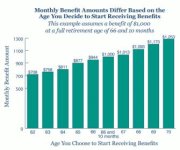
My free retirement advice is this (which I just learned from a class my work was offering): The age that you start taking social security affects the amount by a lot.

ss.jpg

You can log into the Social Security Administration's website, and it can tell you exactly what to expect, and at what age (because the law slowly changes based on your birth year. So don't look too closely at that chart.)

Also, compound interest is your friend, https://www.investor.gov/financial-tools-calculators/calculators/compound-interest-calculator (This is all words, because I could not save a dime until I quit video production and got a job at a corporation. I applaud all of you who were disciplined enough to run your own business and not only make a living but actually have some extra for savings!)
 
It sounds like the real magic comes from having low income. That's how I avoided paying taxes for years when I first started out!

And social security. But I'm confused - isn't half of your social security payment taxed even if you're in the bottom tax bracket for social security? Or maybe you're not taxed if you're below that, but then how do you get to $70k/year?
 
FWIW, if one resides abroad, then the first $110,000 in income is non-taxed. Double that for married filing separately.
 
But I'm confused - isn't half of your social security payment taxed even if you're in the bottom tax bracket for social security?

No. The vast majority of my social security is non-taxable and I am pretty close to the max payment. Again, there's just so much bad information out there. I highly recommend everyone does the exercise of pretending they are retired and fill out a tax return and see what happens.

Everyone gets a social security income estimate from the IRS, yes? Take that estimate and fill out the social security worksheet and see what happens.

My free retirement advice is this (which I just learned from a class my work was offering): The age that you start taking social security affects the amount by a lot.

This is true, but also misleading. Yes, if you start to take it before your full retirement age, you will pay a significant penalty in reduced payments. But once you are at full retirement age, there is no advantage to delaying payout. Over time, the total amount you get paid is the same. While the payments are higher, you don't get anymore total money. I've run the spreadsheets. I took it early, retired early, had fun early.
 
Last edited:
Yes. This is another thing no one tells you. You won't know when or where, but one day a man in a black hat and long black coat will approach you. He will have a decided limp and black eyes. He will hand you a pill and a metal cup of warm sour milk. He will convince you that it is in your best interest to take the pill. You will take it. Then, you will have a restful sleep.

The next morning you find out you are a grumpy old man. Them's the breaks.
 
Every type of financial service is itself a business, and all financial advice regarding that service is marketing material for that business. The "advice" you read is marketing material, sales material, and propaganda. In order to understand what you should do with your money, you need to read the contracts and the law yourself in order to make the most informed decision.

Regarding IRAs, I know that one of the big issues is that we cannot predict what is going to happen to the tax code in the future. Deciding on which type of retirement account to start has a lot to do with what you think is going to happen politically regarding tax law. For that reason, any time you receive investment advice (which is itself marketing material), it will usually begin with propaganda stating that taxes are either going to go up or go down over the next few decades, which will inevitably lead to making it sound like you're incentivized to start the type of retirement account that those people are selling.

This is the most important post in this thread. Remember, not one of these financial advisors is rich or retired. They are just trying to make a buck like you are. I have found their advice to be nearly worthless. I consulted one once when I was young, realized how worthless the advice was, and I've never listened to another advisor.

Here's a perfect example (that I have posted in the past) how how bad you can be advised by an 'expert'. During the 2008 financial crash, the Dow index had fallen from about 12,000 to about 9,000. A noted financial advisor was on the Today show. The hosts asked what people should do with their stock. He said hold on. Don't sell. That is almost always the correct advice for the work-a-day investor. Ride out the bumps and crashes. Trying to time the market is very difficult and can burn you. But it was clear to me that the market was going to continue to go much lower. I couldn't believe he said to hold. Then the Dow went down to about 6000. Ok, if you didn't sell at 9000, as we all know things turned out ok for everyone. But he was once again on the Today show. The Dow is at 6000. The hosts ask what viewers should do. He slumps his head down and says they should sell. It was the bottom. The market recovered after that. Had anyone followed his advice, they would have been ruined. There's your financial advice expertise.
 
A few people I used to follow during the dotcom boom/bust went private, others retired, others still sold their funds/holdings. The key for me foremost was finding someone who had the same view on the fundamentals, even if there was a divergence after that. And some of the smartest (bear) funds went broke or underperformed because their timing was off.
 
There is a wide range of sources for financial and investment advice. The most unbiased source is a financial planner you pay for. For everything else you must do your own homework. Even if something is generally true it doesn't mean you can't lose lots of money especially in the short term. The best advice and strategy can't predict the future. Something that seems low risk can turn out to be very risky or not very profitable. Often the most boring approaches are the best, diversify buy and hold quality assets for the long term.
 
Last edited:
Back
Top