GH5 Report of the trip in Ethiopia with the GH5

FoxAdriano

Well-known member
I'm back from a month's trip in Ethiopia and maybe I'll sell the GH5, but here in my country I have to make some other tests in Automatic before deciding. The people in the forum is very well prepared and knows the GH5 well and also their work but not mine and often they give incorrect advice. I started to hate my GH5 for many reasons. 1) In manual I could never shoot what I wanted but I shot only the final part of what I wanted to film. In manual way I always got a delay of 10-15 seconds in order to change shutter speed, aperture, etc. etc. 2) Every time I needed to change or remove the ND filter and / or the lens it made me stomach cramps. 3) It is impossible to hold the GH5 in the hand as well as a videocamera. 4) It does not have the zoom like a video camera. 5) Batteries do not last like those of the camcorder. 6) Stabilizing the videocamera is better when you film walking. 7) The audio is worse than that of a videocamera. etc. etc.
I stop here because otherwise I get depression just talking about the problems GH5 gave me. On the other hand I got a wonderful video quality. There is only one problem: this time I will not be able to do the video editing of my trip because it is not what I wanted.
Now I would like to try GH5 in Automatic to see how it responds. If I'm not satisfied I sell it. I think it is not the right camera for me. The technicians of the video can not understand what I do in my travels.
Good night to all.
 
Last edited:
I think you are right, but didn't you know that too before you started your journy?

BTW I use a Lumix g7 and I like it a lot, execept for the sound of course, battery life is not as good as my FS7 but good enough, I carry a set of spare batteries.

And I use it almost always in full auto mode while sailing.

'One hand for the ship, one hand for the camera'
 
You have the nerve to come on this forum and actually blame the very patient contributors that gave you as much help as they did because your shoot went badly? That's really rich buddy, really rich.

I'm not as optimistic as most others here, and if you recall, I figured your shoot would not go well, not because of your equipment choice, but because of your inexperience of doing the job. YOU CAN'T BUY EXPERIENCE. I wish it would of worked out for you, but it didn't, and that's on you buddy.
 
It amazes me how little respect video gets to this day. It is treated like a thing people should just get out of the box and somehow along the way it tends to lose all respect as an art form.

Do musicians actually sell/return a guitar when they realize they can't produce music as good as Hendricks? Do they blame the instrument? Do sculptors blame the clay? Do illustrators find they have defective pencils?

Video may be a technical art form but at the end of the day its still an art form. Nobody and I mean nobody picks up a camera and creates beautiful images fro day one. Cameras also do some of the heavy lifting in terms of rendering an image but at the end of the day the rule of garbage in, garbage out still applies to what gets laid down on a memory card.

Yes a DSLR has certain challenges compared to a video camera. It also has some advantages and once one gets over the limitations thats when they can appreciate and respect the advantages a DSLR provides for video. It will be frustrating at first but true art takes time and practice. I have shot video for over 23 years and I still get better every day. Anybody who thinks there isn't room to improve is a lunatic. I'm also mature enough to know when I get a bad shot is not the fault of the camera but the bonehead holding it.

There is also a right way and a wrong way to shoot with a camera. Well many right ways and wrong ways really. Just because a new shooters feels they have to shoot a certain doesn't always mean that is entirely true. I taught video production at a college for years and students always have a certain comfort level or understanding before they learn a better way to handle different situations. Some ignore the advice of the mentors and professionals and some take the advice to heart. Occasionally the rogues do very well and develop a style that works but 90% of the time its just arrogance and a lack of understanding that gets in the way of their true potential.

As creatives we don't want to be told we are doing something wrong but my advice is to suck it up and learn to take feedback and advice and cherish the crap out of it. Learn from the experts and then learn a way to break it and develop your own style.This is true of any art or design discipline from the dawn of time and it didn't suddenly change just because we have cool 4k video cameras.

To me video is like a pasta sauce. You can buy a jar of sauce (video camera on auto) or you can learn how to make your famous great grandmas recipe (DSLR). Both will deliver a meal and feed people but the famous recipe will likely deliver better satisfaction once you master it.
 
If as much time was spent researching craft and technique as equipment and tools, and as much time practicing as shopping, perhaps these problems would be avoided.

My main takeaway after reading your 7 problems was that you did not discover any of these prior to a month trip... how? The fact that a surprise about battery life was included indicates that not even an entire battery was run through prior to embarking.

Video acquisition is about skill, practice, talent, technique. It takes time, effort, energy, and refinement. How you imagined you might get good results without even 1 week (40 hours) of work practice (tests, etc.) prior to leaving on your big trip is beyond me. What other craft is this taken for granted in? It's like buying a a bunch of kitchen tools and recipe books, never practicing, and trying to cook for a room of 100 people and complaining about the tools etc. Or as Thomas said, buying a guitar - and acting surprised when your performance as not as good as the famous musician who owned one.

These are tools only, they are only as good as their weakest link, and that is almost always the operator.
 
I have been working in the field as a journalist, producer, director, cinematographer since 1990. I have shot every kind of camera imaginable etc.
I still take a month after getting a new camera before taking it on a real Job. I stress test it in every way possible to find its weaknesses figure out solutions etc.
Its the old paradox you need to gain a certain amount of knowledge about something just to wrap your mind around how much you still need to learn.


If as much time was spent researching craft and technique as equipment and tools, and as much time practicing as shopping, perhaps these problems would be avoided.

My main takeaway after reading your 7 problems was that you did not discover any of these prior to a month trip... how? The fact that a surprise about battery life was included indicates that not even an entire battery was run through prior to embarking.

Video acquisition is about skill, practice, talent, technique. It takes time, effort, energy, and refinement. How you imagined you might get good results without even 1 week (40 hours) of work practice (tests, etc.) prior to leaving on your big trip is beyond me. What other craft is this taken for granted in? It's like buying a a bunch of kitchen tools and recipe books, never practicing, and trying to cook for a room of 100 people and complaining about the tools etc. Or as Thomas said, buying a guitar - and acting surprised when your performance as not as good as the famous musician who owned one.

These are tools only, they are only as good as their weakest link, and that is almost always the operator.
 
Because I am feeling helpful...

1) In manual I could never shoot what I wanted but I shot only the final part of what I wanted to film. In manual way I always got a delay of 10-15 seconds in order to change shutter speed, aperture, etc. etc.

It takes me about 2-3 seconds, if that - and usually while doing something else at the same time. Not because I am unique and special, but because I have hours of practice. How much did you practice? Did you tweak the menus, customize buttons, run hours of tests, just sit there and practice the dials and switching, making it muscle memory?

No? Than why are you surprised? Tools respond to their operator.

You said that you got "wonderful video quality". It is up to you to decide if the juice is worth the squeeze. I would encourage you to practice your craft and use this as a wake up call. You can be an excellent cinematagrapher, but you have to work for it. It takes real work, time, and practice with your camera. But you will get wonderful results if you work at it. It is just like playing an instrument.

2) Every time I needed to change or remove the ND filter and / or the lens it made me stomach cramps.

How many times have you changed a filter? 10, 100, 1000? My stomach cramps too when I am nervous from inexperience, too. But this should be second nature, something you can do whilst talking and eyes closed. Practice, friend.

A streamlined setup helps here as well, such as a lens filter case, lens belt (see thinktank, lowepro, mindshift). Xume adaptors and great too.

3) It is impossible to hold the GH5 in the hand as well as a videocamera.

I disagree here, I love the way the GH5 holds in hand, but you are simply used to a different tool. It is hard to break habit or adapt to something new.

Did you try configuring your GH5 with 3rd party hardware and mounts or stabilizers to get it hold the way you want? Smallrig cage, etc?

4) It does not have the zoom like a video camera.

You are referring to a feature called servo zoom. You can buy lenses with servo zoom to adapt to your GH5. i understand you are used to shooting this way. This is not very common way to shoot using a GH5, DSLR, etc.

However, you shouldn't really be using zooms mid-shot anyway for a cinematic look, unless you are going for a specific effect. I started on cameras with servo zoom, too, and it takes time to get used to but consider that almost no movies are shot on cameras with servo zooms. You don't need this, but it does take time to adjust.

5) Batteries do not last like those of the camcorder.

The GH5 is doing a lot more work internally so it takes more battery. You can buy Wasabi batteries for cheap. I personally have 12 for my two cameras (GH5, GH5s).

I am not sure what you are expecting, but most consider the GH5 to have excellent battery life. Batteries are cheap, as well.

6) Stabilizing the videocamera is better when you film walking.

I think your quality standards may be much lower than many people here; no video camera has good stabilization when walking without stabilizing equipment.

The reason that the videocamera looks more stabilized to you is because it is heavier than the GH5 and this gives mass. You can add weight to the GH5 via cages and rigging and other forms of weight, this is basic physics on how you hold the camera and where your contact points are. But really, you should be using a proper stabilzier if you want to walk.

Also, I am questioning if you had IBIS settings properly setup for your walking shots, and how zoomed in you were while walking?

Regardless, with a GH5 you need to take more care when walking and use additional equipment, proper focal lengths, and proper IBIS settings. Experiment, practice, try things.

7) The audio is worse than that of a videocamera. etc. etc.

the GH5 has terrible onboard audio if you do not add proper microphone equipment. It is meant to be for visual acquisiton only. Did you use the GH5 audio unit + a rode video mic pro, or stereo video mic x? Did you use a boom pole with microphone for audio on interviews?


............................

Fox, I mean this respectfully, and not as a discouragement. I mean this helpfully: It sounds like you have different needs and standards than many users here. I would wager that the vast majority of users here never even touch "auto" mode. I haven't used "auto" on a camera for at least a decade now, and I never zoom midshot. The GH5 can give you much better results than your old setup, but those results are directly proportionate to how much time you spend practicing, learning, reading, and testing. If you are looking for quality that can be achieved on a camcorder with servo zoom, and consider the stabilization good enough when walking handheld with such camera, there might be better groups of people to get input from. It sounds like you want a simple tool with one lens, servo zoom, good auto settings, onboard audio, etc. that will not require too much practice from you or new skill development.
 
I have been working in the field as a journalist, producer, director, cinematographer since 1990. I have shot every kind of camera imaginable etc.
I still take a month after getting a new camera before taking it on a real Job. I stress test it in every way possible to find its weaknesses figure out solutions etc.
Its the old paradox you need to gain a certain amount of knowledge about something just to wrap your mind around how much you still need to learn.

Absolutely. Even coming from HVX200 to AF100 to GH4 to GH5 to EVA1... when I got the EVA1 I had to shoot a couple dozen hours of practice footage on it just to get the ropes, tinker, read the manuals, etc. And I still feel like I am "new" to the camera and slow with it.

There's no reason to expect to be smooth as silk with any camera or camera/lens/gear config without putting in a solid 40 hours on it. When you get in the field, you want to be thinking about content and art, not gear. The only way to do that is to make the gear dissapear through familiarity, muscle memory, etc. It should be second nature.

Everytime I swtiched to a new tool I hated it, because I was not used to it. When I swapped from HVX200 to AF100, I lamented the loss of all sorts of things, having to do lens swaps, etc. When I swapped to GH line I was annoyed without physical switches, built in ND, etc. When I got EVA1, I was annoyed at all sorts of things that were better about the GHx line. Ironic, huh?

We are creatures of habit. That can be used to our advantage, and disadvantage.

Practice. Invest in your own skill and technique, it is the more important side of the equation to be sure.
 
Adriano,

As somebody who has tried to help you on multiple forums, I would say you have burned some bridges with your little post here. Your are blessed with the free knowledge people (including myself) have given you and even continue to give you even though you are many negative things in return. I know I will never post on one of your threads again. You could have just as easily come back and said "things are not working out with the GH5. Can you help me sort them out?" But you decided to try and blame random people on the internet for your lack of preparation. If you want to play the second language card, I would suggest putting this post in a translator. Your are rude and YOU caused your own outcome in this situation. We only tried to help. I probably suggested a real video camera to you but you probably wanted to save money or get the film look etc... Nobody ever said this business was easy.
 
Adriano, like Tim and Noa we have responded to you on at least 3 forum's as well as PM's to help you through your decision making. You have a perfectly good camera in the AX100 for your purpose an upgrade would be the latest the AX700, that you could have achieved improvements with work on your part. Yes the GH5 will create better image quality but not without a lot more effort which you could have achieved with the AX100. The issues you had with the AX100 was running in automatic and not understanding the effects of auto shutter speed, auto ND etc on image quality. You could have learned to put the GH5 in a semi automatic mode too ( I think I told you how to do that too ) With using custom presets, etc the GH5 could be ready to record as soon as it is switched on. Clearly you did not do this. As I mentioned on another forum in response to the same post I have my GH5 and GH5S custom settings for the theatre I shoot in and with these set I can return to the settings immediately. In fact as I mentioned I switched my camera on and it returned to the exact settings from when it was switched off two weeks ago at the last shoot including the focus position of the lens. Easy to do but you clearly did not learn this before you went on your trip.
 
All you still don't understand me. I don't try to use the GH5 with a technique. The basic technique is sufficient for me. And you still don't understand my work. I'm not looking for the technique because as soon as I turn on the camera I need to shoot instantly. Thi is waht I need to do. All you are expert guys but you have not yet understood my work.
 
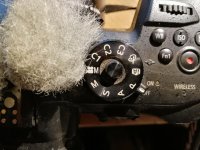
Adriano you are demonstrating that you do not know the basics of using the GH5. It is possible to set the GH5 up with any of the Lumix lenses to shoot immediately it is turned on. Within a few seconds like any camcorder. You clearly do not know how to do this. It is not a fault of the camera it is your lack of knowledge. I will give you a clue. Did you use the custom settings on the dial ?
 
Adriano you are demonstrating that you do not know the basics of using the GH5. It is possible to set the GH5 up with any of the Lumix lenses to shoot immediately it is turned on. Within a few seconds like any camcorder. You clearly do not know how to do this. It is not a fault of the camera it is your lack of knowledge. I will give you a clue. Did you use the custom settings on the dial ?

No, I didn't use custom settings on dial. If I understand you well, I attach you the pic of the dial/ring.
 

Attachments

  • a.jpg
    a.jpg
    102.7 KB · Views: 0
You could have set up the customs presets for 5 different situations and been ready to shoot immediately. For example set the camera to frame size ( HD or UHD ) set to shutter 1/100, iris f8 and auto iso and then set WB for morning and save as C1, set WB for mid day and save as C2 for evening set C3-1 for indoors set C3-2 for really low light set C3-3. In menus set lens resume ON. Before you turn off the camera set the focus at say 3 M and turn off. Now when you turn on, the camera will resume focus at 3M and will have the settings you programmed in one of the presets when ever you select them. Ready to go in seconds. I am sure I sent you the link to the Lumix YouTube site that covers all these things I just mentioned. Once you start with a preset you can of course then change as needed as you shoot but they are quick start. Focus less on buy things you think will make your video better and more on learning what to do with what you have now. Including the AX100.
 
Back
Top