C100: Rented a C100: Image is rather grainy.... What am i doing wrong?

i wound up settling with high DR mode, ISO500 and yes i BB all the time.

I just need more experience with the settings. had about an hour with it before we started shooting.

its totally user error. I'm was looking to see if there was a "whats that clunk?" level solution, like if i missed something obvious.. ( old school dvxusers know what im talking about..... ;)
 
Funny, i remember having a similar experience when I first got my c100. Image looked horrible to me, but now that i've got the hang of CP's and exposure settings on it, I absolutely love the picture. Weird how that works
 
Yikes! An hour before a shoot with a camera you have never used before. That sounds like a reality game show for DP's! I hope your shoot went well.
 
Glad you worked it out and good to see you back on this forum! I am a big C100 fan, but at 850 ISO it's simply grainier than the F3 and Alexa, although the Alexa has its fair share of shadow noise, too. Epic footage looks cleaner and more clinical at 800/850 ISO to me than either Alexa or C100 footage, but both the Alexa and C100 look cleaner to me at 3200 ISO, at least based on the Epic build I used last (a while ago).

I've heard this complaint about the camera a lot before, and I think it's valid, but I also think it's a difficult camera to expose correctly because Canon log is so strange. The noise helps keep the 8 bit codec gradable... there is not a lot of posterization no matter how you grade, unless you really overexpose, imo. And the texture of the noise is very nice.

I've also had bad issues with it when I didn't black balance. TERRIBLE noise at all ISOs.

The camera's reputation for low light is largely based on its ability to produce usable footage at 20000 ISO. There is a lot of noise at that point, but it's very nicely textured and less than with any other camera I've used, only the F3 getting close. What is most impressive is that resolution and color remain excellent at this ISO.

But yes it's noisy and a bit strange to expose. Colors are inaccurate (blues tend toward teal, red toward orange) but greens and skin tones are great. It does very well for natural light day exteriors in nature, but it's easy to overexpose in which case everything looks "video."
 
where can I get informed on proper iso usage for the c100? I see a lot of mixed results some say 320 some say 850 always, ideas?
 
iso 850 is for max. dynamic range with canon-log gamma (I used log in some special high DR scenes, at evening with spot lights, flames, etc.).

If you use others gammas (normal, cine, wdr) then it is better to start with iso 320 (WDR gamma has more noise in black than normal or cine1 gamma, at 50i I use it to max. ISO 2000, in sunny exteriors is wdr gamma best with iso 320).

Normal4 gamma is (for me) the best in lowlight and cine1 gamma has more accurate color (I used cine1 with normal4 color matrix and with shifted saturation- color gain), both are noise free to ISO4000 (remember C100 price level at this point). WDR has a little less accurate colors, but bigger dynamic range and little desaturated highlights makes a very nice image feeling, so I used this wdr gamma very much.

C100 with some speed lens (F1,5-F2.0) is the queen of lowlight in its price level, I used Samyang 24mm/f1.5 and Canon 50mm/f1.4 and the result is amazing.
 
Last edited:
where can I get informed on proper iso usage for the c100? I see a lot of mixed results some say 320 some say 850 always, ideas?

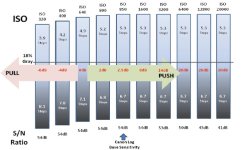
It does a digital pull, much like the Alexa at ISOs less than 800. Treat low ISOs as you would with the Alexa, except with two stops less DR in the highlights. 320 will have a cleaner, smoother look, but will clip a stop and a half faster.

I almost never rate it at anything other than 850 ISO. For day exteriors you need the highlight detail. For interiors you need the stop. I will overexpose day exteriors by as much as a stop if there's flat light and no risk of clipping as the image can get noisy once graded otherwise.

I only use cinema lock mode, just too lazy to bother learning about the rest fwiw.
 
I almost never rate it at anything other than 850 ISO. For day exteriors you need the highlight detail.

If you used canon log gamma then it is true.

But with WDR, cine1 or normal gamma is better iso320 (at sunny exteriors). You can test this on the scene with the same exposure of the C100's CMOS chip - set iso320 and exposure (with iris) to be "just without clipping" on the WF monitor. Then change iso to 850 and you will see that you get only some amplifier clipping (it is not clipping from CMOS chip - dynamic range on the chip is the same as before).
 
It does a digital pull, much like the Alexa at ISOs less than 800. Treat low ISOs as you would with the Alexa, except with two stops less DR in the highlights. 320 will have a cleaner, smoother look, but will clip a stop and a half faster.

I almost never rate it at anything other than 850 ISO. For day exteriors you need the highlight detail. For interiors you need the stop. I will overexpose day exteriors by as much as a stop if there's flat light and no risk of clipping as the image can get noisy once graded otherwise.

I only use cinema lock mode, just too lazy to bother learning about the rest fwiw.
Absolutely, i'm the same. Learned the hard way that with cinema mode if there's no clipping definitly error on the side of overexposing than under. Gets VERY flat when you underexpose and creates really weird curves that make it tough to rescue in post without some damage to the image.
 
Im a bit confussed, if canon log is so good at 850 why would you want to shoot wdr at 320 and compromise?


iso 850 is for max. dynamic range with canon-log gamma (I used log in some special high DR scenes, at evening with spot lights, flames, etc.).

If you use others gammas (normal, cine, wdr) then it is better to start with iso 320 (WDR gamma has more noise in black than normal or cine1 gamma, at 50i I use it to max. ISO 2000, in sunny exteriors is wdr gamma best with iso 320).

Normal4 gamma is (for me) the best in lowlight and cine1 gamma has more accurate color (I used cine1 with normal4 color matrix and with shifted saturation- color gain), both are noise free to ISO4000 (remember C100 price level at this point). WDR has a little less accurate colors, but bigger dynamic range and little desaturated highlights makes a very nice image feeling, so I used this wdr gamma very much.

C100 with some speed lens (F1,5-F2.0) is the queen of lowlight in its price level, I used Samyang 24mm/f1.5 and Canon 50mm/f1.4 and the result is amazing.
 
Im a bit confussed, if canon log is so good at 850 why would you want to shoot wdr at 320 and compromise?

It better in 320 ISO 'cause have more dynamic range in black zone.

the 850ISO it's better but it's the medium dynamic from low and highlight.

For example, if you need shoot some scene that have more black zone and non-existent highlight, you should use low iso for more DR in low lights.

F
 
Im a bit confussed, if canon log is so good at 850 why would you want to shoot wdr at 320 and compromise?


Canon-log is better than wdr gamma, but in "sunny exteriors" is dynamic range often higher than its ability. In 8bit camera you also have smaller room for correction at post and color grading is a very time consuming. So gamma which I used depend on the project which I did. I shot different types of project, from wedding to documentary, For wedding is WDR gamma a very efffective, at lowlight (at evening) I shot with cine1 or normal4 gamma and color correction is very easy at post. If I shot to log I don't have significantly more in result and colors are much worse. because there is a known shift with log.

But sometimes (for me it is often in the evening) I used log for special DR situation - highlights on the lamp shade or flames, there is result with canon-log gamma significantly better.

For some short movie you can used canon-log gamma, if you have good color grading possibility (at my broadcast work I can used the best monitors, projectors, AvidDS or my friends Baselight working station, but you know - it is time consuming .-) ).
So my decisions about gamma are based on the knowledge and experience of shooting with the c100, I tried log gamma and tried wdr and cine1 or normal4 gamma and take the best from each of them for my purpose.
 
Last edited:
very good info here, so at 800 its actually doing a 2db gain but if used where there is plenty of light it shouldnt matter you wont notice the noise in other words, when its dark dont want a noisy image its best to use wdr or cine or normal?
 
very good info here, so at 800 its actually doing a 2db gain but if used where there is plenty of light it shouldnt matter you wont notice the noise in other words, when its dark dont want a noisy image its best to use wdr or cine or normal?

Not exactly, noise is different sort of view for using gamma (wdr is best to iso2000, cine1 or normal4 to 4000ISO, canon-log is to 5000ISO in 50i). It is true that Canon log gamma mask noise, but after color correction is noise more visible, but it is not the main reason for WDR gamma. The C100 is an 8bit camera, so color correction has smaller room for grading. With canon-log there is a shift in colors (cyan-yellow or purple go to blue-green) and this takes a lot of time to correct faces of people. But it is correct that with good amount of light it is better has less noise with iso320 (but for less noise is cine1 gamma better than wdr .-) ).

Finally, when people compare dynamic range of the canon-log gamma and wdr or cine1 gamma, often make the mistake of setting ISO - set correct exposure of chip (with iris and shutter or ND filter) with canon log and 850ISO, then change ISO to 320(!!) and gamma to wdr or cine1 (or normal4 with knee in 90-92pct) and look to WF monitor. You will see, why is so important to change iso with wdr .-) .

So there are three point of view (for using different gammas) - quality of colors (for me the main difference between wdr and log), dynamic range and noise level
((and in time of sunset I sometime see a banding on the fine gradient of sunset color with log or wdr gamma, where my old XF100 with cine1 gamma was ok, so at this types of scenes is better to use C100's cine1 gamma for good result, if you don't like a banding - in addition my Avid Symphony QT H264 export is wrong and make the banding worse (+ made a small color shift), so I need export with sorenson x264 encoder - it's a life .-) ))
 
Last edited:
i've noticed a fair amount of grain as well but also the dreaded vertical banding in the shadows... here's what i've found helps.

black balance after every iso change - hell i do it every time i turn the camera on just to be sure! and expose properly. for some reason the noise in the shadows seems to be worse if overexposed. can't figure that one out!

use the onboard vector scope. if shooting in wide dynamic range put middle grey at 40%, if shooting in canon log put middle grey at 30%. so far this has given me the cleanest image but there's still a bit of organic noise in the shadows.

hope that helps!
k
 
Great post. I recently has some of the same questions. Played around with it a bit and noticed that WDR is best in my eyes. Also 24p helps.
 
yup... anything more than 24p is just more frames pulling from the same size bandwidth pool. 24 p is the way to go...
k
 
Back
Top