
Navigation
Install the app
How to install the app on iOS
Follow along with the video below to see how to install our site as a web app on your home screen.
Note: This feature may not be available in some browsers.
More options
You are using an out of date browser. It may not display this or other websites correctly.
You should upgrade or use an alternative browser.
You should upgrade or use an alternative browser.
RED Komodo to start limited shipping soon for $6k
- Thread starter ahalpert
- Start date

ahalpert
Major Contributor
Not much larger. The R5 will use CFexpress and looks to be on par with the 5D - a couple inches wider than Komodo but about the same height and an inch shallower. Maybe the width makes all the difference. Or maybe the R5 will not record high bitrates for extended periods of time.
G
Guest
Guest
I’d imagine the larger cards would dissipate heat more evenly. Given the DSMC reputation, ANYTHING to reduce heat output would be nice.
I still use CF cards from the video dslr days for things. Some older gear is still worth using. I always preferred the size over SD and CFexpress for glove work. Like being in a cold environment with gloves on and dropping a hot CFexpress boi in the snow... unlikely to happen, but murphey’s law.
One of the things i prefered about flagship dslr’s over mid to entry level ones, was the size of the media. CF vs SD. After holding and operating a camera all day, my hands are not as deft as normal hands, and i dropped the SD card often enough to not like them.
Not upset about CFe though. With how small cameras are getting, the smaller size makes a lot of sense. And the pins in CF slots are possible to bend when forced. I had a AJA product that made it possible to insert the CF card either way and nearly bent some pins. And i have seen other’s cameras with bent pins.
But i get the feeling that i won’t enjoy CFexpress prices for an “outdated” media format. I briefly looked at prices and it appears to be more expensive than CFe. Is that right?
Last edited:

Teddy_Dem
Well-known member
RED has posted their dynamic range test for the Komodo with a comparison to Helium. There is short write up on it over on Reduser from Jarred and Phil Holland:
http://www.reduser.net/forum/showth...ynamic-Range-(and-more)&p=1899556#post1899556
Picture courtesy of Phil:
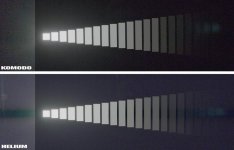
http://www.reduser.net/forum/showth...ynamic-Range-(and-more)&p=1899556#post1899556
Picture courtesy of Phil:
ahalpert
Major Contributor
Thanks for posting - this is an interesting chart and the comparison to Helium looks really promising.
I'm still a bit skeptical as they state that this is not the official chart but a throwaway lens flare showing how smear is not present on the Komodo. Indeed, looking at the smear on the Helium spilling out to the left of the chart, it's clear that the Komodo is not doing the same thing.
But I wonder how closely we should read into the DR performance if it's a misfired test?
"Loren and I have been doing some deep deep deep diving the last few days and this chart between Komodo and Helium was a throw away as we had a bit of lens flare from a bad angle of the setup... but that mistake reveals a lot. We have talked about the dreaded sensor smear over the years and it’s a really hard one to solve... almost all CMOS cameras experience it. The super bright spilling over into adjacent columns of super black. This fugly chart really shows this anomaly off on the Helium, and shows how the new design of the Komodo all but eliminates it."
John Brawley
Well-known member
Yeah, two things.
Yes to reducing overflow...I've found RED are pretty susceptible to it in the past (but all CMOS are)
https://johnbrawley.wordpress.com/2011/06/06/the-old-venetian-blind-trick/
Awesome if they've licked it.
and RED have a bit of history with amazing DR charts...
check out the 20 stop dragon chart they posted....
https://www.cinema5d.com/red-dragon-sensor-has-20-stops-no-more-scarlet-upgrade/
from
http://www.reduser.net/forum/showthread.php?92158-Enter-the-Dragon
JB
Last edited:
ahalpert
Major Contributor
Agreed re: amazing DR charts.
That being said, if they use the same methodology to test Komodo and Helium, and we already know something about Helium's performance, then the chart is useful in relative terms if not in absolute.
I'm pretty excited if it compares to Helium as seen. And with a global shutter, no less!
Now all that's left is to hear the specs, lol. And see more footage
ahalpert
Major Contributor
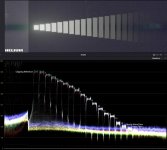
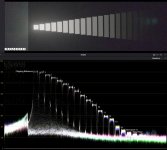
The charts are a bit visually deceiving, but pull them into Resolve and look at the waveform and you instantly get a clearer picture. 14 stops on Helium and 14 and a bit (maybe 0.3-0.5 stops) on Komodo. Which is great and plenty flexible.
Really? Can we even judge DR from this chart because of the flare? In the waveform it looks like 16.5ish on Helium and 16 on Komodo to me

Grug
Veteran
Really? Can we even judge DR from this chart because of the flare? In the waveform it looks like 16.5ish on Helium and 16 on Komodo to me
Well if the chart hasn't been done properly, then it's completely pointless anyway (and shouldn't exist, since it would literally serve no purpose), so let's assume it has been done correctly. How are you reading the chart? The first chip is a reference chip to establish the white clip point. So you count from the second chip downwards, the steps between each solid line showing your DR. Once the lines meet the noise floor (i.e. you can't see a black gap between the line on the waveform and the noise floor below it) you've reached the limits of your shadow detail (unless you're willing (and able) to distribute your images with exceptionally noisey shadows.

NorBro
Major Contributor
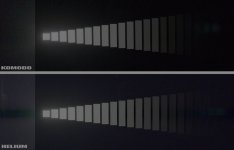
I always liked to drop the exposure on these charts as if I were grading them.
Obviously nothing scientific and that alters the intended analysis, but I'm always curious to see how shorter some of the bars get.
Either way...those Helium magenta/purple blacks gotta go. Unpleasant.
[ALTERED IMAGE...not RED's ORIGINAL UPLOAD.]
Obviously nothing scientific and that alters the intended analysis, but I'm always curious to see how shorter some of the bars get.
Either way...those Helium magenta/purple blacks gotta go. Unpleasant.
[ALTERED IMAGE...not RED's ORIGINAL UPLOAD.]
G
Guest
Guest
The iso push to 8,000 averaged (or 12800/6400 split screen that Jarred referenced) was to show two things. One was to exaggerate the cmos smear. And the second was to show how much better the Komodo retained neutral colour when lifted. It is still black or grey, but the Helium is showing some colour shift. That is exciting.
They likely were also having fun showing that the Komodo runs with the Helium on DR performance too, though obviously they couldn’t do that “officially” with this comparison.
Edit: lochness digital pointed out that the screen is split between iso12,800 on the left, and iso6400 on the right.
They likely were also having fun showing that the Komodo runs with the Helium on DR performance too, though obviously they couldn’t do that “officially” with this comparison.
Edit: lochness digital pointed out that the screen is split between iso12,800 on the left, and iso6400 on the right.
Last edited:
G
Guest
Guest
With so many good cameras out today (though, nothing has surpassed Alexa in DR in the last decade) it is almost like any camera choice is as good as the next (unless you can afford Arri, then there is one choice, jk). Once cameras surpass the “mythical” alexa DR, which according to some does even compare to the DR/latitude of film, then i think we’ll see camera sale spike again. That is the current main reason to buy one camera over the other right now, as colour science is a bit more subjective than clipping or noise.
But what is interesting is seeing what kind of eco system each camera gets you.
BMP6K and Ursa G2 (and a P4K because you can).
Canon C200 and C3002 (and maybe a mirrorless gimbal cam?)
Canon C3003 and C3005 (or just two C3003’s, which is kind of awesome to have the back up cam be an A cam)
Red Komodo and Red DSMC2/3 (for the added features and the frame rates) komodo dramatically lowers the point of entry for a two camera Red setup.
Arri Alexa Mini and Mini LF
Mavo Edge and Mavo Edge
Panasonic EVA1 and Varicam LT
Varicam LT and Varicam 35 (S1H thrown in their)
Sony Fs5 and Fs7II (with A7 series as additional special use)
Sony Fx9 and Fx9
Sony Fx9 and Venice (sony like canon do pretty well with their whole video eco system)
Zcams, collect them all.(would be interesting to see if they match at all)
Sony’s Venice seems to be on a $50,000 island. Perhaps an F55 ‘Venice style’ replacement is on the horizon. But the rest of Sony’s line up is incredibly diverse and relatively integrated. And everyone has an A7 laying around somewhere to use as those D, E, F, and G cams even on low budget shoots. Sony has almost every imaginable type of camera from their Cellphones to action cams to the Fx9 to the Venice and everything in between. Would be interesting to see how the Fx9 fares as a Bcam to the Venice. But overall, i think Sony has consistently had some of the best video options whether they were the first to market or not. They’ve remained a safe Brand or eco system to stick with for the last 40years.
Last edited:
G
Guest
Guest
The irony will be seeing Komodos getting higher rental rates on share grid than DSMC2. :/
It was kind of sad for a bit when an A7sii kit and an Fs7ii+lenses were nearly the same rental rate on sharegrid. That old “demand” thing.
It was kind of sad for a bit when an A7sii kit and an Fs7ii+lenses were nearly the same rental rate on sharegrid. That old “demand” thing.
ahalpert
Major Contributor
Red Komodo and Red DSMC2/3 (for the added features and the frame rates) komodo dramatically lowers the point of entry for a two camera Red setup.
Or 2 Komodos if you don't need HFR - then you're REALLY lowering the cost of a 2-cam RED setup
ahalpert
Major Contributor
Well if the chart hasn't been done properly, then it's completely pointless anyway (and shouldn't exist, since it would literally serve no purpose), so let's assume it has been done correctly. How are you reading the chart? The first chip is a reference chip to establish the white clip point. So you count from the second chip downwards, the steps between each solid line showing your DR. Once the lines meet the noise floor (i.e. you can't see a black gap between the line on the waveform and the noise floor below it) you've reached the limits of your shadow detail (unless you're willing (and able) to distribute your images with exceptionally noisey shadows.
View attachment 139233
View attachment 139232
I see what's happening - I was looking at the waveform with Luma, where the noise floor appears lower (and matches their high reported figure). When I switch to RGB overlay, I get the same figures you do because of the chroma noise. And the advantage here of the Komodo, as James has pointed out, is it doesn't get as much color shift at higher gain (ISO 8000 here), so the color noise floor is lower and that helps the DR. I wonder how they compare at base ISO. (PS James are you English? I noticed you spelled color with a u.)
And yes, the chart has been done incorrectly. They released it because it's a good example of superior CMOS smear performance. Land wrote: "this chart between Komodo and Helium was a throw away as we had a bit of lens flare from a bad angle of the setup"
Unrelated: I realized today that Komodo takes the cheaper Canon BP batteries and not the BP-A, as some sources had reported. Savings!
Been thinking about RED vs BMD. I feel like clients take the RED brand much more seriously, no? Oh, how I wish Komodo could record in ProRes as well...
Last edited:

LochnessDigital
Active member
(ISO 8000 here)
Just to clarify, the 12,800/6400 ISO "split" statement was meaning that the left portion of the frame where it's lighter was processed at 12,800 to show the CMOS smear. The rest of the frame (which is the Xyla chart) is processed at 6400 ISO.