RED CONNECT: Cable Breakout Box

joelnet

Well-known member
I was just looking at CVB's cool Red renders here: http://www.dvxuser.com/V6/showthread.php?t=58691
and the topic of where all the plugs would go came up.

I think one cable into RED that ended up in a breakout box would be a much neater solution to the problem of "where do all the plugs go?"

Why would anyone want more than one cable connected to the camera? (Just unplug the cable when you're running and gunning. Maybe composite and component video plus 2 xlr's and lens control ports are actually built into the body)

If you've got 4 channel audio why not have radio recievers and/or all those XLR cables connected by one cable to a breakout box 20 feet away? Doesn't that make running this thing from a jib or steadicam while still feeding audio in sync a LOT easier to manage?

You could run AC power on that same cable. If there are jacks on the camera for zoom/iris/focus motors they could be controlled via that breakout cable too. Basically the breakout plug should contain a way for 3rd parties to access EVERY camera function.

Imagine Premiere, FCP or even Photoshop plugins that would actually control the camera. Change aperture, white balance, crush the blacks, saturate the reds, Zoom lens to 100, focus, zoom out to 65, roll camera (recording to in camera HD AND Final Cut HD at same time for instant backup), "ACTION", Rack focus to killer walking in the door, superslow zoom easing in to faster zoom and then easing out, "CUT"!

All via that cable.

If if that makes sense then why not have TWO breakout plugs?

One could breakout to a very short custom cable/connector mounted on the cage proivide access to something else that MUST travel with the camera but wasn't built in already.

I think any cable that doesn't HAVE to travel with the camera should be offloaded to a breakout box. Then you could have multiple USB, Firewire, Component, VIDEO etc.

Now if you damage a plug you're not damaging your camera. The major wear and tear of plugs happens to the breakout box. DUAL breakout plugs on the camera gives redundancy if one of those is damaged. OK maybe 3 of those would be better. :-)

Oh, if 6 pin firewire is going to be used then there should be an ON/OFF switch next to it for connecting/disconnecting. Many a firewire port has been blown hot swapping 6 pin plugs.

Different breakout cables could be designed for different setups.

You gotta admit... this idea would be easy to do, reduces the complexity of RED's body design and generally just makes a lot of sense. (well, to me anyway)
 
Last edited:
Thought about this some more.

RED needs an IP address. The cable could be ethernet AND wifi could be built in. Or added... but if you could control the camera via wifi then any city that was wifi enabled would allow full RED control over the Internet.

Now imagine you're a Studio Executive or Ad Agency that could pick up feeds via the Internet of every camera you've got working. Now imagine the art director at the ad agency and the hottest colorist in Hollywood are color correcting the camera over the Internet by looking at a $40,000 monitor in the editing suite.

That's inevitable so you might as well build it in now.
 
my two cents

my two cents

Some members don't like me leaving comments below their idea contest entry. Here goes anyway.

Go to the website below
http://www.pco.de/pco/php/company/news_1-en.php?01020201&nid=37&offset=&37;en;0;=

You will see the heart of RED ONE.

PCO makes the industrial high speed camera, CMOS chip, and owns the lens maker Cooke.

News of the PCO Turbo Inspector, the "heart" or RED ONE, was not announced untill 6/22/06.

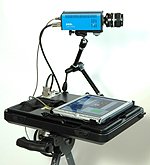
The camera is connected to a PC tablet. From the picture, it looks like there are no buttons on the camera. The PC tablet controls everything, and is connected by firewire to to camera. So, joelnet, it looks like your idea is a good one. Maybe instead of a tablet PC, RED can be connected to a MacBook Pro. Apple will make FCP Extreme. Read my post about, joystick.
Please leave a comment about my joystick idea. I don't have fellings you can tell me if my idea sucks. I don't want buttons on the camera, and I don't want to control everything by a PC. I want a joystick with buttons on it. I am trying to be helpfull.

The moderator of this forum has taken down some of my comments I have made about other people's entries. Complain to the moderator if you don't like my comments, lots of others already have.

Below is the news statement about the PCO Turbo Inspector, from www.pco.de

Has RED announced that PCO is making the CMOS chip and "heart"? On the RED website, they still call it the Mysterium chip. Am I going to piss Jannard off by posting where the Mysterium comes from? Too bad, let him whine to the moderator.

Below is copied from www.PCO.de.

"22.06.2006 - Turbo Inspector Enables Mobility


Portable inspection system accelerate on-site error tracing - pco.inspector highspeed.

Do you know every production manager's worst nightmare? It's errors – or even stoppages – during the production process. On-site disruptions are often combined with great frustration and high costs. Therefore it is important to determine the cause as quickly as possible and to eliminate it with certainty. To this end, PCO AG's engineers have come up with something clever, i.e. a special type of inspection system – one that's mobile and hyperfast. It resides in a special case, has its own energy supply via storage batteries and can be transported and implemented directly at the suspected source of error.


Despite brisk speeds: spotting errors

Discovering disruptions is often not easy, especially if a fast production process is involved, and the human eye is forced to capitulate – such as in paper production. With brisk speeds of around 33 meters per second, the paper webs whip through rolling mills and press works, over drying cylinders, through the calendar and, finally, onto the bearing rolls. What happens in this situation is that something gets stuck or the machines don't run smoothly. In such cases the observational capacity of a technical specialist on-site is insufficient because a human being can only differentiate up to 16 individual pictures per second. On the other hand, the artificial eye of the Turbo Inspector can achieve over 1000. The special case also contains a heavy-duty, 10-Bit CMOS camera, the pco.1200 hs. Dr. Gerhard Holst, Director of Research and Development for PCO AG, learned that “For applications with high picture rates the CMOS technology with sensor chips has proven itself; meanwhile CCD chips can't keep up.“ At a resolution of 1280 x 1024 pixels the nimble eye inspects at 636 images per second, and in VGA-resolution even 1357 images, all without any trouble. Primary storage of 4 GB stands ready to utilize. The camera communicates via a FireWire interface (IEEE 1394) with an integrated tablet PC in the case as the processing unit. With the heavy-duty camera pco.1200 hs, the technical specialist is now in a position to film sequences during production and then later review the movements clearly in slow-motion mode, analyzing what is going wrong.

Eliminate errors quickly, avoid costs

“Wherever fast sequences of events are involved,“ said Research Director Dr. Holst, “our mobile inspector finds its niche. Above all it is intended for mobile, on-site error tracing.“ For example, analysis of vehicle crash tests places a great challenge on the abilities of a camera system. High image rates reveal interesting details of the impact sequence and help designers to improve vehicle safety. The Turbo Inspector can also provide helpful services in the bottling plant of a brewery. A stoppage can occur when tilted bottles cause a jam, or else perhaps one of the many grasping mechanisms wears out, putting the assignments out of alignment. If one implements the Turbo Inspector, an additional, major advantage presents itself -- as a result of the recorded picture sequences, the product puts on-site technical personnel in the position of illustrating the problem to the mechanical engineer's service team in a clearer and more detailed manner. The result is: a reaction can take place significantly quicker, which can save enormous costs. Finally the production manager can once again get his well-deserved, peaceful rest!"
 

Attachments

  • pco_inspector1_150p.jpg
    pco_inspector1_150p.jpg
    44.2 KB · Views: 0
  • pco_4000_2.jpg
    pco_4000_2.jpg
    7.4 KB · Views: 0
Last edited:
acrochordon said:
I give your idea five stars. What do you rate my joystick idea?

I think as long as the entire camera can be controlled then third party vendors will step to fill in anything RED doesn't create themselves. I can see where MIDI control devices could be adapted to run RED for instance.

Jannard has said the Mysterium sensor is a RED chip, designed by RED and no other camera will have it. I kinda doubt he'd lie about that. Now there may well be competing or similar technologies in development.
 
acrochordon: your posts are concentrated misinformation mixed with off-topic rants and pure trolling. You have no idea what you're talking about.
 
flame bait

flame bait

Greg also wrote the following about tomthemacman, which was pure flame bait.

"tomthemacman, you're just repeating misinformation and throwing in a bit of your own. Do you actually read the other posts before you comment?"

Greg, I read the other posts before I comment. Please stop the flame bait. We can all be friends. Play nice.
 
Last edited:
RED chip

RED chip

"Jannard has said the Mysterium sensor is a RED chip, designed by RED and no other camera will have it."

I think RED would have to outsource the design and manufacture of a CMOS chip. It only makes sense to outsource it. It is too expensive to do on your own. There is no way they could design a chip so fast and build a manufacturing plant. RED has probably obtained an exclusivity and no-compete deal from the supplier of the chip.
 
Back
Top