Recommend good Sound Blankets?

I see most people use simple moving pad/blankets as sound blankets to minimize echoes, anyone have a recommendation for a certain type of moving blanket that is best? I found a dizzying array out there of premium thicker stronger blankets and some that are solid woven material but could use some advice with those in the know of which ones work best. I'm going to use them in an echoey corporate office room with suspended ceiling, carpet and hard walls to cover 3 sides with blankets to hopefully cut down the echo.

http://www.northwestwoolen.com/movingpads.htm these are the woven ones that resemble high density wool blankets.

http://www.uscargocontrol.com/movin...5.html?zenid=b56dec11b8cf925ab0912a8a04a8ca49 these are 6-8 lbs per blanket...pretty dense.

http://www.movingstartup.com/catalo...-blankets-Cotton-Moving-Blankets-p-16162.html these they even mention are used for sound blankets.
 
There was a long thread on this a few months ago - there is a company that makes one that is white on one side, black on the other - much help to gaffers everywhere.

I couldn't find the thread quickly, I suggest you do a search and it will probably appear.

Phil
 
Sound blankets will be largely useless to control echo, unless you had maybe 300 of them or so. ;)

Sound blankets are great for padding a hard floor to silence/quiet footsteps (provided the actors can't slip on it); they're great for putting under dishes so when your actors put down dishes or glasses on a table they don't <clink>, etc. They're excellent for putting over computers or other electronic equipment that's emitting high-frequency whines, to mask that noise. They even can be used effectively to stuff in an air conditioner vent if there's too much noise coming from the AC and you can't turn it off.

But they won't do a thing for echo.
 
Under the covers!

Under the covers!

Sound blankets will be largely useless to control echo, unless you had maybe 300 of them or so. ;)

Sound blankets are great for padding a hard floor to silence/quiet footsteps (provided the actors can't slip on it); they're great for putting under dishes so when your actors put down dishes or glasses on a table they don't <clink>, etc. They're excellent for putting over computers or other electronic equipment that's emitting high-frequency whines, to mask that noise. They even can be used effectively to stuff in an air conditioner vent if there's too much noise coming from the AC and you can't turn it off.

But they won't do a thing for echo.

Huh? Geez Barry, blankets seem to work fairly well - are you sure you unfolded them? <wink>

Try googling "echo sound blanket" and you'll come across sound engineering books, order info (Markertek), etc. True, a sound blanket isn't in the same league as a $200 twelve inch thick piece of acoustical foam (16 square feet), but most of us aren't trying to build an anechoic chamber.

IMHO, sound blankets are fairly effective to suppress echos but not great to suppress noise from external sources (see Soundproofing your Studio).

Anyway, due to the weight of a blanket, it probably makes sense to buy them locally. I get mine from Harbor Freight and prefer the 72x80' Mover's Blanket (Haul-Master RN 77736, item 46115) - it's quilted, has dark/light sides, and isn't stinky like the cloth ones (air the cloth blankets out several days so you don't gag your talent).

Good luck, Michael
 
I've got several of those Harbor Freight ones when I moved cross-country, and I can't fathom how you'd find them effective at echo reduction unless you had a million of 'em... :)

If you had some heavy, heavy, heavy quilted blankets, then yes you could make some headway. You need some mass to absorb the sound. The little Harbor Freight ones are like 1/2" thick. I mean, even in that article they referred to the blankets as "heavy"; I wouldn't classify the Harbor Freight tools as heavy, they're extremely lightweight. I mean, by comparison, the Matthews professional sound blanket weighs over five pounds each:
http://www.msegrip.com/mse.php?show=product&cat=67&products_ID=24629

Of course, at $50 apiece, you may want to think twice about getting a bunch of those. Instead, maybe something like this would prove to be a bit more economical:
http://www.cameronpackaging.com/premium_pads.html

There you're getting 79 pounds for a dozen blankets, or about 6.3 pounds apiece. A dozen of those sprinkled around a room might start to add up to doing some echo control, if they're used properly. And those are about $8 apiece. Too bad they're only green/brown or blue/blue, it'd be great if they were black/white. I think the Harbor Freight ones are less than a pound apiece.

To control echo you ideally want to scatter the sound waves instead of letting them bounce back cleanly (hence the odd wedgy shape of that markertek thing) and you want some mass to absorb the sound waves. You also really want to break up the amount of space where the audio can just bounce around wild; lots of places sell "sound baffles" for that purpose -- they try to corral and trap the bouncing sound waves and keep them busy bouncing in the baffles (hence expending their energy) rather than letting them bounce wildly and then back into your mic.

Barring having mass, reflection-breaking surfaces, and baffles, well, the best thing to do is to stack the blankets as deep as you can in front of the actor so that they'll absorb as much of the sound waves before they have a chance to start bouncing, and get the mic in as close as you can to overpower the echo.

If you find that a few thin blankets are having an appreciable effect on echo, your experience differs very much from mine. :)
 
Last edited:
For what it's worth, I'm dealing with a bit more echo in a relatively small room than I'd like. Not having money for acoustical foam, or even sound blankets, we took the cheap way out -- we leaned mattresses up against the walls. (Outside the shot, of course.) Doesn't completely reduce the reverb, but it does seem to cut down on it quite a bit.
 
Those Matthews got to be a mis-print : 75' X 68' X 0' (5.25 lbs) There no way its that big at 5.25 pounds. That's huge and would approach the weight of a carpet...or am I losing it?
 
Last edited:
Those Matthews got to be a mis-print : 75' X 68' X 0' (5.25 lbs) There no way its that big at 5.25 pounds. That's huge and would approach the weight of a carpet...or am I losing it?
Good blankets are that weight. Many of 'em are 7 to 7.5 pounds apiece. That's what makes 'em useful (or at least as useful as these things get).
 
Doing a search I came across these two threads:

http://www.dvxuser.com/V6/showthread.php?t=32615
http://www.dvxuser.com/V6/showthread.php?t=56725

I think these are the white/black blankets that were mentioned earlier:

http://moverssupplies.com/BW-Cotton-Blanket-By-Dozen-12-pieces-Producers-Choice/

White and Black and 8lbs each for $16 they're looking like a decent option - of course with shipping it's about $20 each.
Still, not bad considering they're heavier than the Mathews blankets that run about 50 a piece before shipping.
 
Last edited:
Thanks Barry - I really appreciate your advice and counsel. If only I had an acoustical time domain reflectometer, signal generator, time and money - I'd love to do some testing to see the dB absorption for various materials. Lacking that, I guess we'll each continue to use our ears and make our own value judgments in various situations. For us mortals, we often settle for compromises within our budget and how much we can haul around. But no doubt, for really serious production work, I'd vote for your solutions.

Warm Regards, Michael
 
Mattresses against the walls. I'm telling you, it's working for me.

I wonder if angling the mattresses would help even more? Think I'll try that.
 
Mattresses are lousy for soundproofing, but can be very effective for echo reduction. (some people think nailing mattresses to a wall will give them a soundproof studio -- er, no.) :)

But yes, any thick heavy large absorbent item (like a sofa) will do its part towards absorbing some reflected sound and cutting down echo. A closet is a great example -- if you pack that closet with clothes, you'll make an anechoic chamber in there. Even though each individual piece of clothing doesn't weigh all that much, when you get eighty or a hundred pounds of clothes in there, it's really going to start making a difference.

So yes, mattresses would definitely have an impact on echo control. As would a lot of big beefy heavy moving blankets. It's all about absorbing and deflecting the sound waves -- even a bookcase can have some effect on echo control as the sound waves flow into the bookcase and get jumbled and bounced off of various depths and textures (versus just bouncing straight back off a big blank wall).

In echo, big hard flat surfaces are the enemy (like the Grand Canyon or a bathroom). Lots of soft, absorbent material is your friend (like in a closet or a plushly furnished, thickly carpeted room). The more absorbtion you can add to the room, the less echo you'll have. It's my experience that this is not something that's going to be accomplished by adding a couple of lightweight sound blankets, but others' experience may vary.
 
Well I ordered a dozen of the moversupplies.com blankets for $160/dz + $60 shipping! If I get them in time for my shoot I'll let everyone know how it goes and post some audio before and after I setup the blankets... Thank you for your help! Oh I rented two schoeps 641's to cover my actors so if the audio is bad it won't be the mics fault! ha ha
 
Well I ordered a dozen of the moversupplies.com blankets for $160/dz + $60 shipping! If I get them in time for my shoot I'll let everyone know how it goes and post some audio before and after I setup the blankets...
That would be most interesting to hear, thanks for planning to take the effort to do that and share.

Oh I rented two schoeps 641's to cover my actors so if the audio is bad it won't be the mics fault! ha ha
Mic placement can actually be more important than mic quality; a $200 shotgun mic'd closely will likely sound a whole lot better than a $1,000 shotgun from 15 feet away. Make sure you get the mic in nice and close, it'll help you overpower a lot of echo and other issues.
 
If only I had an acoustical time domain reflectometer, signal generator, time and money - I'd love to do some testing to see the dB absorption for various materials. Lacking that, I guess we'll each continue to use our ears and make our own value judgments in various situations.
What sounds good to your ears (and to the mic, of course) is all that matters. If you're getting great results with such lightweight materials, that's fantastic and I wish I knew the secret! :)

For us mortals, we often settle for compromises within our budget and how much we can haul around.
You ain't kidding. The big blankets are expensive and huge and heavy; it's certainly not convenient to leave 'em on the car "just in case"...
 
here's the specifics

here's the specifics

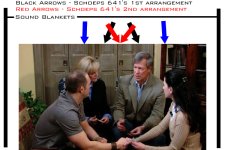
Okay thanks will do, they'll be sitting facing each other with knees about a foot apart so the plan was to have stationary boom for each with the mics positioned above and in front of their heads pointed at their mouth/chest area, they may sway their bodies forward and backward a bit (leaning back in chairs) but that shouldn't change distance too badly. Otherwise will stuff a blanket in the a/c which is fortunately in the other room. Then enclose the shoot area as tightly as possible with sound blankets off screen, and possibly tilted at different angles. I'd estimate mic distance to be no more than 12-18 linear inches from their mouths. I have enclosed a diagram to show you what I'm thinking, I will also have the cameras a bit more on level with their heads so can lower the top edge of the frame a bit and get the mics closer. The black arrows are the way I was thinking of arranging the mics but based on the red and blue, which placement do you think would be best from your experiences? Thank you in advance!
 

Attachments

  • MilitarySMARTMicPlacement.jpg
    MilitarySMARTMicPlacement.jpg
    160.6 KB · Views: 0
Oh was also thinking of procuring a couple of these:

http://www.absolutemusic.co.uk/shop/view_product_mtm.php?product=seeirf

SE Electronics IRF. I have its big brother and in pretty live rooms it does seem to isolate the mic really well. I've used it for a number of voice overs, with great results...at least to my ears. So combination of two of these things with the Schoeps and sound blankets will hopefully give pretty good echo mitigation. Any thoughts? Thanks!
 
Sounds like you have a decent plan. 18 inches is a fairly long way for the mic to be positioned; if you can trim that down to a foot or less you'll do better. Good luck!
 
Back
Top