Question about 'SHOOTING FLAT'.

Youre getting to a point where the simple answer is "you cant do this on your budget." Youre basically talking about either replacing all the light sources with bulbs the color temp you want or using powerful movie lights to fake those sources. Or both.

Maybe look for another location that has the look you want where you can get permission to shoot.

On "Skyfall"(2012), Roger Deakins indicated that for one of the 'underground station' shots, the fluorescent tubes were replaced, and the fixture 'cleaned' up, and even that was not enough to get a 'good' exposure, so they added another line of fluorescents to boost the light for the shot.

Budget for "Skyfall"... $200M... so spending $10K worth of 'location fix up' probably was 'petty cash'...
 
What I was getting at is that pony has this ideal of how he wants his visuals to look, but also has no little to no budget to work with (I'm guessing). Those two things just don't often go together. You either have to compromise and say "well, this is what I have to work with and it is what it is, now how can I make it work for me?", find another location that happens to be perfect, or put the project off 'til you have proper funding.
 
Yeah okay I'll accept that. Is it possible to do anything with the color though so it's not the usual yellow/orange lights? Like what if I put a blue filter on the lens? Thus making the orange lights white, and making any white lights on the street blue. Their is not enough white lights for all the scenes I want at night unfortunately. But what I use a blue filter, with the camera set to '3200 K'? That way the noise and color will not be ruined by turning the temperature down so low, and the filter will do the rest, and cancel out the oranges. Could that work?
 
Well I have to specially order the filter and it's a specialty item, so I can't test it without buying it first. I don't want it to be a waist of money, and would like to have some idea.
 
Find a piece of blue gel like youd use on lights. Wont look exactly the same but should give you an idea of whether youre going to like the idea at all, should be cheap.
 
Both of those master Cinematographers embraced the color of the urban night time. I regularly re-watch both of those films for visual inspiration.
I second that as well. I think, it gives the most realistic look possible. And, to me, it looks more natural that way.
 
Well I can't gel the lights because the city will not allow us to climb big latters to get up there to do it. When you say sheets' I assum you mean an sheet that is on a stand and the light shines through it. Well it will work for the close ups but not for the wide shots, where actors are distant.
 
Well I can't gel the lights because the city will not allow us to climb big latters to get up there to do it. When you say sheets' I assum you mean an sheet that is on a stand and the light shines through it. Well it will work for the close ups but not for the wide shots, where actors are distant.

No, you were saying that you wanted to try color filters on the camera but that they were relatively costly to get without testing them. I don't want to speak for Josh Bass but I took his comment to be what I was thinking. Get some inexpensive gel material and put it in front of your camera lens for your initial testing. It will not have the optical quality that good filters do but it will give you a chance to test your filter ideas inexpensively. You shoot with the gel material in front of the lens and when you come up with the color combo that you like you can then spend the money and get the quality lens filters that you think are right.

When doing this testing I would stick to gels that match the color of optical filters as close as possible. Color optical filters are commonly denoted by a specific "Wratten number".
http://en.wikipedia.org/wiki/Wratten_number

The 80A filter is the closest to a full CTB colored gel and is used for correcting tungsten lighting at 3200K to daylight at 5500K. The 85B filter is the closest to a full CTO colored gel and is used for correcting daylight lighting at 5500K to tungsten at 3200K.
 
The 80A filter is the closest to a full CTB colored gel and is used for correcting tungsten lighting at 3200K to daylight at 5500K. The 85B filter is the closest to a full CTO colored gel and is used for correcting daylight lighting at 5500K to tungsten at 3200K.

Since Ironpony seems to exhibit the 'ever return of the same'... in regard to this 'white balance' vs shooting under 'sodium street lighting'... I will suggest that a 'blue' filter when shooting under Sodium lamps, depending, will not give a 'bluish' cast, since there is very little 'blue' component in the street light...

There is of course the maxim... 'one demonstration is better than 1000 well worded theories'... So, I do agree that Ironpony should go out and 'shoot' under the type of street lighting in their environment, and use various 'cheap enough' filters to get an idea of what will happen.

Were it me... I'd 'white balance' to Tungsten, let the street light yellow 'fall where it may', and 'add' Tungsten in small amounts as needed, if I could afford the lights... or find a location that had a mix of 'white-ish'... light and street lighting and shoot there... perhaps hand held guerrilla style because I can't afford permits/insurance/location fees...
 
Ok. Here is an example from a short film I directed, and in this case shot, last year. I was not happy with the shot, and due to 'creative' differences with the 'producer' on the overall goal of the short film... I didn't have a chance to reshoot this shot...

attachment.php


The lights outside of the care were the usual parking lot variety. The light inside the car to give some detail of the black woman, was a small LED flashlight, hand held to give the black woman some 'texture'.

About the only 'color correction' I would have done would be to reduce the 'bluishness' of the LED light and give the woman's hand a more 'natural brown' color.

Shot tech info: 1920x1080 @ 24 fps @ 1/50 f/3.5 14mm (14-140mm zoom) @ 1600 ISO.

(For some reason the image seems to be cropped via the site... there was a bit more 'room' to the frame right...)

From the same shoot...

attachment.php


Again LED 'hair' light. In this case I may have adjusted not only the 'bluish' of the hair light, but also the 'greenish' of the hall lighting.

Same basic tech specs as before.
 
Last edited:
Okay thanks people. And thanks for the example.

I can use lights on actors for closer up shots, but I want to have some shots of them running after each other, from far away, shot from rooftops point of view, where I will not be able to fight the natural street light.

I want to shoot at night at at a color temperature in my camera around 3200 to 5500 Kelvin. This will not be as noisy than going below 3200, and not have as much unwanted color artifacts. But then I want to put a filter on the camera that will make it look like 2000 K. Can I shoot at 3200 K in camera, with a filter that will make it look like 2000 K for night? The goal is too reduce noise and unwanted color artifacts in camera, by keeping the temperature at 3200 K around or higher if that's better, but make it look like 2000 K or even lower.
 
Last edited:
Okay thanks people. And thanks for the example.

I can use lights on actors for closer up shots, but I want to have some shots of them running after each other, from far away, shot from rooftops point of view, where I will not be able to fight the natural street light.

I would suggest shooting at 'dusk' when the street lights are on, but there's still enough residual twilight to boost the lighting... otherwise it's 1000's of dollars worth of lights, and all the production permit rigamrole, etc.

You can 'adjust' in small increments some color cast in post, and that may be 'best' for this situation... get the shot however, with whatever, you can, then make a color cast choice later... again experimentation will provide 'proof of concept'... or 'need more work'...
 
I've tried that before but their is just not enough time at dusk to shoot such a complicated sequence that would be five minutes of footage once edited. I need need more hours. I am up for doing it but I need to figure out how to do a six hour shoot in one hour. It doesn't look real though.

I mean when cars drive by the headlights are on. But the dusk sunlight from the sky still over powers the car lights, so the lights have no glow to them. Same as the street lights. They don't actually cast onto the streets, so it doesn't even look like night time, at least not in a realistic way to me. The whole thing just looks off. I've tried looking for tutorials for this online but everyone I can find is shot in trees, or a backyard or something like that. I cannot find a tutorial on how to shoot at dusk on city streets, with buidlings and streelights and make it all look like night.
 
Last edited:
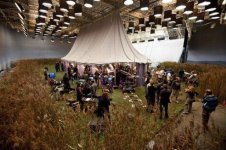
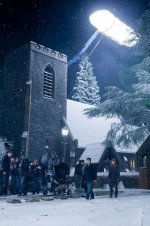
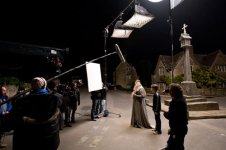
How they do it with a good budget.
 

Attachments

  • awesome_behindthescenes_harry_potter_37.jpg
    awesome_behindthescenes_harry_potter_37.jpg
    79 KB · Views: 0
  • awesome_behindthescenes_harry_potter_41.jpg
    awesome_behindthescenes_harry_potter_41.jpg
    65.4 KB · Views: 0
  • PotterBehindTheScenes5-thumb-500x333.jpg
    PotterBehindTheScenes5-thumb-500x333.jpg
    36.5 KB · Views: 0
Okay I will do it realistic style then. No use fighting it. I will try more day for night tests, but how do I get a whole chase sequence with multiple shots (from different rooftops mind you), and do it all before dusk is over? I know a lot of microbudget filmmakers work fast but it's really hard to get an ideal 12 hour shoot done in one hour. I could do an hour a day, but it's difficult to get the actors to keep their hair the same, etc.
 
Back
Top