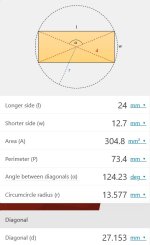
F55: PMW-F55 Sensor Details

I wanted to know the crop factor for the 8.9mp 17:9 area on the F55 because if that number was 1.82 it would seem too high, raising a possibility that it was instead downsampling or binning from the larger, physical 11.6mp area. It’s academic pedantry because I have no need for it beyond curiosity but I’m fine with it.

Going down this path, it was an assumption of mine that CF was based on image circle, that AOV should be the constant among different aspect ratios and that FOV was a separate spec apart.
 
On what principle? I dispute the premise.

The principle that the camera doesn't decide the aspect ratio you'll shoot with - you do.

No one selects the Venice and says "I guess we're shooting in 3:2", or an Alexa and says "We have to shoot in 4:3 now". You decide on your aspect ratio, and whether you're shooting it spherically or anamorphically, and then you go and do that with whichever camera you choose.

The reason we work off the horizontal axis for crop factors, is because using the full width of the sensor is the constant. Whether you're shooting spherical 2.39:1 or 2:1 or 1.89:1 or 1.78:1 on a sensor (be it 3:2, 4:3 or 16:9) the crop factor for that particular sensor (relative to the 36mm of a full-frame imager) is always going to be a constant. A spherical 35mm lens (for example) is going to provide exactly the same horizontal FoV in all four of those aspect ratios - so it would be nonsensical for the crop factor to change between them.

The only circumstances under which it does change, is when you're shooting in formats that are taller than sensor's native aspect ratio (4:3 or 6:5 - for either spherical or anamorphic delivery, and sometimes 16:9 if the sensor is natively 17:9, like the F55) and crop factor has to be revised inwards to meet the taller frame - but even then, you'd still want to calculate for the horizontal axis, because that's the constant, and if you're thinking in crop factors, you want a constant.

It's impossible to get identical compositions from frames of different shapes, as you know.

Of course, but that's a situation that has nothing to do with crop factors. The only purpose that a crop factor serves, is to provide a point of reference to a known standard.

It's about knowing that if a 50mm lens on a full-frame sensor is going to yield a particular FoV for a particular shot, at a particular aspect ratio - and you want to match that FoV on a smaller (or larger) format, you have a very simple (and constant) multiplier to allow you to do the math and figure out what that lens would be (on a given format).

So the best thing is to go for a similar overall feel. And the best overall feel is approximated by the diagonal. As an extreme example, a 50mm lens on a 36x24mm frame will feel very different than on a 36x9mm frame, though they have the same horizontal angle of view. A 43mm lens (if you can find one) would better match the overall feel, since it exactly matches the diagonal angle of view. You're unlikely to have a 4:1 aspect ratio as with my 36x9mm example, but the 2.4:1 aspect ratio that some people go for is different enough from still photography's 3:2 that merely matching horizontal will give you a tighter-feeling shot. Even so, some people will think we're being pedantic, because to match horizontal you would use a 50 on both and to match diagonal you would use a 45.

That's a very unique way of working (and not one I've ever heard expressed before), and if it works for you that's all that matters. But for the vast majority of people, crop factors are simply telling them how wide or tight a particular lens will be on a format they're unfamiliar with, by giving them a reference to a format that they are familiar with (in this case full-frame).

And that's calculated on the horizontal.
 
is the FS5II still a viable purchase? Seeing some decent used deals out there, but not really sure i want to buy another 4:2:0 8 bit camera.
 
is the FS5II still a viable purchase? Seeing some decent used deals out there, but not really sure i want to buy another 4:2:0 8 bit camera.

Get a used FS7. It is 5x the camera for just a little bit more money. The upgrade to 10-bit 4:2:2 is just the tip of the iceberg of what you gain with an FS7MK1 or FS7MK2 over either version of the FS5.
 
is the FS5II still a viable purchase? Seeing some decent used deals out there, but not really sure i want to buy another 4:2:0 8 bit camera.

I think Doug has a valid point about looking into a used FS7, but I'd add that it really depends on what you need it for and how you'll use it. Also the variable ND—one of the best features in a camera ever, IMO—is only available on the FS7MK2, which puts the price closer to 2x what you'd spend on an FS5.

I've been getting great results out of my FS5, both with and without a Shogun Inferno, for years. The FS7 is always tempting but for most of my work the form factor doesn't make sense.

I know people harp on the weak 4:2:0 8bit codec for 4K internal, but honestly it holds up just fine in most shooting situations. If you're using regular (non slog) profiles it looks great, and if you're exposing correctly in slog2 it also looks great. The biggest drawback (for me) is the lack of 4K60 internal, and having to rely on a (relatively) large 7" monitor/recorder when I want 4K60.

So while I'd agree that the FS7 is much, much more camera for the money, consider too what you lose by going that route—e.g., face detection AF (not amazing, but definitely usable), small size, variable ND (unless you spring for the FS7MK2).

If you're looking to get hired as an owner/operator for low/mid-tier work I will add that nobody is requesting FS5's—the FS7 is king of the market when it comes to producers asking for specific cameras in that range (probably followed by the C300Mk2).
 
The biggest drawback (for me) is the lack of 4K60 internal, and having to rely on a (relatively) large 7" monitor/recorder when I want 4K60.


If you hvae another minute, I'm curious to know more about your use of 4K 60p. When do you use it and why? Do clients request it or is it your own choice? Are you editing and delivering in 4K 60p?
 
This has to be the answer, that it's the active area of the sensor, which also makes the pixel pitch 5.9 micron and the CF S-35.

The way I understand it is that 24 x 12.7mm has to be the ACTIVE area of the sensor. The diagonal image circle produced by the F55 is claimed to be 27.1mm. To have a rectangle fit into a 27.1mm circle that rectangle has to be 24 x 12.7mm. To be accurate a 24 x 12.7mm sensor will generate a diagonal of 27.153mm. Close enough to the claimed 27.1mm image circle of the F55 S35 sensor. That is then a 1.89:1 aspect ratio in 17:9. That according to Sony is their DCI 4096 x 2160 Super 35 image. Using 8.9MP of the 11.6MP total sensor photosite count.

If the F55 follows past Sony practice, which I believe it does, the rest of the non-active area of the sensor is used for dark current noise measurement which is related to sensor temperature and the black level obtained at that temperature. A number of manufactures use certain noise reduction techniques in this part of their black level measuring. When you do a "black balance' with a capped lens the black level derived from that balance is retained in memory and read from and used as the reference black level for the active area of the sensor when that is active to light. That is why Sony and Canon recommend doing a 'Black Balance' every time you change ISO as the higher the gain running, the amplifier level in other words, the hotter the circuitry runs. That's why on some cameras if you see dark current FPN when you gain up it's advisable to re-black balance. Sometimes this will help lower that dark current generated FPN off the sensor. Not always successful by any means. Then re-black balance again when you drop back to base ISO or dB. Some cameras, which will remain nameless here also employ greater levels of NR as you gain up which often starts to soften and mush out the image.

Chris Young

Sony F55 sensor.jpg
 
Last edited:
Interesting question Doug. In my case, I have found more and more requests, especially from younger producers is "Can we shoot this in 4k 50P?" (Aus is a 50Hz country) I say yes and then just get on with the job. Like last week I had a job to shoot four dance routines to go to London for a ballet exam for the Royal Academy of Dance. Even if I hadn't been requested to shoot UHD I would have shot that at 50p for the smoothness of motion in the higher speed jumps moves and turns. That was uploaded as 50p MP4s for the board of examiners who had specified the 4K... they meaning UHD of course! I would imagine they must be watching the entries on large 4k monitors or projection to try to simulate judging entrants on a stage. Oddly that shoot was a pure product of Covid travel restrictions. The dancer couldn't travel to the UK for the exam. With SSD space cheap and plentiful and modern PC's having no trouble handling 500Mbps 422 10-bit I find the 4k/UHD 50P easy to live with. It also has the benefit of being easily convertible to interlace for DVD or BD or 25p if required.

Chris Young
 
Chris -
Sounds like the other added advantage for them may have been if they wanted to examine any part of the dance technique by slowing it down in playback - where again the higher frame rate provides a better result.
On my shoots we sometimes get requests from postproduction that certain kinds of shots be done in 60p. Just worked on a cooking show where one of the CU cameras spent most of its time at 60p simply to provide more options for the editor.
 
We shot dance recitals with Sony NX cams at 60p, 720p 59.94 to be precise. We would track the dancers across the stage and were supposed to never let them get out of frame, but invariably another would enter from stage left or right and we would miss. I set up a 2nd cam shooting 4k 60p for backup, and would cut to that cam in post when necessary. I use 48 or 60p for slowdown in post sparingly, but otherwise can’t stand the video-ish look of 60p played at regular speed.
 
If you hvae another minute, I'm curious to know more about your use of 4K 60p. When do you use it and why? Do clients request it or is it your own choice? Are you editing and delivering in 4K 60p?

I have never had a client request 4K, and I'm lucky if they request *anything* without my asking for delivery specifics.

The last freelance job I did (a tour of a facility for a co-working space) I would have liked to use 4K60p. I wanted 60p to slow down and smooth out shots in editing (24p timeline), and 4K would have been nice in case I needed to punch in for reframing and/or stabilization. I ended up just shooting 1080p60 on the FS5 because I didn't want the hassle and weight of my Shogun on the gimbal I was using. And it was totally fine—final delivery was for the web, so punching in a tiny bit on HD footage wasn't an issue. I just made sure to be that much more careful and deliberate in my framing while shooting. Not only was the client happy with HD, but (iirc) they were even happy enough with a 720p draft version that I sent for review that they accidentally posted it online. So yeah, no real need for me for 4K yet from a client perspective 😃

For my regular work (filming athletes for a small sports media company) 4K60p is again nice for the option of reframing and stabilizing (which sometimes involves much more aggressive punching in depending on the shooting situation/venue). But HD 120p continuous *with* sound (which I get with the Shogun) is much more useful than 4K60p, as we do a lot of slow-motion replays in our edits. Resolve's Speed Warp does a pretty impressive job slowing down 60p footage but it takes forever to render and isn't as nice as having 120p.

As for editing, I have never edited in a 4K timeline (that I can recall). All our work is done in HD timelines, and I've never seen a single comment about wanting 4K from our audiences.
 
If you have to play 60p on a 24p timeline at normal speed (not slowed), you have the issue of 3:2 judder. I get a nice slowdown or a decent real-time playback without the judder by using even multiples; 24/48 or 30/60.
 
If you have to play 60p on a 24p timeline at normal speed (not slowed), you have the issue of 3:2 judder. I get a nice slowdown or a decent real-time playback without the judder by using even multiples; 24/48 or 30/60.

I'm not sure I noticed the judder in the few instances I've had 60p footage running at normal speed in a 24p timeline (but maybe because it's never been pointed out to me).

When I edit the athlete footage we're generally in a 30p or 60p timeline so it works out (unless we're in a 50Hz country, in which case we generally shoot/edit in 50p).
 
I have never had a client request 4K, and I'm lucky if they request *anything* without my asking for delivery specifics.

Guess it just all depends on your clients. Although nowhere near the majority, I've been getting requests for 4K/UHD since at least 2015 and I'm pretty sure the first shoot I did with my F55 was "4K"(UHD 25p for a German company).
 
Chris -
Sounds like the other added advantage for them may have been if they wanted to examine any part of the dance technique by slowing it down in playback - where again the higher frame rate provides a better result.
On my shoots we sometimes get requests from postproduction that certain kinds of shots be done in 60p. Just worked on a cooking show where one of the CU cameras spent most of its time at 60p simply to provide more options for the editor.

Yes totally agree. Better slow-mo and more post options.

Chris Young
 
As for editing, I have never edited in a 4K timeline (that I can recall). All our work is done in HD timelines, and I've never seen a single comment about wanting 4K from our audiences.

Thanks for the detailed reply.
My Z750 has a new Sony codec called XAVC-L200 that is only available at 60p and 50p frame rates, and I was just curious how other poeple are already using 60p in the real world.
XAVC-L200 is Long-GOP at only 200Mbps @ 60p -- but still 10-bit 4:2:2. I think it's going to be a great codec for productions with high shooting ratios and multiple cameras that still want to shoot in LOG or HLG.

I don't really like the look of 60p so I've just been converting to 29.97 during grading. Looks great, though.

Anytime!

A quality Long-GOP codec would be great. I know various flavors of RAW are all the rage right now (at least from a marketing standpoint), but in like 99% of my work I'd prefer a good compromise in quality and size. Generally I'm shooting to ProRes LT when using the Shogun but I'd be happy with something of similar quality but more efficient.

And I also don't like the look of 60p—I've slowly gotten used to it for sports related content, but it *still* takes me a few minutes to adjust every time I see a video in 60p.

Also your video series on the FS5 was critical to getting me up to speed on my FS5 nearly three years ago! It's probably the best investment in the camera I've made.
 
Most of my work is event, and some local market corporate/doc type stuff. I have one big national client, and they have no issues with what I am brining back with my 4:2:0 A7III. So, for me, the FS5 adds a nice form factor, and the variable ND, which I miss on the smaller cams. I find the FS7 too big. the biggest issue, is the S35 sensor when
I have a bag of full frame lenses.
 
Back
Top