I built an adapter from ExpressCard to USB. How does this work?
It's pretty easy: On an ExpressCard slot you can find USB data signals on pins 2 and 3. Additionally you need ground at pin 1. Unfortunately the ExpressCard slot does not supply 5 volts which are required for USB device operation.
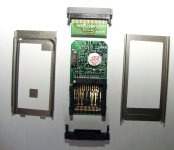
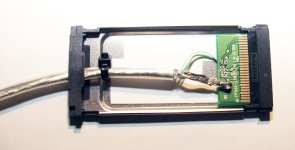
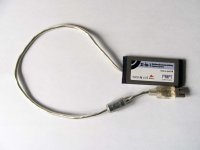
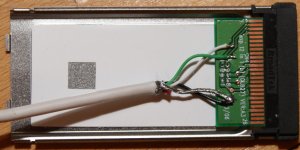
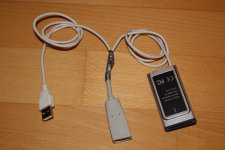
I soldered a cable with connects a cable of an USB socket to the USB pins of the ExpressCard slot. To get a cheap ExpressCard connector I simply removed the PCB from a 9€ card reader (see pictures).
To get the required 5 volts for the USB I connected the ground and 5 volt cable from a normal USB connector to the USB socket. Now it is possible to use any cheap USB connector based power supply which can be found with AC adapter or internal batteries (see http://www.thinkgeek.com/gadgets/travelpower/b4b6/ for an example).
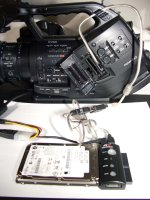
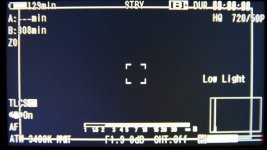
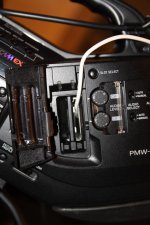
If you now connect any USB device to the self made USB socket the camera is able to recognize it. I tested some common devices with these results:
- USB hubs cause "Unknown Media" and cannot be used therefor,
- 4 of 5 USB 2.0 card readers work without any problems with SDHC or
CF cards (most probably even with Sony memory sticks etc.),
- USB sticks are usable directly,
- Hard disks with IDE or SATA adapters are working fine.
All of these USB based storage adapters need to support a write speed of at least 8.3Mbytes/s. Though the camera creates a maximum stream bandwidth of 4.4Mbytes/s (35Mbit/s) it does not write continuously to the storage medium which causes a data burst every 1 or 2 seconds. These bursts are of about 8.2Mbytes/s.
The original Sony hard disk PHU60K is based on a 60Gbyte 1,8" IDE hard disk connected to a IDE-USB adapter. If you connect a bigger hard disk it will be detected, partitioned and formatted by the camera. Currently there seems to be a hard limit of 84Gbytes (308min@35Mbit/s) which cannot be circumvented.
A quick look on the newly created file system shows a partition of 84Gbytes formatted as VFAT. The remaining capacity is not being used at all. An externally partitioned hard disk will not be used and is being repartitioned and formatted by the camera.
Despite this restriction this solution provides a maximum recording capacity of 2x84GB=168GB (716min@35Mbit/s) which is quite more than anything that can be reached by original Sony storage media.
Now it's up to you soldering your own USB adapter ;-)
And no, it is not possible to use the ExpressCard power rails for powering your hard disk drive! The maximum available power is 0.81W (3.3V@0.21A;1.5V@0.08A) which is not sufficient for any hard disk.
Deti
PS: I will not take any responsibility for failures or damages of your hardware!
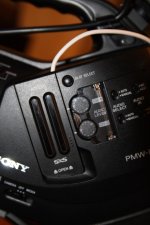


 (I guess Sony offers that option right now, but in a small 60GB capacity)