Photos from the "old days"

So, a bit more about the Soviet cars. In 1966, the Soviets signed a contract with FIAT to license the production of FIAT-124. It was a brand new design that ended up winning the European car of the Year award in 1967. The Soviet engineers actually preferred the French Citroen but Brezhnev struck a deal with the Italian autoworker union off his personal friendship with the then recently diseased head of the Italian Communist Party Palmiro Togliatti. Togliatti spent the Mussolini years in the USSR and, oddly enough, died there while on vacation in Crimea in 1964. The production was placed in a city named after Togliatti, near a city formerly named Kuybyshev (now back to its pre-USSR name of Samara). In the USSR, it was sold as Zhiguli for the nearby river. In Europe and Canada, it was sold as Lada.

For the Soviet use, the car had to be reinforced and rode on much higher suspension than its Italian sibling. That made it horribly unstable in corners. But it was the first modern car in the USSR, when it went into production in 1970. When the production ended in 1994, it wasn't quite as modern.
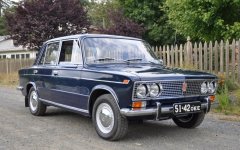
1982-vaz-lada-21033-front-34.jpg

This is my favorite version, 2103. It was supposed to have a 70 hp engine but its 0-100 km was around 20 seconds. My old 1986 Honda Civic had 65 hp and went 0-60 in ~ 12.5. Given the same weight and a similar H-manual transmission, the Soviet numbers seem exaggerated. Nonetheless, when Zhiguli appeared on the Soviet roads in the early 1970's, it was a very prestigious car than was priced around 7,500r, when the average wage was ~ 1,400r per year. 2103 was around 8,500r in the early 80's.

Edit - a January, 1975 test of the export version in Autocar (in English). Priced at £999!

https://diecast43.livejournal.com/54905.html
 
Last edited:
6-24.jpg


Soviet era comic/satire/humor magazine -

---------------------
The lady falls down (off slick iced steps, while wearing high heels)

Husband - you didn't break anything, did you?

Finds the bottle of vodka intact.

Husband - Oh, thank G-d.

--------------------------

Soviet humor.
 
I went to a Soviet version of a "magnet" school. I got into the top study group via a connection (the top physics teacher was a neighbor of ours and my dad's friend). As a part of being exceptionally gifted, we began to study computer programming (FORTRAN, COBOL, PL1) and soon, three quarters of the top floor's lobby was taken by a mainframe. At the time, the Soviets imported the Hungarian made IBM knockoffs. Which looked like the above photos.

I have no idea on the specs. The computer was installed in 1977, so whatever IBM was making circa 1972 sounds about right.

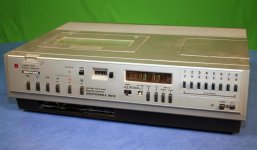
The Soviets kind of/sort of competed reasonably well on the mechanical components but lagged terribly in electronics. Around 1977-78, they began to negotiate with the Japanese about licensing their VHS VCR's and other items. The VCR they got was a 1978 top loader Panasonic NV2000, which came out in 1982 as Electronica BM-12. It was priced at 1,200R (half an average engineer's annual wage) but because it was in huge demand, the "used" prices were around 2,500r. In good condition. A basic 2-head Japanese VCRs were sold in assignment stores only for 3,500r+. And, much like with cars, the VCR was kept in production until 1994.

BM-12.

elektronika_wm12_00.jpg
 
I uploaded the "svimver. eveninkver" ad onto my FB page a couple of months ago .. showed it to my new friends from "over there" ... they never saw it before ... and found it amusing ... a 35 year old video ....
 
6670869_original.jpg

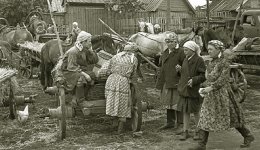
A weekend open air market, somewhere in the countryside, with the patrons arriving via their regular transport.

The catch is that this is 1961.
 
Something more uplifting. A few shots of popular and attractive Soviet era female stars.

Evgenia Simonova, actress (early 80's)

aktrisa-0055.jpg

Irina Ponarovskaya, singer/actress, late 1970's.

Ponarovskaya-birthday-4.jpg

Irina Alferova, actress, 1980's.

678921.jpg

Irina Azer, actress, 1970's.

bb3e66d4450a860bfe277c6468f25f8b.jpg

Lyudmila Senchina, singer and sometime actress, 1970's.

13.jpg

Natalya Vavilova, actress, early 80's.

649576.jpg

Natalya Trubnikova, ballet dancer, actress, late 70's..

1299053.jpg
 
A more prosaic memory.

3b7287401bce304eb926a530b723f4e2.jpg

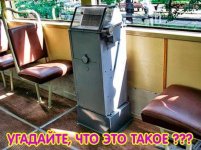
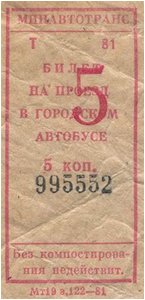
A bus/train fare machine from those days. Often accompanied by a 'conductor" who took your change and gave back the ticket that looked like that.

995552.jpg

Self-service from 1960's.

scale_2400
 
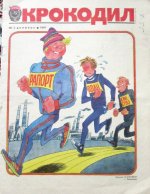
A cartoon from the satirical magazine "Crocodile" (because it delivered biting humor ... get it?).

ruebd5c047ef7.jpg

Three athletes running (in rough translation) - Propaganda, Plan and, bring up the arrears, Actual Product.
 
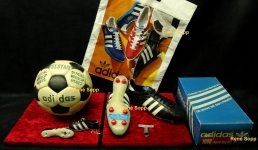
I can only assume those photos predate the invention of the Adidas tracksuit

So, here's the Adidas story. In the early, 1970's, the Soviets realized that their footware wasn't even close to the top quality product from the West and began to purchase running/track shoes for their top stars. A star, naturally, had to file a special form - this was likewise the practice among the musicians asking for a Kremona or a Jolanta, as the Strat's and the Les Paul's were not available via the official channels - and the most requested brand was the dominant Euro brand Adidas. Some basketball players asked and received Converse but most preferred Adidas since it didn't only equip the West German soccer team, it made the greatest soccer ball ever - the Telstar, that was used at all major tournaments for about six years.

18527046308_264d7d4ae2_b.jpg

However, the Adidas footwear was not just used for races. According to Valery Borzov, the 1972 Olympic 100-M dash champion, the athletes would only use them to race in big events but all their training was done in the Soviet shoes, as the brand names were too nice to waste on practice (I am talking about practice, not a game, practice). Instead, the Adidas shoes were taken to the disco parties, where they were not just effective for movement but for attracting ladies too.

Here's Borzov winning the 1972 gold medal. Do note the shoes. On all runners.

track-field-1972-summer-olympics-soviet-union-valery-borzov-in-action-picture-id81341200


By 1976, the Adidas management wanted more and, with Moscow getting the 1980 Olympics, Horst Dassler, then running the French branch of the company, decided to approach the official Soviet representatives for a full kit deal. It was indeed struck and the Soviets begin to both buy and produce the officially licensed Adidas merchandise. The problem was that Adidas took the bulk of what was made in the USSR and sold it to the 3rd World markets, including the Socialist bloc of the East Europeans.

An Adidas labeled shoes ran anywhere from 10 to 26 rubles (average wage 120-140/mo) but were next to impossible to find in state stores. Off "resellers", the prices doubled. An authentic Adidas pair of running shoes made in West Germany could run over 100r. Meanwhile, the label itself much like Levi's or Wrigley's became a sign of prosperity and being a member of the elite subclass.

nemolyaeva_33.jpg

I posted this photo before. It's of an actress Anastasia Nemolyaeva, then 16, from the 1986 Soviet film "The Courier" (aka the "Gopher Boy"). The sweater was actress's own, as her father was a well respected cinematographer and her aunt was a popular actress. The Mosfilm prop department had no such thing and the role was that of a professor's daughter. When I first saw film in 2009 or so, I didn't get the brand reference. I do now.
 
Did you just throw in a little Allen Iverson reference? lol

And also, a Kremona and Jolanta references. A few former members of a popular band told me the process of guitar acquisition. There was a catalog, though most performers looked at what others already had and worked off their reviews. Then one had to fill out a form with the brand and model number and submit it to his local philharmonic hall administration. The administration would then decide if the budget warranted such an acquisition. A Soviet made guitar was in low hundreds but a Czech, Bulgarian or East German guitars could double/triple that. If one wanted an authentic US made model, he was on his own. Boris Pivovarov, considered by many to be the top Soviet player of the 1970's, purchased a 1957 Les Paul Custom for 3,500r in 1972.

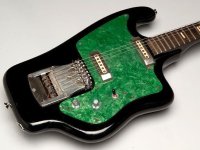
Wedding and college bands had to play the Soviet brands. Here's Tonica, referred by some as "the worst guitar ever".

tonika8.jpg
 
Soviet cigarettes.

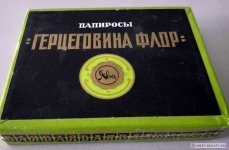
Josef Stalin smoked "Herzogin Flor". He often broke up the individual ciggies and stuffed into a pipe.

Gertsegovina-Flor.jpg

The infamous Belomor Canal.

Belomorkanal.jpg

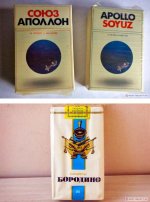
Apollo-Soyuz, because when you're riding through space on rocket fuel, you want a bit more danger. Below that, "Borodino", because the Soviets even celebrated battles of resounding defeat.

Soyuz-Apollon-Borodino.jpg

Cosmos, personally endorsed by Yuri Gagarin. Or not.

kosmos-sigarety.jpg

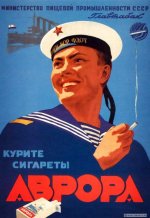
Aurora, endorsed by the entire Soviet Navy.

Ulybayushhijsya-moryachok.jpg

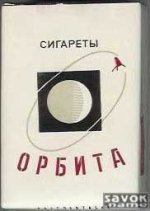
My dad smoked these, "Orbita'.

26.jpg

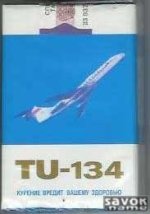
And these, imported from Bulgaria.

45.jpg
 

Attachments

  • TU-134.jpg
    TU-134.jpg
    19.1 KB · Views: 0
  • 14.jpg
    14.jpg
    8.2 KB · Views: 0
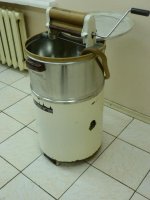
mechanic2laundr++7-18-2013-17-22-6.jpg

A ubiquitous Soviet washing machine Riga55, allegedly a licensed copy of a Swedish model from the same era. Six million units made. A single chamber spinner. Water had to be poured in manually and there was a hose for a run-off (manual too). The water could also be squeezed out ... or one could hang wet clothes on a balcony. In our building, there was even an external drying area, where there were six concrete posts about seven feet in height. The clothesline was not provided.

Once I recall, someone was drying a heavy wool blanket there in the middle of winter. The blanket froze rock solid. So, we kids tried to shoot hockey pucks into it, hoping that a hard slap shot would puncture a hole. I don't think any one us succeeded. We needed more oomph in our shots. And a higher quality hockey stick.

scale_2400
 
Those poles are all over those countries. The ends with the metal top are indeed for blankets and carpets and rugs. We did pull-ups on them. (Were much higher than above.)
 
Ours were actually made of concrete pipes (hollow inside) and the area was much larger than above too, @ ~ 20 x 10 meters. There were no horizontal rods either. We mostly played soccer or hockey there anyway but, when someone covered everything with laundry ... well, we continued playing despite being yelled at. It was an additional series of obstacles one had to overcome.

PS. We were also helped that we had a fence behind it, so we used those concrete pipes as goal posts. Which worked pretty well until someone shot the ball over the fence. Then he had to go into the neighboring building's backyard and get the ball. The puck was a lost cause, especially if we played in snow. If it went over the fence, it would not be found until the following spring.
 
Back
Top