GH4 panny users who also used/have Black Magic....

wwjd

Well-known member
I'm asking here - you guys - because I notice you have a wide variety of experience and several also own some Black Magic cameras. So asking on the BM forum is not helpful in any way to me, so PLEASE don't move my question.

IN YOU GH GUYS EXPERIENCE, what are some of the pros and cons about stepping up to the various BLACK MAGIC cameras? The new 4K looks nice, but I could afford the 4.6 UMP - if I used only the SD Cards (which would be fine for this advanced hobbyist).

BUT, you guys USE these gears and have real world experience with it. Drawbacks?

- is vertical line pattern still an issue?
- is ISO limited? like 400 to 800 only?
- is low light just not as good as GH5?

My ONLY interest is movies/cinema creation, not photos, not commercial, just movie making.

Would love feed back from real GH users, good and bad for springing for BM gear.
REALLY leaning to the UMP, but that orphans my m43 speedbooster, so that is kind of a loss. Wonder if the higher bits (and less that 4.6k, and less DR) of the P4K would seem better, verses loosing a stop with the UMP.

Anyway, post any thoughts and experiences you've had.
 
I think the two largest selling points for the BMPCC4K over any Panasonic offering is RAW and the BM color science.

That the P4K is half the price of a 5s is no small bonus, either.
 
I've owned multiple units of every single Blackmagic camera at one point in my life (including the HD and 4K Studio cameras recording to Infernos or Video Assists) besides the Pocket 4K and the UMP. (The UMP has the same sensor as the original 4.6K URSA Mini.)

The bottom line to answer your questions without writing a novel:

- FPN is to some degree an issue with all of their cameras (IDK about the Pocket 4K), especially their 4K sensor that's in the BMPC 4K, original URSA & UM 4K. There's a trade-off: the more you push a certain model's native ISO (both in camera and in post) the more you're likely to see it. And if you use a a non-native lower ISO the less you're likely to see it, but you'll sacrifice dynamic range.

- ISO is limited on all of the cameras besides the Pocket 4K, which is the first camera of its kind for BM. The native ISO on the BMCC and original pocket is 800 (can't go any higher in the menu) and 400 on the 4K global sensor mentioned above (you can go up to 800 in the menu but the FPN is not forgiving). The UM 4.6K and UMP has a native ISO of 800 but some people claim 1600 is pretty clean for them, and they also just released a firmware update not to long ago raising the ISO to 3200 for the UMP (not the 4.6K UM). No experience with it. The studio cameras behave differently but I'm assuming you're not interested in them.

- Low-light is non-existent in any of the cameras (besides the Pocket 4K) unless you consider a max ISO of 400/800/1600 to be usable. As mentioned, the UMP now has 3200, but it's still a low ISO compared to modern day offerings.

---

That is just half of the story as each camera also has its own quirks.

But with that said, if you receive a good camera off the conveyor belt, and have the patience and experience to work around any flaws, you're not going to find many cameras in the world that produce the kind of images they do.
 
I have the Mini 4K and have been using it since it came out. If you're willing to put in the time to light your shots, it is flawless and probably one of the most cinematic cameras at this price point (even better than the 4.6K which has a video feel to it). If you're wanting run and gun, look somewhere else, these cameras are not for you. On my 4K, yes, the native ISO is 400 is I won't go above that. But I've also shot tests with a single candle that are devoid of all noise because I let the blacks go black. Coming from Canon DSLRs, this camera changed the way I think about cinematography and lighting. It is a fantastic choice with an unbeatable image if you're willing to light it like a movie. Again, if you're wanting low light run and gun like a film student, this camera is not for you.
 
I have a GH4 and a Pocket 4K. I didn't get the GH5 because it didn't seem worth spending $2k to upgrade.

  • It's easier to get a beautiful image with the P4K, but if you can control your light you can also get a beautiful image with the GH4.
  • The P4K goes through storage like my kids go through Halloween candy.
  • Low light is markedly better with the P4K. I haven't noticed any FPN or other artifacts.
  • Focusing is a lot easier with the P4K with its 5" screen, but of course the screen doesn't articulate so that limits the kinds of shots you can get.
  • Autofocus is faster on the GH4 (and the P4K doesn't do continuous autofocus at all).
  • Battery life is much, much better with the GH4.
  • The internal microphones are roughly equivalent, but the P4K's are placed where you might accidentally brush against one with your right hand. They can also pick up the fan noise when the fan kicks into high.
  • The P4K's mini-XLR input has a decent preamp, but its gain (while clean) is nowhere near what you'd get with a Sound Devices mixer.
  • The P4K's menu is much, much better than the GH4's.
  • The P4K is larger than the GH4, and that limits the selection of gimbals that will work with it. It is very light, though.

Overall, I consider the P4K a definite step up from the GH4. I'm not really into slow motion, so haven't played with that much. I also haven't played with the baked-in-LUT capability. Both seem as though they could be useful, and would be better than what the GH4 offers. (Obviously the GH5 slow motion is better than the GH4's, but so far as I know it still isn't easier to turn it on, while the P4K has its High Frame Rate button.)
 
THESE replies are PERFECT, thank you for this info!

That FPN and reliable manufacture is what worries me, and got me the GH4 over the BM PC 4K when it came out, and I feel I made the right choice. I don't like new stuff breaking down, having weird issues requiring returns and waiting months. It's feeling like the Pocket 4K is the better match for my interests/needs. I don't need run and gun at all, but also don't have tons of great studio level lights for the limitations of the UMP style - even if they offer better DR. PLUS I'm already decked out with m43 speedbooster and a range of EF lenses that benefit from it. And have a ton of high speed SD cards..... the UMP, great as it is, would need more parts, more setup, more time, more money, and more restrictive shooting it sounds like. GREAT camera, but I don't get paid at all, so no benefit there.

Avoiding the GH5 as bason said, seems like a marginal (but positive) update, where the P4K can do even higher quality rates/codecs.

Who makes the best batteries for the P4K? I know they go fast compared to GH4, so figure I'll need 4 to 6
 
I dont know exactly the question here are some comments..

BM

Ive shot a feature on the original BMCC (silver square one) - at low ISO the image was good but limited in DR. No fpn - Im sure people get this when they under expose.
The camera was 100% reliable.

I lit a feature shot on the URSA mini .. again great image, 100% reliability and lack of high ISO, DR better.
I found that the 'ISO' was about a stop slower than my light meter - really happy at a true 400ISO on light meter with 800 on the camera

I own a BM micro - 100% reliable, DR not huge and ISO not high.

BM files are proper files that look like stills frames taken from a somewhat dated digital stills camera - this is a very good thing.

Even my BM micro challenges my FS7 for picture fidelity.

All BMs seem to 'sing' when built for cinema with external monitor etc and near some lights. They sing a much louder and purere tune than any panny apart from maybe the GH5s or EVA

GH

The GH4 is small and light and great for grabbing a second angle - its just there -- in the bag, turn on press record, the battery wont be flat, the card wont be full the screen can be wangled to where you can see it. The GH4 is an awesome machine for picking up simple B angle shots. I often use it for overheads on corporate shoots.

GH cameras .. you cant flip out the screen and have HDMI plugged in at the same time - a major design fail.

GH camera have horrific menues.

I own a GH4 - the codec just doesnt feel anything like a BM, its full of compression artifacts and wont grade, ISO is euqally terrible too.

I recently dropped my GH4 from 18 inches and snapped the lens mount - that should not have happened with such a low impact

The GH4 is small and light and great for grabbing a second angle.

I recently shot a GH5s - the file looks nice really a match for my FS7 DR.. but it was too sharpened.. being a rental camera I didnt have long in the menu..maybe I could have dialed the sharpening back. (I expect the rental house to have made it cine ready.. it was in Vlog)

GH5s chip and 10bit aquisition is professionally usable as an A cam that challenges the FS7 for picture fidelity and DR

Breaking my GH4 has put me off the GH series.

Personally I think the physical layout of all the above cameras is terrible. We struggled to get the GH5/cage onto my Ronin gimbal

I hate wide cameras.

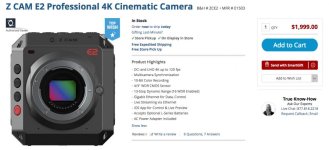
Putting all of these exeriences together.. if you want a small light MFT camera.. then check out the Zcam E2 same chip as GH5s but a form factor for adults.
 
Last edited:
I own both the GH5 and the P4K. The GH5 has quickly become the b-cam and my stills camera. The P4K has become my workhorse.

There is no FPN on the Pocket 4K, and it's low light capabilities are comparable to the GH5S. (Though it does not pre-smush the image with noise reduction, so you must apply NR it in post to see similar results.)

The main reasons I could see to step-up beyond the P4K to the UMP are:

- If you prefer "big camera" ergonomics
- If you prefer the larger format. (Though with SpeedBooster, P4K is almost the same.)
- You need the extra dynamic range
 
Putting all of these exeriences together.. if you want a small light MFT camera.. then check out the Zcam E2 same chip as GH5s but a form factor for adults.
Have you shot with the E2? I've been following it very closely as I think it is the form factor to beat, but I'm waiting for ProRes license to be granted. (I'm not gonna mess around transcoding h265.) If they really can achieve 15 stops of DR outside of the WDR mode, and have 120fps 4K, in ProRes, in a form factor that can be rigged any way you can think of, then it's a killer camera.
 
Supposedly - if granted - the PR license will be only up to 60p, and 120p will be in H.265.
 
Have you shot with the E2?

I have not - we had a VR Zcam in the house for a bit but I didnt concentrate on it beyond observing adult build quality and no complaints from the project.

Having used the GH5s Im sold on the chip .. but if the Zcam works is anyones guess!
 
Long time Panasonic user here from the hacked GH1 days. I've had the GH5 and GH5s since their respective day ones and added the Pocket 4K to the arsenal in early October. They are all amazing cameras, but the GH5s and Pocket 4K are the most comparable for narrative work.

Things that I love about the GH5s for filmmaking:
-Incredible low light performance
-Great colors straight out of camera with even bigger benefits in color grading
-Great compression to image quality ratio IMO
-XLR-1 module has eliminated the need for external recording for much of my work
-Battery life is pretty good. Not great when compared to GH4 though
-AF is actually useable in certain situations now
-Can easily put it on a gimbal
-Viewfinder is incredibly useful outdoors
-Easy to use stripped down
-Dual card slots with backup recording
-240 fps overcrank in HD
-Articulating screen

GH5s cons:
-Lack of some exposure assist tools
-Cannot punch in while recording
-No Raw


Things that I love about the BMPCC4K for filmmaking:
-Incredible low light performance
-Raw recording up to 4K60p
-Native ProRes recording
-Gorgeous Blackmagic color science
-Excellent exposure and focus assist tools
-Huge 5" screen
-Focus punch-in while recording

BMPCC4K cons:
-Battery life
-No EVF
-Fixed screen

For me, the GH5s is a better camera out of the box for commercial videography as well as in some filmmaking applications, BUT once you enter into serious filmmaking territory the BMPCC4K takes the cake. Think about it. You build up either camera with a cage, follow focus, external monitor, external media, and extended-use battery solution for long days and all of a sudden the advantages of the GH5s slip away and you're left with judging them based on image quality. That's the scenario where the BMPCC4K blows pretty much anything under $10,000 out of the water. It has become my A-cam for basically every shoot since I got it.
 
Again, thank you all for typing up such detailed replies. I'm reading, and re-reading them all. WONDERFUL info and feedback from GH+P4K users!

This Zcam E2 thing is intriguing. 16 stops, really? If I can get that for a few hundred more, that's amazing. Gonna check that out.
 
Again, thank you all for typing up such detailed replies. I'm reading, and re-reading them all. WONDERFUL info and feedback from GH+P4K users!

This Zcam E2 thing is intriguing. 16 stops, really? If I can get that for a few hundred more, that's amazing. Gonna check that out.

The Z-cam E2 uses it's dual gain for higher dynamic range instead of cleaner high iso like the GH5s, P4K and Terra 4K (all Sony IMX294).
Both the Terra 4K (nicest image imho, with Log C like color science) and BM Pocket 4K are way more cinematic than the GH5s thanks to no sharpening and noise reduction used in camera as well as better dynamic range (active cooling, better A/D converters) and nicer color science.

The big disadvantage of the E2 are its strong internal processing and the high DR mode only works with static subjects.

Z Cam is claiming their new Zlog2 profile which uses a 14bit readout drive mode to get 15 stops of dynamic range. This isn't HDR so there is no ghosting. They have put out test footage against the Alexa but its hard to determine the Dynamic range from what they gave. Definitely an interesting development. Prores is also available on the camera, though its not been unlocked yet as they haven't gotten the license yet.


The crazy thing is the $1000 BMP4K is beating the $4000 BM ursa4.6k in low light, by quite a bit.
 
have not liked any of the footage I found from the Z-Cam E2. :(


The UMP 4.6 has a lot of other utility and DR as well. different tools for sure. I'd go 4.6 pro in a hot second, if I had a studio to film in, budgets, schedule, profits, lighting.... but feels like the P4k fits MY needs better: smaller, better at some of the things I like, like lower light, I'm already setup with m43 with SPEEDBOOSTER and pile of EF lenses.....
 
The sample ZCAM E2 footage is bad simply because it's bad footage...it would be bad from any camera. With the right codec, it's capable of going toe-to-toe with the Pocket 4K, but with double the frame rate in 4K AND a much better form factor for kitting out into a usable camera. I'm not willing to go through the hassle of transcoding h265 for real work, but I've played with the samples enough to see that when they unlock ProRes, the E2 will be a formidable contender.

PS. The new firmware's new log profile also eliminates any sharpening beyond what is necessary for debayering.
 
and the competition ramps up! Can't wait to see what is next. I hear rumblings of 8K cameras getting ready for release...
 
I own a gen1 pocket and a GH5S.

The Ursa mini pro / 4.6k is the camera to beat if you want dynamic range (besides the alexa ofc).

On the other hand, the Pocket4k and the GH5s will have a much better low light performance (AFAIK, the pocket edges out the GH5s on dynamic range).

Overall, Panasonic has a better track record with reliability and build quality than Blackmagic. The Panasonic GH family is more solidly constructed and works better out of the box without wonkery - the colors work, no need to grade if you don't want to, you don't need an external power source for instance, the battery gives you 2 hours at least, while the old and new pockets have atrocious battery life. If such a thing matters for you, the GH5S has usable AF, while the pocket doesn't really.

The pocket4k will give you somewhat better DR, a wider range of codecs and RAW acquisition at a really really good price.

Really, it's up to you. As the pocket4k is priced so well, I may just pick one up later on, just to have that extra stop of DR and RAW.
 
Back
Top