Panasonic S1 2.0 is out

To me, the craziest thing about full-frame is how insanely popular it was around 2010 and then it somehow disappeared for like 10 years (mostly due to no great options), and then had a major rebirth around 2020.

Obviously you always had the a7S' and company but no one else was making full-frame cameras without crops and awesome specs and then suddenly it's like everyone rediscovered full-frame sensors.
 
To me, the craziest thing about full-frame is how insanely popular it was around 2010 and then it somehow disappeared for like 10 years (mostly due to no great options), and then had a major rebirth again around 2020.

Obviously you always had the a7S' and company but no one else was making full-frame cameras without crops and awesome specs and then suddenly it's like everyone rediscovered full-frame sensors.

Of course, you still have plenty of S35 dead enders
 
Or here, I saw multiple articles about using the light ranger 2 in uncut gems for improv staging and shallow DOF where everything they wrote could be said about AF

The combination of unpredictable choreography and a depth of field flattened by distance would’ve made focusing these scenes impossible. That is, if not for a focus-calibrating device called the Light Ranger 2, which has amassed a cult following among Hollywood’s camera crews. “The Light Ranger 2 is going to revolutionize this piece of the industry,”

https://www.google.com/amp/s/www.in...gems-secret-cinematography-light-ranger-2/amp
 
Oh, yeah, I mean you can say the same for anything in life, really...some stick with what they only know/like to the end.

Many on here love MFT.

And, lol...poor Panasonic threads always get jacked with OT convos.
 
Oh, yeah, I mean you can say the same for anything in life, really...some stay to the end with what they know/like.

Many on here love MFT.

To be fair, there are advantages to each of those systems. But the people who say that full-frame has no advantages or is for dilettantes make me laugh
 
I sort of think that it only became reliable enough to be interesting a few years ago...
70D came out at the end of 2013 and was the first dual pixel auto focus system on the market. The problem with 70D was that its general video quality was pretty crappy, even for its time.

Howevah!

At the same time, Canon offered a paid dual pixel AF upgrade for C100 MKI. The AF worked in the center of the frame only and I recall Philip Bloom shooting some model on Miami Beach while trying to figure out where the "center of the frame" was. He discovered that once the AF was set, one could drag it a bit here and there.

That was over seven years ago and one had to send C100 to Canon's service centers (with the US being in New Jersey) for the upgrade.

Still, 2013 is a long time ago in digital years.

The thing is - in my opinion, autofocus isn't interesting unless it can do at least as good a job as I can. I don't know about the 70D back then. But my interest wasn't piqued until I saw what Sony 4D focus could do (first on the a6500 or something?)

And there's a reason why autofocus improvements are one of the main drivers of camera upgrades for photographers (based on photogs I've talked to about why they upgraded at various times). Because when AF misses, you are royally poo pooed. (And I've seen many photographers go to look at their great shot and say, "The camera missed!" I never wanted to be that helpless and dependent on my machine.) And it's just one of the areas that has seen the most improvements in the last 15 years. If you look at shots from the 5Dmk2 or 15-year old Leica cameras, they really don't look that bad. I don't need 80MP.

It's like relying on self-driving cars. The good news is you can nap on the way. The bad news it may be your last.
 
Last edited:
Sony's 4D Focus was shown around 2014 and I think it was used in a few HD models, but it wasn't truly semi-reliable and well known by the earth until it was introduced in the 4K a6300.

Canon's first truly reliable 4K DPAF camera was the 1DX Mark II.

Both were announced in 2016 a few days apart...which by now I hope surprises no one.
 
I have a friend, who is a jogging addict, a half-marathon each morning, even got profiled in various international running mags. Naturally, he runs with his iPhone. Which has a great AF. So, a few days ago, he sends me a photo of a Krispy Kreme store nearby, which has a free donut ad in its window. Except the store in his photo is badly out of focus because he didn't notice a tree in the foreground. The tree was in focus. The donut ad wasn't. And that's how it often goes for the amateur shooters.
 
S1 runs timecode internally but can’t sync with a jamming device - only S1H

Thanks Soarprod, but are you sure that with the new 2.0 update for S1 there is still no Timecode In jamming our at least timecode out via the flash sync connector possible?
So it only got timecode functionality without jamming?! Where is the benefit then??
 
That’s a S1H exclusive. Before on the S1, each file would start from zero. With the update they have the correct time of day or record run time code.

Thanks Soarprod, but are you sure that with the new 2.0 update for S1 there is still no Timecode In jamming our at least timecode out via the flash sync connector possible?
So it only got timecode functionality without jamming?! Where is the benefit then??
 
View attachment 142993

View attachment 142994

"There is something about having a field of view that is equivalent to 35MM stills format, somehow it feels more natural."
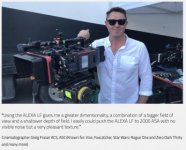
View attachment 142995

https://www.arri.com/en/camera-systems/cameras/alexa-lf

Nothing they're saying wasn't true about shooting with the 5Dmk2

It was never about thinking FF was garbage but addressing the obsession that many felt they had to have FF. Especially those that didn't realize 100+ years of cinema that they love was never FF.

Some of us like to address the gear obsession people have and point out the reality that the sensor size really doesn't make much of a difference at all. Sure some DPs are excited to have it as creative choice but it also isn't a must. Its just a tool to them. The reality is many non pros see FF and think its the standard when it in fact has never been the standard in cinema. That may change in the future but to think one can only be a film maker if they have FF is insanity. Before amateur film makers attempt to push the envelope with FF I would rather see them master the craft first with the tools film makers have been using for over a century and then when it suits the situation break the rules.

The DPs excited about the LF can visualize a stunning movie if they had m43, s35mm or FF. They have mastered their craft and can choose sensor size in much the same way as they used to choose film stock or lens choices. Its an aesthetic choice and not one of necessity or quality.

There is also enough overlap between sensor size and DOF and FOV to only really matter on the extreme ends. FF only truly has an advantage for wider open extreme wide angles. m43 only truly has an advantage for extreme telephoto. most looks can be replicated with the right lens choices and distance except for those rare extreme circumstances.

For example m43 has f0.95 options at 10.5mm. Thats roughly equal to 21mm f2.0 on FF. Thats pretty darn wide and bright. Typically much brighter than a movie would be shot at due to focusing challenges and less than stellar optical characteristics. FF can potentially get even wider and brighter but that starts to become more of a special use more than a norm for a production. For example one can get a decent 14mm f2.8 lens for FF. m43 would need a 7mm f1.4 lens to match that and that is really a very difficult lens to create. So FF has an advantage on that extreme end.

The situation provides even more of an overlap for S35mm that gains a stop advantage over m43. If you add a focal reducer to m43 however its a level playing field. Plus on some m43 sensors like the P4k a focal reducer gets you right in between s35mm and FF. This is again why it matters very little. It was never the sensor size or crop factor that held back anything. It was an excuse and nothing more. Depending on the lens mount APS-C can also use a focal reducer to get closer to FF. I wonder when cinema cameras will adopt a mirrorless mount so they can too use a focal reducer with mirrored lens mounts like EF. The p4k for example is m43 but with a 0.64x Metabones and UHD its a 1.3x crop and 1.22x for DCI. Thats getting pretty darn close to FF already.

My point is it really doesn't matter all that much at all. For every article you can find of a DP excited about the LF there are dozens of articles of an award winning film shot on regular old every day plain jain s35mm. If one has a creative reason to shoot on FF vs s35mm then so be it but that should not be considered the norm or reason to buy a camera. I personally don't like FF even for stills because I like to shoot telephoto a lot and FF kind of sucks for telephoto. The lenses are insanely expensive and heavy with very little gain. m43 is actually a stunning format for telephoto and some photography veterans have moved to m43 for this very reason. Much better for travel/nature. Use the right tool for the job.
 
It was never about thinking FF was garbage but addressing the obsession that many felt they had to have FF. Especially those that didn't realize 100+ years of cinema that they love was never FF.

Some of us like to address the gear obsession people have and point out the reality that the sensor size really doesn't make much of a difference at all. Sure some DPs are excited to have it as creative choice but it also isn't a must. Its just a tool to them. The reality is many non pros see FF and think its the standard when it in fact has never been the standard in cinema. That may change in the future but to think one can only be a film maker if they have FF is insanity. Before amateur film makers attempt to push the envelope with FF I would rather see them master the craft first with the tools film makers have been using for over a century and then when it suits the situation break the rules.

The DPs excited about the LF can visualize a stunning movie if they had m43, s35mm or FF. They have mastered their craft and can choose sensor size in much the same way as they used to choose film stock or lens choices. Its an aesthetic choice and not one of necessity or quality.

Sure, but that was kind of my point: that any strong reactions in favor of or against the sensor size are basically fashion statements. Either a fashion statement by people who see it as bigger and better, or a fashion statement reacting against those people because they're amateurs. And the high-end camerapeople in the Arri marketing materials are obviously also making a fashion statement. Some of what they're saying is complete bulls*%t - like about field of view. There's no inherent difference in field of view between formats (except perhaps as you say for creating ultra-wides, which are rarely used anyway).

But I'm saying that once some big-name DP uses the tool and writes it up in American Cinematographer, it becomes acceptable to show your approval.

And there are definitely advantages to full-frame: light sensitivity, selective focus on wide-angles, superior optical quality at equivalent DOF. But that's about it. Like - you talk about f/0.95 on M43, but you're sort of pushing the envelope there. On a medium format camera, you'd be at an f/2.8 or whatever and likely have far better IQ.

There are also drawbacks to using focal reducers, enough so that some eschew them entirely.

Anyway, my point was absolutely not that full-frame is superior to S35. Just that there's nothing wrong with it, and it has some advantages (obviously deep focus is not one of them).
 
It would be nice if cameras were built with full-frame sensors and interchangeable mounts, and optimized in all crop modes and settings (currently they are not which is why it doesn't work well).

But if possible, Panasonic could have a S1H with a MFT mount and all existing MFT users could use their glass in the S16 mode. Or you can use a full-frame lens and have extreme range.
 
Technically, it is possible but the MFT crop would have to be 4K'ish. A7RIV (and A7RIVa) have a 15MPX center crop off a 61 MPX sensor, so Panasonic would have have its 47 MPX camera with a 4K MFT crop. But it'd not make much sense either.

PS. As to the top end of the cinema market - i.e., big budget features - it's been in the 65mm film camp for a long time. That's what allows a 2.4 ratio and high res in one frame. And that's where digital is going also. Medium format. Stills. And video.
 
Many years ago, Kinefinity cameras cropped down to MFT/S16mm 3K and 2K from their 4K S35 sensor, but quality was questionable. Was a long time ago though.
 
Back
Top