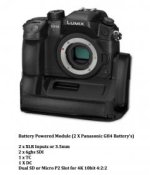
Panasonic 4k camera system info & updates

The EOSHD hands on review stated it needed external power.

Looking at the EOSHD hands on, it doesn't seem like they had much hands on. It was a presentation from Panasonic they attended. When I see something from someone using it in the field, I'll believe it... but neither press release nor the B&H page mention it. They only say that it's available to power the camera.
 
No really? Well that's different then, I'll go out and buy a large sensor video camera from Panny then. What do you mean they haven't done one since the AF101? I already sold mine. Oh, the Varicam you mean? Is that less than $20k then? Great! Wait, it isnt? Oh.
If you want to patronise me then I'll do it right back, I've been doing this a long time. If you read the post, you'll see that what I'm complaining about is the fact they release a video-mount-unit-thingy that's designed to turn a DSLR into a video camera, which in itself is a great idea, and one lots of us have been asking for - but then they screw it up by making it unwieldy and requiring V-locks to power, so we may as well stick with big rigs and offboard recorders. Pointless. If they've made a dock that LITERALLY turned your DSLR into a video camera, with handles, mounting points and proper controls then lots of pros, including me, would buy it. But they haven't.

Why does your large sensor video camera have to be from Panasonic? There are plenty of
large sensor video cameras under 20 grand out there. If you need one, you don't have to wait
for Panasonic to make one.

And yes, you are right, they should have made the attachment better. But then, I don't
really like the form factor of the GH4 itself (or other DSLRs for that matter). I guess these
things will always be a matter of personal preference, some people will like them, others,
not so much.
 
No really? Well that's different then, I'll go out and buy a large sensor video camera from Panny then. What do you mean they haven't done one since the AF101? I already sold mine. Oh, the Varicam you mean? Is that less than $20k then? Great! Wait, it isnt? Oh.
If you want to patronise me then I'll do it right back, I've been doing this a long time. If you read the post, you'll see that what I'm complaining about is the fact they release a video-mount-unit-thingy that's designed to turn a DSLR into a video camera, which in itself is a great idea, and one lots of us have been asking for - but then they screw it up by making it unwieldy and requiring V-locks to power, so we may as well stick with big rigs and offboard recorders. Pointless. If they've made a dock that LITERALLY turned your DSLR into a video camera, with handles, mounting points and proper controls then lots of pros, including me, would buy it. But they haven't.

Chill, my friend. Sorry, I wasn't patronizing you.
I was saying (maybe in a clumsy way) that what you wished for basically described a true video camera. Sensor? -check. Lens mount? -check. Time code? -check. SDI? -check (in some cases). XLRs? -check. ND filters? -check (not on the GH4). Easily swappable batteries? -Ah, ha! That's where a video camera can shine, unlike the base unit for the GH4 (assuming it cannot be internally powered, are we sure on this?). And there are affordable S35 cameras already out there, as you well know. Not from Panasonic, not yet, anyway. Do you have to buy a Panasonic? I'm not brand loyal, if a company doesn't offer what I require, I look elsewhere. (For the record, I own a Panasonic camera. And a Sony.)

I agree, this is a fantastic camera from Panasonic. The detachable base is a delight, I love the idea (I hope its internally powered). For run and gun, quick shooting and portability, the GH4 by itself is hard to beat, especially if it's for around $2,000. The internal 4K codec sounds great to me. I expect they'll sell tons of these, maybe even one to me.

But if Panny decided to put the sensor and internals into an AF100-type body and charged about the same for the GH4 and its base, I'd pick that over the GH4, as I prefer a true video camera. It would be more easier to wield, yes? Put it in a small shoulder-mount design, and I'm all over it.
Isn't that what you were basically asking for? That was my point. You and I may be looking for the same thing. A DSLR-type camera design always seems to have compromises in order for it to be both a good stills and video camera. The GH4 is no different, although it's a lot more video friendly.

And as far as you "doing this a long time," I assume you meant work in TV/film production? Congratulations, longevity in this field is a very good thing. I've been in it myself since 1984.
 
The big question is how much of the sensor gets used for 1080 HD? You'll get optimum quality (with the extra crop factor) by still using a 3840x2160 window, from which HD can be easily derived. Easily checked - take a still photo, then record some 1080 video with the same lens settings and see what happens to angle of view.
The big question to me, which relates to your question, is how are they doing the downscale to 1080p? If it's full sensor, they'd either need to line skip (horrible), or software scale (good but processor/bus expensive). If it's 2x2 bin from 3840x2160, then the quality will be good, but more cropped.

I don't think software scaled is a possiblity as it would require the full sensor read out, and since 1080p can go up to 96fps, doesn't seem possible.

Which would you prefer then, line skipped no crop, or 2x2 bin cropped?
 

http://youtu.be/hHKJ5eE7I1k

Rule #1 of tropical shooting "avoid using monkey ass shots"

. . .seriously though, this thing is going to work really well for me (the GH4), I particularly appreciate the prospect of a sanely compressed 4K workflow. All-in-all I'm satisfied I didn't drink the BM koolaid.
 
Last edited:
I love that panasonic has went with the IO optional attachement, but man, I can't imagine how they came up with the layout/shape. With that size, you'd surely be able to fit another standard battery in it (or two), or make it slightly bigger and make room (as you suggest).

Why are the ports on the right side? It makes it have to be far too wide for hand holding. Though, if you're going to use those ports, anyways, the optional grip seems to be suspect for hand holding. But having XLR's/Power on the left, and SDI on the right (stacked), would have been good for people who want XLR mic's but not use external SDI outputs, and still hand hold.

The big meters on the back are neat, but seem like a big waste of space. They could have put them closer together, or smaller, and put some ports there (as if you're using this, you probably won't be putting it to your face, but have an external monitor, or in a rig.

Oh well, it's a huge step forward for DSLR/Mirrorless video, and kudos to Panasonic for providing it! I think I suggested something like this quite a few years ago!

I would think body will be around $1699, and this accessory to be around $2499, combined, around the price of a AF101, and I bet they'll sell more of this accessory than the AF101, so it's a win. It's really a good idea, get people of all markets in on the GH4 body, and entice them for the upsell.

This could leave room for an AF200 which has all of the GH4+grip features + a few others like ND's, and ergonomics, at around $4-6k.
 
They've said 4:2:2 can be output at either 8 bit or 10 bit through HDMI - Whan HDMI is output at 8 bit 4:2:2 you can have simultaneous footage recorded to the card (which will only be 4:2:0) Simultaneous recording to the card can't be done when outputting 10 bit through HDMI

Yep; the only remote question I was considering is -- while we can record 4:2:0 and output 4:2:2 8-bit simultaneously, we can turn off the recording and output 10-bit, so... does the reverse also work? Could you turn off the output, and then gain enough power back to record 4:2:2? If we turn off the recording, the camera gains more power to output a bigger signal, so ... is the opposite true? If we turn off the output, would it gain enough power to be able to record a bigger signal? I think the answer is almost unquestionably "no", but I didn't want to rule out that remote possibility until we see final specs.
 
Because the 200mbps mode is All-Intra, and the 100mbps mode is long-GoP. It sounds like if they tried to do all-Intra for 4K, it'd take up 800mbps, and that's just unreasonable to record. Apparently they feel they can get the quality high enough using the long-GoP system at 100mbps.
If a 200-Mbps data rate is supported, then why didn't they do a 200-Mbps long-GOP mode? It seems to me that that if 25- to 50-Mbps AVC-LongG can record 10-bit 4:2:2 1080p, then a 200-Mbps data rate should easily be able to handle 10-bit 4:2:2 4K2K with room to spare.
 
Yeah, processing power. Long-GOP compression takes more processing power than All-I because (AFAIK) you need to compare a series of frames to determine what is the same about them that can be discarded. All-I just compresses each frame and dumps them, with no regard for how similar or different the other frames around it are. With about 4x the number of pixels for 4k compared to 2k, this calculation probably overwhelms, or at least overheats, the processor.
 
Probably processing power. 4K is a lot of pixels to process.
But the 100-Mbps 4K mode is also long-GOP. Wouldn't a higher data rate out of the image processor mean a lower compression ratio, and therefore possibly less intensive processing?
 
If a 200-Mbps data rate is supported, then why didn't they do a 200-Mbps long-GOP mode? It seems to me that that if 25- to 50-Mbps AVC-LongG can record 10-bit 4:2:2 1080p, then a 200-Mbps data rate should easily be able to handle 10-bit 4:2:2 4K2K with room to spare.

It's probably because of how the ASIC is designed. It must have a path for 100 Mbps IPB, and a different path for 200 Mbps all-I, that doesn't support 4K-processing. It's not just two numbers you can change at will, there's a lot of work to get at that 100 Mbps result, and, being an ASIC, it's not a flexible thing at all!

Why they wouldn't go in the first place for a 200 Mbps IPB path, or for a 200 Mbps all-I path that supports 4K, it's probably because of technical reasons (with my limited knowledge of these things, I'd say: most likely: memory requirements).
 
The big question to me, which relates to your question, is how are they doing the downscale to 1080p? If it's full sensor, they'd either need to line skip (horrible), or software scale (good but processor/bus expensive). If it's 2x2 bin from 3840x2160, then the quality will be good, but more cropped.

I don't think software scaled is a possiblity as it would require the full sensor read out, and since 1080p can go up to 96fps, doesn't seem possible.

Which would you prefer then, line skipped no crop, or 2x2 bin cropped?
2x2 bin cropped. (By which I take it you mean use a 3840x2160 crop of the sensor, then form a 1080 output pixel directly from the R,G,B values within each 2x2 Bayer block?) It will mean lenses will become a little tighter in angle of view, but the quality will be dramatically better than anything involving line skipping.

If the full sensor area was needed, then yes, the best approach would be to read it all, then deBayer and downscale, but yes, I'm inclined to think that's unlikely. First step is to see what practically happens with 1080 video - how does angle of view change relative to stills mode.
 
It is looking like outside of needing higher than 30 fps, even those who do not care about 4k would be best to always shoot in 4k and let your NLE do the downsample.
 
Back
Top