

CharlesPapert
Director of Photography
2nd to last day on my current series, shooting on two LT's. We were day exterior all day today on a street corner in Hollywood. Our last scene involved a bit of stunts and some precision driving, and characters inside and outside of cars. We started shooting the scene around 7:20 and wrapped at 8:25, with sundown at 8:08. I started the scene at ISO 800 with a polarizer and N6 on the camera, shooting around T4. By the time we wrapped we were at ISO 3200 (down from the 5000 base) at T3.5, meaning the light level dropped around 6 stops throughout the scene. I was able to keep the pola in place until all but the last shot which helped us see through the windshield to the actor inside (and it was a stunt driver on the last shot so it helped us to obscure the window).
The point of the story being: once again the dual ISO of the Varicam came to the rescue, allowing me to shoot useable and matchable footage longer than we had any right to. Reviewing my reference frame grabs from the beginning to the end of the scene, I feel fully confident that we can make it look seamless in the color suite. There are many attributes of fading light after sundown--contrast changes significantly along with color temperature--but I think we can pull it all together and turn dusk into day.
I never stop finding new ways to take advantage of the Varicam's high ISO, far beyond low light or night exterior work. This is just another example.
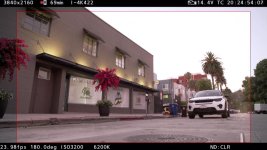
Still below was from our last setup of the night, again almost 20 minutes after the sun had set, at ISO 3200. Too bad about the lights coming on above the awning, but it's possible we can paint those out. The car had running lights that we couldn't turn off, so we taped over them with paper tape.
The point of the story being: once again the dual ISO of the Varicam came to the rescue, allowing me to shoot useable and matchable footage longer than we had any right to. Reviewing my reference frame grabs from the beginning to the end of the scene, I feel fully confident that we can make it look seamless in the color suite. There are many attributes of fading light after sundown--contrast changes significantly along with color temperature--but I think we can pull it all together and turn dusk into day.
I never stop finding new ways to take advantage of the Varicam's high ISO, far beyond low light or night exterior work. This is just another example.
Still below was from our last setup of the night, again almost 20 minutes after the sun had set, at ISO 3200. Too bad about the lights coming on above the awning, but it's possible we can paint those out. The car had running lights that we couldn't turn off, so we taped over them with paper tape.

