VaricamLT: once again, high ISO to the rescue

CharlesPapert

Director of Photography
2nd to last day on my current series, shooting on two LT's. We were day exterior all day today on a street corner in Hollywood. Our last scene involved a bit of stunts and some precision driving, and characters inside and outside of cars. We started shooting the scene around 7:20 and wrapped at 8:25, with sundown at 8:08. I started the scene at ISO 800 with a polarizer and N6 on the camera, shooting around T4. By the time we wrapped we were at ISO 3200 (down from the 5000 base) at T3.5, meaning the light level dropped around 6 stops throughout the scene. I was able to keep the pola in place until all but the last shot which helped us see through the windshield to the actor inside (and it was a stunt driver on the last shot so it helped us to obscure the window).

The point of the story being: once again the dual ISO of the Varicam came to the rescue, allowing me to shoot useable and matchable footage longer than we had any right to. Reviewing my reference frame grabs from the beginning to the end of the scene, I feel fully confident that we can make it look seamless in the color suite. There are many attributes of fading light after sundown--contrast changes significantly along with color temperature--but I think we can pull it all together and turn dusk into day.

I never stop finding new ways to take advantage of the Varicam's high ISO, far beyond low light or night exterior work. This is just another example.

Still below was from our last setup of the night, again almost 20 minutes after the sun had set, at ISO 3200. Too bad about the lights coming on above the awning, but it's possible we can paint those out. The car had running lights that we couldn't turn off, so we taped over them with paper tape.
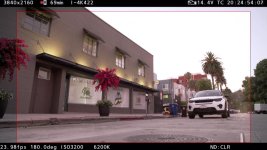
varicamdusk.jpg
 
When I first got my LT, I pretty much stuck to the 800 ISO. I really kept thinking of the higher ISO mode as a last measure resort. Since then I've started to experiment more and more with the Base 5000 ISO and have been extremely impressed.

Just yesterday was shooting office interiors for broadcast. Ended up leaving the camera at 2500-3200 ISO (down from 5000) all day long. There was no objectionable noise whatsoever. And if I took a dynamic range hit, it was definitely not obvious. This was under controlled lighting, but I sure wasn't seeing any highlight clipping.

I used a lighting package a quarter of the size of my usual kit. My lenses were all T3 zooms.

The producers were blown away.

I was on a narrative project a few weeks ago that will be projected for some of its run. This was super low budget. Our "moonlight" coming in through the windows was a NILA boxer, which is a 200w LED. They say it's as bright as an 800w HMI, but I don't really think it is when you start to widen the beam with Nila's lenses. In any case, shot all those interiors at 2000-4000 ISO. The image started to get a little noisier up at 4000, but I wasn't bothered by this at all on-set. I'm really curious to see the results on a big screen. Sure, I would have loved a bigger light, but I would have had to change my entire strategy if I'd been shooting on another camera.

I wish I could share some of the footage. I'll try to find a project I'm allowed to do that with.

Charles, have you ever seen projected footage of any of your low-light native 5000 work? Have you ever used the camera at 5000? Or are you always dropping the ISO a bit from there?

I'm curious about what looks like a magenta shift on that image you posted. The pavement especially seems to be skewing that direction. Is that just me or was that a function of the light changing? Looks easy to correct out, but wondering if you've noticed any of that in any of your other footage. I occasionally see it in the blacks and have attributed it to a bit of IR shift.
 
That grab is captured off the monitor-out at 709, I don't consider it color accurate. And at that light level, it's not unusual for the daylight to take on odd tones. I can't attribute that to the camera or not. To be clear--there's nothing "sexy" about that still, I don't expect anyone to be blown away by it because it's not meant to impress as a visual frame. The point is that we were at that point beyond the ability of certain cameras to still be shooting what would pass for day (including Alexa).

I have indeed seen my footage projected various times. We did a few presentations at NAB for one, and a series I shot last year was colored in a suite that had a 4K reference projector. I got really close to the screen to inspect the image. Pretty great. Yes, there is noise at 5000, but to me it replicates the look of grain enough that it gives what I would consider a nostalgic ring to night exteriors, which is to say that up until about 10 years ago there was always a bit more grain as high-speed stocks and/or pushing the negative resulted in that look. That said, I've also seen all of that noise knocked out by noise reduction with very little effort or penalty to the image.

I find 2500 ISO (down from 5000) to be a sweet spot where the images are all but identical to the 800 setting, and the only loss is about a stop of dynamic range, but I have yet to see any issues emerge relating to this. In controlled environments, this is a complete non-issue. If you search for my thread about using the V35 on Mary& Jane, I talk about shooting all of my stage work at 2000 ISO. If I opted to blow out a highlight, as I often did with the exteriors seen outside the window, I found the rolloff more than acceptable.
 
Thanks for reply Charles, I did check out that thread on Mary & Jane and found it to be very interesting and helpful. And it's corresponding with my own findings. I have found it to also be a bit scene dependent. Some colors and shades definitely highlight the difference in noise between the 800 to 5000 modes more than others. Was Mary&Jane shot internally to AVC? I didn't see a codex.

David Darby ASC was generous enough to answer a few questions about the Varicam 35 for me a little while back. I hate to paraphrase, but found it very interesting that he said he wouldn't generally adjust ISO for the sake of noise if it sacrificed dynamic range. Now I'm sure the productions he's working on have the budget for noise reduction in post if necessary. In my experiences so far, lowering the ISO from 5000 has just not had a significant impact on dynamic range. And it sounds like you are experiencing the same thing.

All three of us agree that the noise at 5000 is not ugly!

It's fascinating to hear everyone's take on exposure practices!

Paul F. Who knows at this point what EVA-1's gonna be capable of. But dual native in the Varicams is legit. It is a different ballpark than the A7s of the world quality wise.
 
David Darby ASC was generous enough to answer a few questions about the Varicam 35 for me a little while back. I hate to paraphrase, but found it very interesting that he said he wouldn't generally adjust ISO for the sake of noise if it sacrificed dynamic range. Now I'm sure the productions he's working on have the budget for noise reduction in post if necessary. In my experiences so far, lowering the ISO from 5000 has just not had a significant impact on dynamic range. And it sounds like you are experiencing the same thing.

It's one of the the things I'd like to formally test, but in regular useage I haven't felt it. It's rarely something that gets used in conjunction with contrasty daylight situations...night exteriors where you see into streetlights and car headlights would be where I'd think you'd have some grounds to want to keep your dynamic range intact.
 
I have no hesitation shooting from 5000 base in any situation. We shot a 6 Varicam job recently of a stage play thats going to be released in theatres. All cameras set to 2500 on 5000 base. T5.6 practically the whole shoot on Cabrios. This was a live performance with no reshoots, so no room for errors on our part. Its in edit at the moment, but once done Ill be in the grade so hope to share some stills of that when the time comes. I don't think there's another camera that could have shot this piece so cleanly with the ability to retain focus so easily. I've found that even at 5000, where there isn't enough light, the tinniest of NR in resolve, where it's not smoothing the image at all and it cleans up perfectly. Not sure if you guys have heard of Don McAlpine's ASC ASC, experiences with the Varicam but he shot a movie called Ali's wedding choosing the camera after testing because of the dual ISO. Trailer is below. One of the things he liked was at critical moments he could get large pupils in an actors eyes shooting to 5000 base and lowering light so they opened up. Lots of 5000 in this trailer.


Charles --- if you ever have a chance, check out a 5D Mark IV or an a7sII if you haven't yet (although I doubt they would be cleared for any of the higher-end work you do), and let us know what you think if you're interested.

5000 for a real cinema camera like the LT with super high-spec recording and dynamic range is a no-brainer, but I think you'd be pleasantly surprised with the clean images these little toys can provide you.

The a7sII is a given, but if you're not a fan of the color science, the 5D Mark IV also provides high-quality results via the MJPEG format @10000.

EDIT --- P.S. Not that I'm comparing them to the LT, but they may be a suitable solution for some last minute low-light work.
 
Last edited:
Charles --- if you ever have a chance, check out a 5D Mark IV or an a7sII if you haven't yet (although I doubt they would be cleared for any of the higher-end work you do), and let us know what you think if you're interested.

I was on that bleeding edge of DSLR high ISO stuff back in 2009...joined Vincent Laforet and Stu Maschwitz to shoot "Nocturne" on the first 1DMKIV to arrive in the US, which led me to buy my own when it came out. And bought an A7S a couple years ago and use it as a C or D camera when we need an extra angle or unmanned camera (pumped into a Shogun Flame for the codec and 4K recording). I know the A7SII is an improvement; haven't had a chance to use the 5D since the MKII.

I'm just not a fan of the DSLR form factor for shooting video, since I have other options available to me.
 
great info as usual Charles and another intesting peak into your world. look forward to seeing (or perhaps I should say not-seeing) that 6 stop difference in the finished product. I can see this dual iso becoming a real advantage for those of us who tend to work with smaller scale lighting packages.
 
Back
Top