FS7: Odd motion blur double frame effect

jhex6

New member
I might be going completely mad here, or just not know what I'm on about so please bear with me.

Recently shot something and found the resulting motion blur to look a bit weird:

MoBlu1.jpg

For a lot of the movement it looks like two separate frames overlayed on each other rather than the image blurred evenly between the two points of movement. Is that normal? It certainly caught my eye.

Has it been doing this the whole time and I haven't noticed? Or is this a thing with the sensor / that I can change?

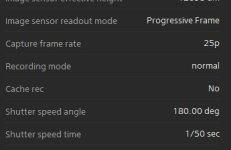
I shot 25p, 180 degs:
MoBlu2.jpg

Thanks!
 
With 25p and 50th of a second you shouldn't be seeing ghost interpolation like that. What NLE is this frame grab from. When I see that on the timeline it is usually a conflict between the camera file frame rate and the project's settings/timeline frame rate. Maybe worth a check? Can you upload maybe a second or two of footage to look at?

Chris Young
 
Could be a camera strobe or other lighting that is cycling at a different rate than the camera, thus causing part of the frame to be captured sharper than the rest because it had more light. Doing it on purpose is called slow sync in flash photography.
 
I think it is normal for the FS7 - Ive seen this and wondered about it.

If it were a camera flash or a an off cycle 'constant' light (like a tungsten and the wrong shutter angle/framerate) then the artifact should be horizontal across the frame like a flash band.

I just think the sensor or video compression is not 'true' - where true = the way a film camera and shutter capture light during a frame.
 
I run into this exact issue when I shoot 24P and have my shutter at 1/60 indoors. I have never shot 25P so I can't be of help but it does happen with the prior settings I've mentioned.
 
A social dancer's feet are often moving rapidly between 2 stable positions in a quick triple step. Could be that's what you caught in the blur? Just a thought.
 
How does it look when it's playing.. if the legs ,feet are moving fast , at 24/25p. 1/50th .. there would be some blur in a still frame ..no.. ?... only the "moving " leg has it... the other "static" one looks sharp enough.. I think you would get this in a film camera too..
 
Like Doug suggested, looks like the effect of a flickering light at the location.

If it were a camera flash or a an off cycle 'constant' light (like a tungsten and the wrong shutter angle/framerate) then the artifact should be horizontal across the frame like a flash band.
 
Thinking on.

Consider a white clock face with a moving second hand.. actually not a second hand but a spining black semi circle.

If you shoot that at super high shutter then 180 of the clock face is white and 180 of the clock face is black.

Slow the shutter and you maybe get 160 of pure black and 10degrees each side of grey, where the black semi was obscuring the white for half of the frame

SUper slow shutter and the whole image is grey having been exposed to white 50% of the time and black 50% of the time

As you change the speed of the framerate and also the rotation speed of the disc many different effects may occur.

Maybe grey at both ends of the black, or depending on the mismath between framerate and subject rotation speed the darkest bit of the frame.. that was never white during the exposure may not be central on the blck area.

Hard to explain in words!

That thesis would make such a frame possible in certain situations depending on the frequecy of the leg swing and the camera frame rate and shutter speed/angle and could therefore be 'normal' with no probalems with the camera or lighting.
 
If it were a camera flash or a an off cycle 'constant' light (like a tungsten and the wrong shutter angle/framerate) then the artifact should be horizontal across the frame like a flash band.

Wrong. Wrong because the duration of one cycle of a flickering light can be longer than it takes to scan the entire frame, but still shorter than shutter speed. Remember that the frame is not scanned the full duration of the exposure but much much shorter (I'm talking about the rolling shutter, how quickly the entire frame is scanned). Even if the cycle of the strobes/flashes/flickers were as long as the shutter speed but not synced with it, you'd still get two exposures happening within one frame. It happens all the time with tungsten lights but because they have a long dimming / brightening period in their cycle, we don't see two exposures, they have a sine wave type cycle. But take anything with a more square wave and you have that problem.
 
Back
Top