Now that we don't need lights... How are you lighting?

I'm more of a Mole guy than an Arri guy when it comes to tungsten lights.

Not much experience with them.
In my micro budget world, the classic Arri Softbox kit (2 X 300 and 1 X 650) plus a 1K which can be rented for $100/day pretty much anywhere that rents gear has been the go to kit for us. You can do a pretty decent job on a small to medium sized interior with that. I'd like to work with Moles sometime, but only the big rental house in town carries them and just never seems to be what we get.
 
There are a couple of techniques that I've done for stills, and read about for film. The 'traditional' expose for the shadows, develop for the highlights, I think has movie making equivalents. What may be different for movie making is the 'flatter' negative, but that was also due to using various interneg/positives in the process from shot negative to projection print.

The other one is 'preflashing' to get a little more 'density' in the shadows, even if it was essentially 'fogging' the film...

When we first went digital the 'best' advice we got was to 'think you are shooting slide film', that is shoot for the highlights, and either let the shadows fall where they may, or boost shadows to lessen contrast. Increase in dynamic range has improved things, but still there's no equivalent of 'develop for the highlights', other than perhaps using some sort of fancy camera that has a 'raw' mode... not available in my price bracket for 'motion pictures'... in any case...

In terms of film stocks, as I recall Panatomic-X had a pretty contrasty curve, and even Plus-X was not all that 'wide'.

The only time we used anything greater than 400, B&W rated at 200, was for interior church shots, when there was absolutely no way to get lights on the wedding, and definitely no 'flash' during the ceremony anyway... (we would use the manfacturer's ISO for color, because we could not really get good results by changing the developing times for color. On the other hand, after doing hand developed B&W we got the B&W lab we ended up with to 'special' process our film based on the use of the 200 rating.)

That is spot on. Coming up shooting film, I learned to expose for the shadows with negative film and expose for the highlights with reversal film. This worked for me. Negative film seemed to have a much better ability to handle exposure approaching the shoulder, and handle highlight roll off very well. Approaching the toe, negative film can get real muddy with underexposed shadows, so to maintain the blacks in the shadows they really had to remain above the toe. Reversal film on the other hand, because it was designed for direct projection, had a level of contrast built in (a steeper gamma curve) that maintained the black levels at or near the toe, but had real ugly highlight roll off. When I switched to digital video, I to was also given the advice to expose it like reversal film and that too has been, for me, spot on. Avoiding clipped highlights, at almost any cost, is still a wise rule of thumb for shooting digital video, even the new cameras.

I did push film on more than a few occasions, and I found that to be a pretty good way to go. When I first started there was a 400 ASA B&W reversal filmstock that Kodak made, and I loved the film. We used to regularly push it one stop, for an effective ASA of 800, and the sh*t looked great. Of course it was grainy and pretty contrasty, but that was what we were after, shooting punk bands and commercial/promos for a Detroit area fetish leather shop. I also had the occasion to push some negative stock, and it held up very well also. Pushing does add contrast and grain. It is my understanding that you can manipulate saturation while pushing by giving a little underexposure, from your stock rating, then pushing it. I never was able to do anything like that, or test out overexposure.

The only thing I know about flashing is from what I have read in old copies of American Cinematographer. I guess there was pre-flashing, post flashing, and also several devices made to flash the film during exposure. I think Panavison made one and Arri made one, and they put a controllable amount of light into a shot, through the device mount in front of the lens like a matte box. It is my understanding that flashing did raise the fog level, but I guess adding push processing and manipulation during printing, they were able to bring up shadow detail, and still maintain good looking blacks. I never really understood how this worked, until I started seeing stuff shoot using the S-Log gamma functions, like the in the F3 and images shoot with RAW. Flattening the characteristic curve of the original footage gives you control in post. Those guys doing it with photo-chemical processes back in the day had some real guts and my hat is off to them. I guess Vilmos Zsigmond was a big fan of flashing film, and if I remember correctly he did a lot of it on the Robert Altman film "McCabe & Mrs. Miller"; which I recommend to anyone who wants to see a landmark film in the history of cinematography.

I guess it is my great interest in the history of cinematography that is at the center of this thread. Because cinematography is an art form so reliant on technology it is impossible to track the advancements in cinematography without also tracking the advancements in the technology and the innovative cinematographers who embraced the new technology and changed the cinema experience. I recently watched the Criterion collection two disc set on Jean-Luc Godard's "Breathless" ("À bout de souffle"), one of the landmark films of the French New Wave of the late '50's and early '60's. In the extras, there is an interview with the film's cinematographer, Raoul Coutard (Definitely one of my heroes). In the interview he says that the night exteriors in "Breathless" were shot using an Ilford high speed B&W negative film designed for still photography with an ASA of 400. Because the film was a still film, the pitch of the sprocket holes was different from motion picture filmstocks. The only way they were able to use it was because the claw mechanism of the Cameflex camera had tolerances that would work with that film. If you watch the film, you really do see some very good low light cinematography. Going forward from the New Wave we see rapid changes in the technology of motion pictures; smaller, lighter and more quite cameras, smaller, lighter sound and lighting gear, faster lenses and faster, higher quality filmstocks. IMHO, this convergence of technological innovation, and cinematographers and filmmakers willing to embrace it really came to a head in the late sixties and early seventies, with the rise of the American New Wave, or The New Hollywood. I was a kid during this time, but even I was able to notice the time as a watershed. I am now going back and re-studying the films of the seventies and I am amazed at the great cinematography and it is impossible to divorce that great work from the technological advances that proceeded it. I think that we are now also in a watershed era of motion picture technology, whether that translates into a watershed era of cinematography is yet to be established, but I am very optimistic about that.

It seems to be the consensus that the new cameras, and their capabilities, means that in many instances the only change in lighting is that less quantity of light may be needed. That is very cool, IMHO. As for new fixtures, the rapid advancement of LED technology is very exciting.

Issues with ambient contamination is interesting. I never really thought of that, but it makes sense. So, it may seem that, in some situations, more control of the lighting environment maybe needed with the new cameras. Does anyone have any specific situations about that, and how they handled them?

I am not so sure that I agree, 100%, with the idea that the capabilities of the new cameras does not mean that there should not be, or can not be, a change in the approach to, or philosophy of, a lighting design for a given project. For example, standard 3 point lighting is a lighting design that is technologically based, established in the days of low speed B&W film. The Key and Fill light were needed because of the low speed and low dynamic range of the available filmstocks and the back light was needed for separation from the background; an acute issue with B&W film. This type of lighting is still standard in a lot of talking head interview type situations, but I don't know of a fictional narrative film that I have seen in a long time that utilizes that approach in a serious manner. Now, while standards like off axis key are still standard, the days of unmotivated back or side light are over, IMHO. This is more of an issue with the higher dynamic range of the new cameras. Bouncing a big light through a window can now work as the only light a scene may need. Of course these are aesthetic choices that a DP would have to make, and there is not right or wrong with that. I just think that the new cameras give a whole bunch of leeway in the aesthetic choices that are available.
 
Last edited:
The greater sensitivity of sensors may mean that you need less illumination to get a good exposure, but it doesn’t change one simple fact: the sun is really really bright. Because it generates approximately 70’000 FC, when shooting interiors with windows or exteriors in full sun you still have a contrast problem because the sensors can’t take in the full contrast range. In the case of windows you still have to cover them with ND gel. But, where a roll of 85/ND9 gel can set you back $140.00, it is expensive and time consuming to gel windows if there are a lot of them. Without gelling the windows to 3200K, using smaller quartz lights won’t even begin to narrow the contrast range inside or out because full color temperature blue correction gel (Full CTB) cuts the output of the light by 70% in converting it to 5500K. A 1000W 3200K light becomes a 300W 5500K light when you put Full CTB on it. The output you get after correction is not nearly enough to balance the sunlight coming through a window. For example an Arri 1k Fresnel at full flood puts out only 55 FC after correction with full CTB to 5000K – that’s not nearly enough to fill direct sunlight.

It doesn’t matter how sensitive the chips are, if you can’t gel the windows you probably need at least a 6k HMI par to pick up interior levels to within one or two stops of the exterior level seen through the windows. And, you still have the problem of powering such a large light. So things haven’t changed that much when it comes to lighting day interiors and exteriors. One advance that does help, but has nothing to do with camera sensors, is Arri introduction of their Max reflector to the 4kw power class. Basically a par without lenses, the Arri M40 has the output of a 6kw Par and if you know how you can run them off of regular wall outlets and Honda generators (see http://www.dvxuser.com/V6/showthrea...sun-as-a-rim-light-outdoor-lighting-technique for details.) In my experience the new sensors make it easier to light night scenes, but haven’t changed my approach to day interiors and exteriors much.

Peter Berger
Berger Films
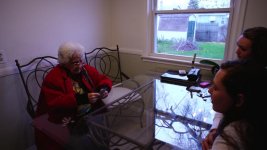
I am not finding that to necessarily be the case. The ability to shoot interiors, with lighting just from the windows is one of the things that I am finding to be within the capabilities of the new cameras. What I am finding is that, yes, there is good degree of difference between the light level between outside and inside, there is still a tremendous amount of light that comes from the windows. The more windows there are the more light there is that comes in. Now, I have to say that the stuff that I have tested, here in Michigan, has been under overcast skies, common here, but, shooting with a FS100, I have been able to expose interior shots, and views outside the window. The views outside the windows are overexposed, but they are not clipped, or blown out. I think that I will be able to balance, the looks inside the house I am shooting in and outside the windows with very much less than 6k worth of daylight lighting.
 
I hate windows.
If I can find a motivation for drawing the curtains I do so. If the windows don't need to be in frame I black them out and don't show them. If the windows HAVE to be in frame I've gone as far as triple sheets of ND4 on them. I avoid natural light in my shots like it was AIDS.
 
I love shots with windows in them...

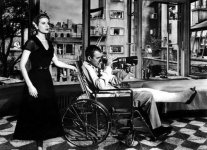
I know this is on a set but the whole of Rear Window is a love song for windows.
 

Attachments

  • imagesrear-window-framing-small.jpg
    imagesrear-window-framing-small.jpg
    59.2 KB · Views: 0
Now windows are tough. I did not want to give the impression that the new cameras have solved windows for ever and ever. As usual it really depends on what look you are going for and the exact situation you find yourself in. If you want to exactly match interior and exterior on a shot looking out a window on a bright sunny day, you still have some work to do. However, I think that the new camera capabilities can open up some great opportunities for using natural light.
 
Here is an interesting set of BTS videos for the film "13:59" shoot with a pre-production C300. The use of natural and available light is pretty cool. I like in some of the shoots they are using little battery powered light panel types lights. I think lights like this are going to be very handy as accent lights and what not. I have picked up a couple of inexpensive LED ring lights that I have been impressed with. I may pick a few more, just to have. they are surprisingly bright. their design, as a ring light, powered though a battery pack with a cold shoe mount is kind of awkward, but for the price, they are a no brainier to pick up. Here is a link to the type that I have:

http://www.amazon.com/Macro-Flash-LED-Light-lenses/dp/B0031AQ302/ref=sr_1_1?ie=UTF8&qid=1326419797&sr=8-1

Shop around though, I got mine off of eBay for for less than that.

Here is "13:59"


Here is BTS one:


And BTS two:

 
That looked pretty poor to be honest. Or well you know... It looked like natural light... Sure, sometimes it ends up brilliant, but it usually doesn't. IMO.

For me, as a young filmmaker, it makes a hell lot of sense that we (my generation and the next...) doesn't get lazy & rebellious cus we can. Honestly this will, actually, even further bridge the gap between professional looking productions & amateur stuff.

I get what David is after here though, and that is the emerging new cinematography. But it does not replace anything, and the high-ISO exposure look is pretty different looking.
 
Last edited:
The only real objection I have is the 'yellow cast'... It's something that I've associated with 'Canon'. However, a lot of the 7D footage that people have shown seems to have a 'pink/magenta' cast... So, I had thought that Canon had changed something... You can sort of see that with some of the BTS shots. So, perhaps the filmmakers have 'graded' for the yellow.

As a note... I just watched "The Third Man"(1948)... It is not particularly popular in Wien... and what's that about not finding 'texture' in Germay... wait, this is Austria... and then there's Bratislava across the river...
Definitely one knows one is not in Kansas...
 
I think the Canon presets tend to have a yellow cast. I have moved to custom white balance. Custom tends to be a little "sanitary" looking, but that's easier to deal with in post than the yelllowish cast.
 
Going back to the handling of windows for a sec. I know that these images look like sh*t, but here is a couple of jpegs of a test shoot I made. I was just testing the Abel Cine Varicam picture profile for the FS100. These were shoot is at 0db, which Able Cine has calculated out as 500 ISO, with a Sony 16mm f2.8 E-mount lens, at about f5.6 (If I remember correctly). The electric light on these shots is from five 9 watt 2700k(ish) CFLs in a light fixture above the table, which I calculate as about 200 watts incandescent equivalence give or take a little bit. No color grading at all. The white balance is "Indoor" (3200K). While the image out the window is overexposed, considering that no effort was made to balance for that, I am pretty confident that, with a better picture profile (G-Log A probably), daylight white balance, some more (but not that much more) supplemental daylight inside and careful grading, balancing to the windows would not be that much of a problem. Now these were shot in the afternoon on an overcast Michigan winter day, and that a bright sunny summer day might be a different story, I am still pretty impressed with the capabilities of even a, relatively, low cost camera like the FS100. I don't think that the issue is about being lazy or sloppy, but embracing the capabilities of these cameras and really taking cinematography up a notch.

window test.jpg

window test II.jpg

The light in the back ground on the second shot is light from a window out of frame.

BTW, I am not a fan of the Varicam profile.
 
Last edited:
Here is an interesting article about the cinematography of the upcoming film, "Rampart", shot by DP Bobby Bukowski. They used the Arri Alexa with Cooke Panchro lenses and used an augmented available lighting shoot approach. Reading this made me think back to this thread.

http://www.dv.com/article/115650

"Shooting with the ALEXA meant that Bukowski could often go with existing lighting that was reminiscent of the photo Moverman had shown him. "We looked at a lot of photographs that Oren didn't like, and I eventually began to discern that what he didn't like was movie lighting," says Bukowski. "The photos he liked were captured vérité, with available lighting. So I said, 'Let's make an available-light film. Production designer David Roscoe worked with Bukowski to prepare practical locations. "We designed a lot of lighting into the sets that could be worked practically, as scenic instruments that could also work as illumination and mood for the scene," says Bukowski. "If I wanted to create hard light, or soft, bounced lighting, I could enlist David in creating these fixtures where I needed them. My gaffer would put everything on dimmers, and that worked well, especially given that Oren likes to be able to shoot in any direction.

"As I moved through the room with the camera, my gaffer, Michael Bauman, could react and bring up a certain section of a room as I approached it. It was a really interesting dance, and I had never done that before—have my gaffer remotely control lighting in reaction to an image he was seeing on a very good monitor. It was an interesting way to work." Bukowski found that he had to change his approach to lighting for the ALEXA. "It's quite a different approach," he says. "I found that with the ALEXA, everything becomes a source light. I always start now by shutting all the lights off in a room, or closing all the blinds and curtains. Then I start turning them on one by one, and opening the blinds little by little. The ALEXA seems to be affected by everything—not only the primary source, but the secondary source bouncing off the wall, and the tertiary source that's going up to the ceiling and bouncing back. It winds up being a very heavy grip job, particularly in daytime shooting. You end up subtracting a lot of light just so you can hone in on a primary source."


In some night exterior situations, Bukowski used simple solutions. "I worked with very small sources on this project, even in night exteriors," he says. "One night we shot on a hill in Echo Park, and with city lights in the background. There was virtually no light where we were, so I said to the production designer, 'Let's go to Home Depot and buy sodium vapor security lighting.' I asked him to supply me with a lamppost, to get it high enough to be out of frame. That was the lighting for the scene."

I love it. I am looking forward to seeing the movie. I love Woody Harrelson also.

I really do think that the newer cameras really can be used with newer approaches to lighting. It still has to be GOOD lighting, and well designed, but they really do open up some new opportunities to make some great images.

Trailer:

 
David, what are you talking about?

This kind of naturalistic lighting was going on for god knows how long... Like since the 70s? Not that it doesn't work - if anything it gives the film "credibility": because it looks like reality show... But there ARE ways to give a film credibility without having to compromise the lighting. Think of The Insider - found framing, playing with overexposure in the frame - all the tricks to give the film sense of a documentary (that as we all know have to deal with found lighting, funky framing, crap staging, overexposed parts of the frame). This doc-like approach isn't new or the result of more light sensitive cameras.

Oh yeah, there have been films that have "Shoot out in the streets", so to speak, for a long time. One of the earliest that comes to my mind is Godard's "Breathless" where they were able to use a lot of available light to shoot in the streets of Paris. I have recently seen an interview with Raoul Coutard, the DP on "Breathless", and he says they were able to shoot in low light because they were able to get a fast (400 ASA I think), relatively fine grain 35mm negative still stock from Iford that they could use in their Cameflex cameras. I guess that the pitch of the still stock sprocket holes are a little different from 35mm motion picture stock, but because of the tolerances of the Cameflex movement, they could use it (How they were able to send it through a contact printer and make an inter-positve is another question). Still, this is an example of technology spurring the artist to try something different, or, at least, to achieve a look that would have previously taken much more resources.


I am also a HUGE fan of films of the 1970's, especially the so called "Gritty Urban Look" of that era. A lot of filmmakers went out into the streets, even at night, and shot, in much of the manner that Bobby Bukowski describes was his approach for "Rampart". However, even as a fan of the 70's cinematography in those films, I do have to say that the technical limitations of the film stocks and lenses, while faster, is still evident. In many instances there is a tremendous amount of artificiality in their images. In urban night scenes, the approach to lighting still involved very large lights, usually concentrated just concentrated on the action. The rest of the frame falls off very quickly to darkness, with almost no effect on the surroundings from the available lighting in the scene. I understand what you are saying that this was accepted as a "Naturalistic" approach, because that is what a camera of that day would record when shooting under those conditions.

BUT, I still think that the newer cameras are bringing a whole lot to the table. In my mind, this is illustrated by contrasting the last 15 minutes, or so, of one of my favorite gritty crime films from the '70s, "The Friends of Eddie Coyle", shot by the amazing Victor J. Kemper ASC, one of the kings of the "New Cinematography" of the '70s, with the opening sequence of the 2011 movie "Drive", shot by Newton Thomas Sigel ASC, who ain't no slouch. I just can't help think what kinds of images that Mr. Kemper could have made with a camera like the Alexa. Mr. Sigel did use the Alexa and his images do not look like a documentary or a reality show.


I also do not believe that shooting under augmented and designed natural/available lighting has to mean compromising the lighting. Come on now, you mean to tell me that having cameras with sensitiviies up to 2000 ISO, or beyond, with 9(ish) to 13(ish) stops of DR, depending on the camera, doesn't change things? Like I said in the OP, apologizing for the ten cent thread title, I am not advocating shooting without lights, or, as you said, in the manner of a documentary or reality show. I just can't help but to believe that the expanded capabilities of the tools now available calls for, possibly, new ways of doing things. Maybe everybody is right, and it just means that lower powered lights can now be used, and that is all it means. Maybe. I just get this feeling every time I hold my camera (The low end FS100) that by doing things the way I have always done them is just not enough, and that there are capabilities in MY hand that can only be exploited by a different way of thinking or "Seeing". There is a part in the DV article above about the making of "Rampart" that really hit that nerve, for me:

"We looked at a lot of photographs that Oren didn't like, and I eventually began to discern that what he didn't like was movie lighting," says Bukowski. "The photos he liked were captured vérité, with available lighting. So I said, 'Let's make an available-light film.'"

That, to me, was the response of a great cinematographer. He was able to discern the look that his director wanted, and was able to exploit the technology available to him to provide it. While they made a, "Available Light" movie, it is clear from the article that the lighting was carefully designed, and that there were no "Compromises". I have a feeling that the film doesn't really look very "Good", but I would be willing to bet that it is very appropriate to the story. That is the way that I want approach the projects that I have .
 
Last edited:
There is "artistic" approach and "Artistic" approach. And we have to be careful that what we do try to go at least two steps ahead (into the big A territory). My beef is that just artistic ("let's shoot film with available light") is not enough. As a matter of fact it's a heap cop-out as there are DPs who went for reality style and withing that style they managed to push boundaries (i keep on thinking about the night scene lighting of The Insider that looked anything but realistic and yet gave you doc-style vibe).

Now, look at "Night on Earth" (1991) - whole film set at night inside of moving cars:
http://www.youtube.com/watch?v=P7wa9kSI5Ew

You will be blown away with how "realistic" it looks even though it's anything but as they used complicated rigging for the lights on the trailer to give you that vibe. In comparison the scene from "Getaway" looks almost primitive despite much higher capabilities for seeing into the light. In other words the capabilities were there for very LOOOONG time and only particular DP's talent and ambition was limiting factor.
 
A lot of this falls into taste and what serves the story. I don't much care for the "available light" look. I don't much care for a "naturalistic" look. Personally I like stylized lighting, but I'm glad we don't all like the same thing or movies would be pretty boring.

Though I have to admit, every time I see the title of this thread it makes me want to punch somebody because it's about the most retarded statement I've ever seen.
 
Ok it's the 4th page, but to answer the title, since sensitivity is up, and if i have the chance to play with a high iso machine, I'd light with one point and bounceboards.

Lighting was primarily for illumination and mood. RPO put it like that in an awesome thread. I think now illumination is no longer needed, so it's just mood. I'm lighting like I did when drawing still life in class. One point.

There is only one sun right?
 
Illumination isn't needed as long as you don't mind your images looking flat and boring.

All the light sensitivity of digital has bought us is the ability to use less volume of light. What was a 2K might now be a 650. Two grip trucks might now be a single grip van. Nothing about lighting theory has changed much since people were painting in the 1600's and probably never will. The price had just come down.

There's only one sun in reality, but I'm not making reality, I'm making a film.
 
Back
Top