Now that we don't need lights... How are you lighting?

David G. Smith

Steak Knife Member
Ok, sorry for the ten cent thread title! I don't want to get into the discussion about the new crop of light sensitive cameras means that filmmakers no longer need to use lights to make their films. I am definitely of the camp that believes that lighting is still the essence of cinematography. However, the new light sensitive cameras have opened up opportunities for new WAYs of using light. I was just wondering what changes, or new ways of lighting, people using the new crop of large sensor, light sensitive cameras have made? If possible, please post pictures or links that show the way people are starting to exploit these cameras. For starters, here is the link to an article by Shane Hurlbut about his take on lighting with the new cameras.

http://www.hurlbutvisuals.com/blog/2011/11/05/lighting-basics-going-with-what-is-available/
The Wife and I have been shooting available light stills for years... we had a studio, and she used it about 2 times a year, and pretty much was a storage site for us... we closed it down about 10 years ago... of course our house now looks like a storage site... but anyway...

The biggest problem I have other than orchestrating projects... is getting locations that have sufficient light to shape it. For the stills we would use a lot of refector/bounce cards, nothing really big, because often the shots were portrait or waist up shots. For full length often we would shoot exteriors.

Since I've started looking in to 'narrative' short films, while some of the available light techniques may work, they really limit the available times and locations...

I've been experimenting... haphazardly... with using CFL or similar to boost in various places or make lightbulb boards to basically support the available light and drop contrast in shadow areas. Oh, yeah, I tend to think in terms of presenting in B&W, so I'm not all that worried about the color of the CFL's.

I would like to shoot at 'high ISO', but unlike film, high ISO digital doesn't seem to give you 'latitude' that shooting Tri-X or Neopan 400 did... just the 'digital grain'...

I think that there is confusion about this. Shooting under "Available Light" is not necessarily the approach that I think that I am trying to advocate, necessarily. I do think that, in many situations the new cameras do allow folks to shoot literally in "Available Light", the actual light that is at the location with out any other supplemental units or devices supplied by the filmmaker. That is not an approach that I think that would work for most fictional narrative films. I think that a more practical approach would be best described as "Augmented Available Light", where the actual available light is manipulated, by placement and the possible raising of the light output (Like replacing of bulbs with higher wattage ones, using reflectors, ect.), and then bringing in actual filmmaking lights for enhanced portraiture, and to effect mood, tone and other visual elements. There is also the pure cinematic lighting approach, where all of the lighting in a scene is provided by the filmmakers. I think that even this approach, using the new cameras, can be done in new ways and with new tools.

It is interesting that you bring up the term "Latitude". There is a whole lot of confusion about that term, and a lot of folks seem to use this interchangeably with "Dynamic Range". Since you have worked with film (As have I, shooting Super8mm and 16mm film while I was coming up), you know that is not the case. Dynamic range is the ability of a sensor, or film to make proper exposure over a large luminance range within a shot. Latitude is the ability of the sensor system, or film to handle over or under exposure and still be able to render an acceptable image (After post processing either digitally or photo-chemically). I have not studied the characteristics of the newer filmstocks, but I would image that even the newest Vision 3 stocks probably only have 3 stops of real usable latitude. I am of the opinion that digital video systems have ZERO stops of latitude. I know that is an exaggeration, but I think that the important thing to realize is that digital video needs to be properly exposed, especially in low light situations. Tim Burnett has posted, in the GH2 thread about the PB Christmas shoot out ( http://www.dvxuser.com/V6/showthread.php?270924-Philip-Bloom-Christmas-Shootout/page23 ) about knowing your camera's noise floor. He is spot on with that. Only when you know where your camera starts to fall apart, can you start to push the low light capabilities.

Which is a round about way to get back to new and innovative ways to light with the new cameras. What I am doing right now is putting together a guerrilla/low budget light kit for shooting fictional narrative with the FS100. I have been shooting pure available light stuff with it, specifically shooting live punk shows in local bars, and I am very comfortable taking the camera up to +15dbs, which I think that Abel Cine has rated at 3200 ISO. There is noise in the image, but it very minimal and not displeasing to me at all. I am confident, if needed, I can shoot at that sensitivity for most of the fictional narrative projects we are planning. However, I plan on shooting at lower sensitivity levels, which means putting together a versatile light kit.

I am testing CFLs also. I have shot with them before, but have used pretty low CRI ones and have had issues with the color. I am looking to kit out with high CRI (90+ if possible). Chris Santucci suggested ( http://www.dvxuser.com/V6/showthread.php?269610-Car-headlights-to-light-an-actor-during-an-outdoor-daylight-scene/page4&highlight=car+headlights ) these CFLs http://www.alzodigital.com/online_store/light_bulbs_compact_fluorescent-daylight.htm. What I like about these bulbs is that the brightest one, 85 watts, still has an E-26 Medium (Edison) base, for standard home sockets. Most of the ones I have seen in this output range have Mogul bases. Mogul bases, while not rare by any means, are still not as prevalent as the standard Medium base. Chris said that adding 1/8 or 1/4 minus green helps to them to match daylight. I have a lot of 4 socket and 2 socket Medium light bars/battens, designed for home movie making in the 8mm/Super 8mm era that can take very high wattage incandescent lights and having the availability of these types of CFLs, along with other readily available incandescent bulbs make these lights very versatile. For a warmer look, I am also stocking up on standard household incandescent lights, soft whites are my favorites, in 25, 40 and 100 watts. Throw them in one of these light bars, or simple clamp on work lights and you have household lighting augmentation, simple and cheap.

I have also bought a couple of LED ring lights like this one (This light, not from this seller, the two I bought were right at $25) http://www.ebay.com/itm/LED-Macro-Ring-Flash-Light-Nikon-D40-D40x-D80-D60-D90-D5000-D300s-D700-/310369164574?pt=Digital_Camera_Flashes&hash=item4843719d1e . They are very bright actually and I am thinking that they can be used for interior car lighting or accent lighting where ever it is needed.

What other suggestions are there for new ways to light with the new cameras?

EDIT: In my current kit, I do have over 12K worth of lights, total. So, I understand that a basic light kit takes more than clamp lights and CFLs. I was just wondering what new innovative ways to light folks are using.
 
Last edited:
Photographers have had this level of low light sensitivity for decades ... and they use lights
 
Photographers have had this level of low light sensitivity for decades ... and they use lights

This is not a thread discussing the need for lights. This is a thread asking if anyone is using new and innovative ways to light now.

I also disagree with you, nobody has had the low light sensitivity that is now available with digital capture systems, even still photographers shooting film. What they have had is the ability to enhance their low light capabilities with increased exposure times (Plus specific processing and still printing techniques). This has not been, and is not now, an option for motion picture capture.
 
Last edited:
In stills photography I use a nikon D3 and virtually no lights - up to the release of the D3 I was using a hasselblad and HAD to light everything (I own about 10 studio strobe lights)

Motion still cannot match the flexibility of a stills raw file IMO - so is more light hungry

As for tools that I use for motion..

Google : Rolson 72 LED torch - you need a pile of these !

The other huge tool I use is a reflector

And also a net (frame with net curtain material)

Also some simple fixtures with those CFL bulbs (IMO they are a tad green/yellow)

I have a whole box of crap - LED christmas lights, normal coloured christmas lights, candles

The trouble is every weekend The Missus goes to the hardware shop to look for something for her house and I come out with some torch or other light source

I still think there are times when you need proper, lights however, I have a kino, and did have some arri redheads that I got rid of but actually kind of like now as long ass you gel them to the max

Its all great fun !

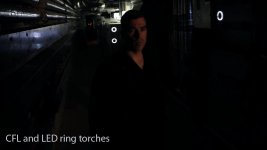
LED ring torches used as a lighting 'motif' for the 'bad corporation'
led.jpg

CFL versus daylight - I am filling with CFL on the right side but balanced for the DL in the winnow (left side)..
CFL.jpg

S
 
Last edited:
Not a single thing about lighting theory has changed because of "light sensitive cameras". Lighting is not one iota less important than it ever was or ever will be. The ONLY difference is that you can get away with a little less volume of light. What used to be a 2K might now be a 1K, what used to be a 650 might now be a 300. Not lighting a scene (using the same principals that have been used for decades) results in the same thing that it always did, shots that look like garbage.

Hurlbut's article points out that now that we need less volume of light, you can make better use of DIY, practicals, etc... nowhere does he imply that anything about the theories of light placement or the need for light have changed.
 
Last edited:
This is not a thread discussing the need for lights. This is a thread asking if anyone is using new and innovative ways to light now.

I also disagree with you, nobody has had the low light sensitivity that is now available with digital capture systems, even still photographers shooting film. What they have had is the ability to enhance their low light capabilities with increased exposure times (Plus specific processing and still printing techniques). This has not been, and is not now, an option for motion picture capture.

There are a couple of techniques that I've done for stills, and read about for film. The 'traditional' expose for the shadows, develop for the highlights, I think has movie making equivalents. What may be different for movie making is the 'flatter' negative, but that was also due to using various interneg/positives in the process from shot negative to projection print.

The other one is 'preflashing' to get a little more 'density' in the shadows, even if it was essentially 'fogging' the film...

When we first went digital the 'best' advice we got was to 'think you are shooting slide film', that is shoot for the highlights, and either let the shadows fall where they may, or boost shadows to lessen contrast. Increase in dynamic range has improved things, but still there's no equivalent of 'develop for the highlights', other than perhaps using some sort of fancy camera that has a 'raw' mode... not available in my price bracket for 'motion pictures'... in any case...

In terms of film stocks, as I recall Panatomic-X had a pretty contrasty curve, and even Plus-X was not all that 'wide'.

The only time we used anything greater than 400, B&W rated at 200, was for interior church shots, when there was absolutely no way to get lights on the wedding, and definitely no 'flash' during the ceremony anyway... (we would use the manfacturer's ISO for color, because we could not really get good results by changing the developing times for color. On the other hand, after doing hand developed B&W we got the B&W lab we ended up with to 'special' process our film based on the use of the 200 rating.)
 
Not a single thing about lighting theory has changed because of "light sensitive cameras". Lighting is not one iota less important than it ever was or ever will be. The ONLY difference is that you can get away with a little less volume of light. What used to be a 2K might now be a 1K, what used to be a 650 might now be a 300. Not lighting a scene (using the same principals that have been used for decades) results in the same thing that it always did, shots that look like garbage.

Hurlbut's article points out that now that we need less volume of light, you can make better use of DIY, practicals, etc... nowhere does he imply that anything about the theories of light placement or the need for light have changed.

David good thread as its certainly interesting to be looking at light requirements and thinking wow, I dont need a grip truck for this. But as you intend here - it requires clarification and discussion if people are going to take anything useful from it.

Agreed Gonzo - Its extremely important IMO that people continue concentrate on lighting, lighting ratios and style and dont just think ah well I can get a key of that streetlight that'll do.
 
That article points out a bunch of "traditional" issues related to cinematography (using the bright points of the string lights to establish the exposure level so that we know that the images is not underexposed - as there is sufficient amount of "whites" in the frame) but also psychological aspect of lighting... For instance for my liking the image is too flat for a drama/action and too "dark" for a comedy so the only way i would accept that frame of the couple walking down the street if it was some kind of reality based work... but, this is only my opinion and as always the DP's personal sensibility is crucial in designing the lighting/framing.

Now, does the sensitivity of the cameras change the way we light... I don't think so. It's still the very same side light, back light, fill we've seen for over 100 years.
 
First off, this topic is very interesting.

Two things came to my mind:

1. When talking about 'large sensor, light intensitive cameras' I guess you mean the likes of 5DII or FS100 etc as you also refer to Hurlburt?! Looking at the measurements for any DSLR, their performance peak usually is around lowest ISO settings, and dynamic range, tonal range, SN ratio, color sensitivity drop with every ISO increase.
http://www.dxomark.com/index.php/Cameras/Camera-Sensor-Database
I guess it's safe to say that in video mode it behaves similar, so, for best quality, shouldn't these cameras be at their lowest possible ISO/db settings anyway which will again decrease the ability to use less light?!

2. If there is less light hitting the subject/objects, less (color/detail) information is being bounced from them and onto the sensor. So even if the cameras are more light sensitive and the base brightness of the image might be good, doesn't less lighting also cause less color, tone and detail in the final image?


From what I experienced, these cameras need a lot of (day)light to shine as well. On the other hand, they do get away with less light and still look good so I'm looking into new setups as well.
As for new ways of lighting, I also like CFLs for their flexibility (screw them in any household socket) and softness but they are not practical for mobile setups.
 
This is not a thread discussing the need for lights. This is a thread asking if anyone is using new and innovative ways to light now.

I don't think anything has changed too much, except the need to see, kill and flag ambient fill has now increased in proportion to the lower level of light you are now shooting at.
And we can move faster with smaller units !
 
Last edited:
Also David, I want to apologize if my earlier post got your back up. It was careless typing of me. I totally agree with you that just because low light availability is in abundance doesn't mean lights are no longer necessary. In face they are just as necessary as ever. Maybe even more so. I'm seeing a real need for a great catch light in low light situations.
 
The real joy of sensitive cameras is not that you won't need just as many lights as always, but that they can be so much smaller, lighter, cooler, and sometimes run on batteries. I got rid of my hot light kit about a year ago and replaced it with a collection of fluorescent, LED, HMI and CDM fixtures. Not only have I saved a couple hundred pounds or so of weight that I used to carry to every shoot, I no longer need to worry about cooking the talent or blowing fuses in the homes, offices and other unprepared spaces where I usually work, and I can pack up the lights immediately without allowing for cooldown time when I'm finished. I used to carry a couple of 1500W tungsten softboxes with me all the time (each one, by itself, would require a full dedicated circuit of its own) and now, the largest single unit I own is a 220W, 4-bank fluorescent light. The quality of my work hasn't suffered at all and, if anything, I'm probably better at what I do because I can be faster and more mobile now.

I recognize the need for more wattage from time to time, but that's what renting is for. And I'd still be getting a lot less equipment than I used to need 20 or 30 years ago.

- Greg
 
Now, does the sensitivity of the cameras change the way we light... I don't think so. It's still the very same side light, back light, fill we've seen for over 100 years.

Would you say the only big change is just the amount of power you have to have to get those?
 
We certainly can get away with smaller fixtures now - if lighting for increased sensitivity is your primary criteria. Ratios for good, thick images have not changed and neither has the sweet spot for exposure on many lenses. It may be possible, but not advantageous to expose at a 1.8 when the lens wants to be 2.8/4 or even F5.6?

We sell LED bulbs with CRI95 and excellent red rendering. CREE and Sylvania are doing some of the best work out there in that regard. LED Fresnels are beginning to hit the market and there is no shortage of softlight / wash compatable fixtures available now. It is a good time to be a lighting cameraman!
 
The great thing about it is... People are now selling off many of their tungsten lighting instruments which I am buying up for pennies on the dollar. :happy:
 
The new sensors, being more sensitive, allows me to approach lighting in the same way, but use smaller units. If I needed my key light to be a 2k, now it has to be a 1k or etc. Allows me to run off of house power more often, allows for smaller units, and that saves money, time, and space. Some shortfalls of this method is getting a dense negative at times, as using more light tends to have less ambient contamination, that said, shooting day interiors becomes a problems because light coming in from outside remains just as bright, so you have to start knocking it down to use the attributes described above.
 
The great thing about it is... People are now selling off many of their tungsten lighting instruments which I am buying up for pennies on the dollar. :happy:

I wish. An Arri fixture in good shape is still a pricey item. A 650 beat to hell goes for $200 plus around here. I'm still a renter. The volume of projects I do that $75 a day for a 3 light Arri kit with stands, barn doors, scrims, case, etc... is still pretty enticing.
 
Back
Top