Newbie about to buy first camera... accessories question.

LCD

Member
Hello all,

I will be purchasing the T3i once it's released along with some accessories. Aside from a tripod and a 50mm lens, what are the top 5-10 accessories I'll need to get great video, and in what order should I acquire them? I know this is kinda subjective, but I'd like to hear your input since I'm a complete newbie.

Thanks!
 
Greetings. One thing you might consider is a monopod. If you're doing any kind of run and gun, it's a great way to get the shots you need and move on.

Other than that, here is a small list of bare bones things to consider:
-Shotgun mic with an 1/8" plug
-Pocket recorder with an 1/8" lav mic (don't get a wireless mic, you'll run into problems I guarantee it)
-LCDVF which is a magnetic view finder for your LCD screen
-An on-camera LED light panel
-Another lens, probably a zoom since you'll have a prime
-A follow focus with base plate and rods (if you're going to do any kind of narrative work)
-An external LCD screen, which will come in handy when trying to pull focus (definitely not to be used for run and gun)

Those would be all the bare bones things you might want to consider. It all depends on your budget. The T3i isn't a huge improvement from the T2i, besides the articulating screen...so if you're buying the T3i for video, you might want to consider the T2i also.

My only complaint about the T3i (and T2i) is that it doesn't allow you to set your Kelvin manually. You can do a custom white balance, but that takes time and if you're doing a multi-cam shoot it won't necessarily come out the same for each camera...at which point you'd have to resort to white balance presets. The Canon 60D - 1D all allow you to set your Kelvin manually. That option is a HUGE plus, so if you can afford moving up to a 60D or 7D I would say go for it.

Best of luck buying your camera!

Thanks Chris!

I originally had my sights set on the T2i, but the articulating screen on the T3i seems too good to pass up. I'll be shooting lots of music videos (as well as some documentaries and narrative things I have in mind) and I know I'll be outdoors a lot... I think that screen will be vital on sunny days and when I need to gets shots from down below. I've recently been reading up on the 60D... it MIGHT be an option for me... the 7D is out of my price range though.

Thanks again for the list...

-D-
 
You're welcome. If you're going to be shooting outside, you should get some screw on ND filters as well (.3, .6, .9). Make sure you get filters that fit your general lens size (most are 77). The articulating screen is great for down low shots (especially if you're using a slider). I'm not sure how easy it is to fit an EVF (eye view finder) on those, but it is definitely work looking into getting one. It is EXTREMELY difficult to pull focus on a DSLR, and the EVF helps to see the screen much better. The nice thing is that you have easy access to crop zooming on the Canon DSLRs, so you can zoom in without actually zooming in the lens to focus, then zooming back out to get your regular shot (doing this causes the lens to breathe which loses the original focal point).

Also, just a could of tips...try and avoid hand holding the camera while you're shooting video. The rolling shutter on these things is ridiculous. Always use a shoulder rig (having your lens IS on), a monopod (IS isn't necessary, but good to have on), or a tripod (no need for IS to be on). Second thing is when you have an IS lens on the camera, you won't be able to use any of the internal audio at all. The motors for the IS are going to fill your sound up with noise, so you should get an external mic for when you're shooting with your IS on. IS is Image Stabilizer, just in case you were wondering.

Good luck!
 
My only complaint about the T3i (and T2i) is that it doesn't allow you to set your Kelvin manually. You can do a custom white balance, but that takes time and if you're doing a multi-cam shoot it won't necessarily come out the same for each camera...at which point you'd have to resort to white balance presets.

Since white balance is based off a picture taken with the camera, you can technically calibrate multiple cams by having the same picture copied onto all the cards and using it as the reference image. Yes, it takes extra time, and having manual settings would be much simpler.
I've honestly never bothered trying to do this, but I'd think it would work. I also believe Magic Lantern allows manual WB kelvin settings.
 
My only complaint about the T3i (and T2i) is that it doesn't allow you to set your Kelvin manually. You can do a custom white balance, but that takes time and if you're doing a multi-cam shoot it won't necessarily come out the same for each camera...at which point you'd have to resort to white balance presets. The Canon 60D - 1D all allow you to set your Kelvin manually. That option is a HUGE plus, so if you can afford moving up to a 60D or 7D I would say go for it.
No.. There IS a Kelvin setting for the T2i. - Magic Lantern
 
You're welcome. If you're going to be shooting outside, you should get some screw on ND filters as well (.3, .6, .9). Make sure you get filters that fit your general lens size (most are 77). The articulating screen is great for down low shots (especially if you're using a slider). I'm not sure how easy it is to fit an EVF (eye view finder) on those, but it is definitely work looking into getting one. It is EXTREMELY difficult to pull focus on a DSLR, and the EVF helps to see the screen much better. The nice thing is that you have easy access to crop zooming on the Canon DSLRs, so you can zoom in without actually zooming in the lens to focus, then zooming back out to get your regular shot (doing this causes the lens to breathe which loses the original focal point).

Also, just a could of tips...try and avoid hand holding the camera while you're shooting video. The rolling shutter on these things is ridiculous. Always use a shoulder rig (having your lens IS on), a monopod (IS isn't necessary, but good to have on), or a tripod (no need for IS to be on). Second thing is when you have an IS lens on the camera, you won't be able to use any of the internal audio at all. The motors for the IS are going to fill your sound up with noise, so you should get an external mic for when you're shooting with your IS on. IS is Image Stabilizer, just in case you were wondering.

Good luck!

I had been looking into the ND filters and different stabilizers as well... As for the filters, what does the .3, .6 and .9 mean? How are they different?

I'm looking at picking up a Flycam or Glidecam to help on the monopod side of things but not sure about a shoulder rig yet. They all seem to be pretty pricey but I found this one that's a steal: http://jag35.com/new/products/the-field-runner/ Any experience or knowledge about this "Field Runner"?

I really appreciate your time and expertise!

-D-
 
The grades of .3, .6, and .9 represent differences in stops; 1 stop, 2 stops, and 3 stops respectively (.3 = 1 stop... .9 = 3 stops). Basically .3 is the lower of the three filters. Start with the .3 filter, and if that doesn't do the job switch for or add the .6 filter. "Stop" is a general term that is used for exposure and lighting.

If you're looking into getting a shoulder rig I would say try and go light, but also try and keep stability. I am not familiar with the one that you linked to, but I have heard that it is adequate (if you put a RedRock rig as a 10 and a homemade rig as a 1 on a 10 point scale, it would be rated around a 6 or 7). I'm personally a fan of the inidSYSTEM rigs, which are a good bang for your buck. However, there are many different rig manufacturers so they is a wide array to choose from.

Are you saying that you would get a Glidecam instead of a monopod? If so, they have two very different uses. The Glidecam is great for following and moving quickly, however they are difficult for changing settings when you're "run n' gunnin." Unless you have another operator adjusting the focus wirelessly, you're going to have to increase your depth of field so you don't get caught out of focus. With a monopod you can control your and track your focus very nicely, however you cannot follow someone with the monopod without the jello effect (rolling shutter). I've done A LOT of SteadiCam work, and it's much different than using a monopod.
 
The grades of .3, .6, and .9 represent differences in stops; 1 stop, 2 stops, and 3 stops respectively (.3 = 1 stop... .9 = 3 stops). Basically .3 is the lower of the three filters. Start with the .3 filter, and if that doesn't do the job switch for or add the .6 filter. "Stop" is a general term that is used for exposure and lighting.

Ohhhh f/stop! I had no idea the filters had actual f/stop numbers too.... makes sense now!

If you're looking into getting a shoulder rig I would say try and go light, but also try and keep stability. I am not familiar with the one that you linked to, but I have heard that it is adequate (if you put a RedRock rig as a 10 and a homemade rig as a 1 on a 10 point scale, it would be rated around a 6 or 7). I'm personally a fan of the inidSYSTEM rigs, which are a good bang for your buck. However, there are many different rig manufacturers so they is a wide array to choose from.

I've heard a lot about Red Rock's dominance, so with that rig being around a 6 or 7 in comparison I guess its a pretty good value.... I just checked out the indiSYSTEM UltraCompact, time to do some more research!

Are you saying that you would get a Glidecam instead of a monopod? If so, they have two very different uses. The Glidecam is great for following and moving quickly, however they are difficult for changing settings when you're "run n' gunnin." Unless you have another operator adjusting the focus wirelessly, you're going to have to increase your depth of field so you don't get caught out of focus. With a monopod you can control your and track your focus very nicely, however you cannot follow someone with the monopod without the jello effect (rolling shutter). I've done A LOT of SteadiCam work, and it's much different than using a monopod.

That IS what I was saying but your explanation makes sense. I can't wait to get the camera and start learning how to rack focus properly... I can already tell that will be the trickiest part of getting started.

Thanks once again!

-D-
 
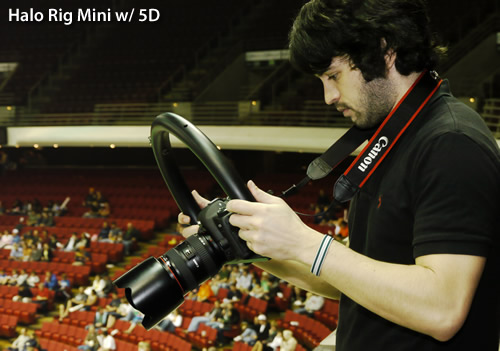
You may need something simple and light weight to help stabilize your camera and allow for more accessories like the HaloRig Mini.

halorig_mini_5dsports.jpg
 
Back
Top