FS7: New Sony F7 XDCAM 4K Super 35mm Camcorder

FINALLY had a chance to sit here and read the 7 page WP for SLog3/S.Gamut3, and it's saying exactly what I experienced last night, especially with a cineon workflow.

Between SLog2 and SLog3, I personally felt just that still showed far more promise than SLog2 (just to me) where color was concerned, and it felt like I ran into fewer tonal shifts toward cyan and magenta comparison to Slog2, which I sincerely cannot stand. Also, the mention of fewer LUTs sits right with me, as well.

I didn't have to throw any sort of LUT on the image to find separation, it responded pretty well to simple curves and log adjustments.

The real trick might be getting people to understand that (unless you can do what RatLab suggests and kick out SLog3/R.709 from camera together) it's dependent on post-processing more than SLog2 was/is.

I need to get my hands on this camera.

Edit here: also just realizing that the F5 shoot was SLog2 as well and not 3. Thus I've never actually run into SLog3 in post on my own. INteresssting.
 
Last edited:
That feels pretty grainy Starcentral, intentional filter on your part? Seems pretty granulated around the exposed light bulbs in the background.
 
Thanks for all the useful info as usual, Dennis.

So what you are saying is if you expose SLOG 3, 1 stop less than the SLOG 2 equivalent, you get about the same highlights?

No!

As I understand it, the difference between the gamma curves shouldn't be affecting the sensitivity of the sensor in any way, merely the way detail is distributed along the curve. So proper exposure should be proper regardless of which curve you use.

i.e. if your meter reads f/4 at 2000 ISO and a 180 degree shutter. Your exposure is f/4 for both SLOG2 and SLOG3 - the only difference should be the amount of data allocated to the highlight and shadow portions of your frame by the different gammas.

So you'll still have 6 stops of overexposure latitude with both gammas, the difference is (according to Sony's charts) that SLOG3 will top out at about 896 (in 10-bit code values) as it allocates the remaining bits (up to 1024 in 10-bit code values) to an extra 1.5 stops of highlight latitude that the camera is incapable of capturing. Whilst SLOG2 will top out at around 1000 (in 10-bit code value) with just a tiny bit at the top end allocated to highlights the camera is incapable of capturing.

So the latitude, and therefore your exposure, doesn't change between the gammas (I think this is where a lot of people get confused - I know I certainly did at first) only the data allocation. By Sony's charts, SLOG2 utilises about 98% of the 10-bits of data available. Where SLOG3 is only using about 87.5% of those 10-bits (the remaining 12.5% being reserved for a hypothetical 1.5 stops of additional overexposure latitude that some future camera will one day be able to capture).

Here's the chart from Sony:

mC8E5Zt.png
 
I guess what the sensor sees at its peak, perhaps gets mapped down to 95% with slog3 and 106% with slog2 - is that what you're saying?

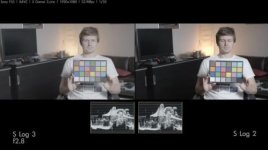
It's quite odd, but looking at this side by side shot with both slogs set to f2.8 on the left (slog3) grey is mapped higher as it should be, but the peak white is lower on the overall IRE scale. It's not clipped, hence maybe its mapped down accordingly?

I'll say one thing, the highlights with the slog3 at f2.8 look nicer to me than the slog2.. what do you guys think?

wolf.jpg
 
I don't think one can say:

SLog2 is better/worse than SLog3

It's just different!

In the end even the look of the Log-footage isn't important as you won't use it unlogged anyway.
For me, it's important how the delogged footage looks like and therefore how easy it is to grade
the Log-footage.

As I'm doing my tests with the FS7 right now, I really like what SLog3/SGamut3.cine is delivering.
It's very close to what you want to get from a 10bit footage.

SLog2 does use more bandwidth of the 10bit values sothat the tonality should be bigger in theory.
And it is, but only in the highlights!

If you want as much tonality on the highlights as possible SLog2 is your way.

If you want a more linear response which is therefore much easier to cc and grade, SLog3 is the route.

Some say SLog3 introduces more noise. It can't as the sensor is still the same but the shadows are
lifted up to 1,5 stops vs. SLog2.
Again, this is only true for the Log-footage but equals out after delogging as the shadows of both
gammas are brought back to the same values. They just have a different tonality.


To sum this up:

Choosing the kind of SLog is all about tonality as a function of exposure stored in the bandwidth of the codec
not about dynamic range or noise!

Don't judge the quality of your footage in Log as it just isn't appropriate. That's why LUTs for monitors exist
and Arri and RED don't really want anybody to watch their footage in Log! If you really want to know what you can
pull out of your footage - delog first, then grade!

More on this from Alister Chapman here:
http://www.xdcam-user.com/2014/03/understanding-sonys-slog3-it-isnt-really-noisy/
 
Last edited:
I saw that a couple of days ago and it is very nice looking. Apart from the nice look what makes this video is the movment of the camera and the fast paced editing.
 
Yep. Without reopening a certain debate the use of the location and the movement of the camera really adds a lot to making that piece look very 'cinematic'.
 
So what you are saying is if you expose SLOG 3, 1 stop less than the SLOG 2 equivalent, you get about the same highlights?

One thing I noticed from the Wolfcrow.com test you posted is that SLOG 3 was noticeably less contrasty, which I like. The shadow detail in SLOG 3 was noticeably more perceivable as well. At least in that indoor test, I preferred the SLOG3.

Is there any outdoor tests between the SLOG 2 and 3? I'd love to see that.

Just so I can sleep at night, my observation regarding exposure on Wolf's slog2 vs slog3 video was incorrect.. if in fact you do stop down with slog3 (or put 1 stop ND filter on lens) it will only keep the middle grey value in the same spot between the two gammas but as you can see the highlights, because with slog3 are mapped lower, would be even lower on the waveform monitor scale.

In post however you really should be able to pull the highlights apart to match the slog2 waveform and have the nearly same image and look. But I haven't tried it, I just shoot in slog3 all the time now and never looked back to the slog2.

sorry for any confusion guys.
 
did any FS700 & FS7 owner test if the FS7's handgrip works with the good old 700? I really like that new handgrip! I suppose it won't work though... thanks
 
Someone on Facebook posted these FS7 S-Log 3 S-Gamut3 shots and I just ran a quick pre-set using FilmConvert. Looks nice to me for a no effort / pre-set grade. I like the vibe, the colors are rich and the blacks on the ungraded S-Log 3 are far less noisy than S-Log 2 I've been getting on the 7Q which is surprising because I was under the impression that S-Log 3 is way noisier than S-Log 2.

Here's a full sized version since DVX user makes all .jpgs so small.

www.builtbyugene.com/images_client/pix.jpg


View attachment 93328

While I appreciate people taking the trouble to grade my shots and it is interesting to see now how far they can take them, I'm little disappointed on seeing them here. When I posted these to the closed group on Facebook I also mentioned that please don't share them publicly (there was a reason for it). Yet I find them here now credited to "someone"... oh well. Show is over. I've taken the original DPX link down. Go Internet!
 
Grug - Right On!

Erik - Perfectly Said!

Dennis - You asked for opinions SLog2 vs SLog3; Erik said it for me, but I lean toward SLog3; feels like it gains more in the shadows than it gives away from the highlights. But as Alister notes, the S/N ratio is the same.

I'm a big fan of your lighting methods and discussion. If you aimed the F55 at a gray card and put the exposure at 32 on the WFM for SLog2, then switched to SLog3 without changing anything else, the gray card will be at 41. If you were rating your camera with the spot meter, it's the same iso because you haven't had to touch the iris, so the end points have remained the same.
 
Back
Top