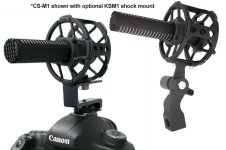
New Sanken Shorty Shotgun

"The simplicity of the design allows a price of under US$900." Oh. Well, I guess the CS-3 is 50% more.

Is there another XLR shotgun just four inches long? It looks like DLSRs got Sanken's attention.

CSM1_02.jpg
 
I listened to the CS-1M at NAB. Nowhere near a reasonable place to carefully evaluate to mics... But I did like what I heard; enough so that I'm hoping to demo one in a month or two. Seemed kind of like a Sennheiser MKH50 but with less low end (totally OK, and even preferable, for dialog, imo). Yes, it's not cheap...but since I do a fair amount of work as a production sound guy, own various $1000+ mics, the price of this mic doesn't freak me out... if, that is, it proves to fill a hole in my current collection of mics.

I've been hanging with a group of people all in a really tough situation. I'm considering making a doc about and with them; if so, there would be days when for many reasons the best course would be to shoot solo. I could see the CS-1M possibly being useful in that situation.

It's cool to see Sanken (again) do something different. Though riffing off Grant's comment about there being decent low-cost mics out there, = I wonder how many CS-1M mics they'll sell.

What does everyone else think?
 
Made "legendary" here by numerous advocates, the lowly AT875 priced at $175 definitely punches above its weight. I have one and can easily say it is one of the best economy mics available; it is small in size for camera mounting and is very versatile compared to longer shotguns. I don't have experience with high end shotguns, my best is a NTG3, which to my ears is a few lightyears better than my AT875. The NTG3 has much more presence and much more gain. To my ears, it really sounds good. Is there a market for a good quality shorty at a similar price to a NTG3 or 416 after the intro price fades a bit? Could it be used instead of a small condenser in many situations? I am intrigued by this new Sanken, but it will have to be pretty good to get me to bite.

Grant
 
This will definitely be interesting to try. Sennheiser has a very small shotgun, the MKH 8060, and I have worked with that one. It’s a fantastic shotgun. Even with a shockmount and zepplin it’s a very lightweight rig at the end of a boom pole. That makes shoot days even easier. At $300 less, I’d love to see if the CS-M1 is similar in performance.
 
I own two CS-3e's and ~10 COS-11's. I could really see this being an 'on-camera' shotgun/nat mic on my F55 or C300 when I need one. I've repurposed my old Senn. ME66/K6 for that job when I need it, but it's really too big for on-camera use, for my taste, and always feels like it's in the way.
 
I used to own a CS-1 (not the updated CS-1e). That was also pitched as an on-camera mic. Worked well enough, rather short (7 inches / 180mm), but I didn't use it a bunch so I sold it. R&G, did you ever try one of those?
 
I used to own a CS-1 (not the updated CS-1e). That was also pitched as an on-camera mic. Worked well enough, rather short (7 inches / 180mm), but I didn't use it a bunch so I sold it. R&G, did you ever try one of those?

No sir. I have contemplated it a few times, though(I do think one of my friends has one). I've never needed to "add" a shotgun/nat mic until I got my C300 after it came out(and still don't have a dedicated one for it. Lol). I always had the "stock" shotgun's on my Betacam's and VariCam's. Truth be told, the vast majority of the shooting I do with my 300 and 55 and feature/sit-down type stuff and I'm just being fed by an audio guy, but there are times I do actually need a nat mic when I'm running around just shooting b-roll.
 
Bit of a conundrum with this mic for me. It'll sound great, I'm sure, I haven't tested a bad sounding Sanken. It will be built impeccably and will punch above it's weight class. As a boom op, it'll be a dream, light and compact.

As on an camera mic, that's putting lipstick on a pig though, total overkill. We all know on camera mics are going to sound bad in most instances. On my own C200, it's going to pick up the relatively noisy fan. I've seen a lot of people mounting (inexplicably) MKH-50s and even CMIT-5Us on cameras, what a waste! I'll go back up to what Ggrantly said, I still stand by the cheap, lowly AT875r as probably the best combination of weight, cost, size and sound quality for an on-camera mic. Sure, if you're going to use this new Sanken as a boom mic, I bet it's glorious. But as an on camera mic, massive overkill because on camera sound will always suck, it's just a convenience for ambience when you don't have a sound mixer with you. I had to use a single soundbite in my current documentary that I recorded with on-camera mic in a car as the subject was driving. Mic was only perhaps 20" from subjects mouth but it still sounds like garbage, but I am stuck and have to use it. It was an unplanned interview that wasn't even supposed to happen, we were just going to shoot b-roll.
 
Every cam is different I suppose. My Panny PX270 records four audio tracks, two of which are from the onboard mic(s) and can be configured to suite. To be honest, I have rarely added an additional cam mounted mic since the onboard sounds about the same as adding additional mics.
 
Every cam is different I suppose. My Panny PX270 records four audio tracks, two of which are from the onboard mic(s) and can be configured to suite. To be honest, I have rarely added an additional cam mounted mic since the onboard sounds about the same as adding additional mics.

I can say that the AT875r on the C200 sounds noticeably better than the built-in mic, which sounds like a tin can, strictly for scratch track for syncing. So I guess there are different levels of bad on-camera audio?
 
I have thought that the mics on my 270 were better than any of my previous cams. Having said that, it also illustrates the idea that from a distance, it doesn't make much difference what you use.
 
Without re-opening the whole "on-camera mic" discussion that just happened recently, I'll just say it all depends on what you do(narrative, doc, news, sports, ENG, etc.). I remember a news story from my early days, I was just more or less shooting b-roll and the very upset family just started talking while I was shooting in their backyard(cop had gone into their yard without permission while they were not at home and their chained up dog lunged at him and he shot and killed it). I was just a few feet away and had nothing but my on-cam shotgun going. Afterwards one of the producers (or maybe editors) asked me if I lav'd them up ahead of time, because it was so clean. I'm not advocating that an on-cam mic is all you need, but do not universally dismiss it, either.
 
Without re-opening the whole "on-camera mic" discussion that just happened recently, I'll just say it all depends on what you do(narrative, doc, news, sports, ENG, etc.). I remember a news story from my early days, I was just more or less shooting b-roll and the very upset family just started talking while I was shooting in their backyard(cop had gone into their yard without permission while they were not at home and their chained up dog lunged at him and he shot and killed it). I was just a few feet away and had nothing but my on-cam shotgun going. Afterwards one of the producers (or maybe editors) asked me if I lav'd them up ahead of time, because it was so clean. I'm not advocating that an on-cam mic is all you need, but do not universally dismiss it, either.

At CanJam 2018 in DTLA I had a conversation with one of the Smyth Research folks, whose product, the A16 does some pretty amazing 3D audio processing. We talked a bit about the math and physics of their product, his time as the head of audio engineering at Warner Brothers, and then he starting talking about an anechoic room experience he liked to show people. In an anechoic room, have the person close their eyes, and talk to them from various distances away, and see if they can tell the difference. When revealed that they could not tell the difference, they were quite surprised. I started laughing as soon as he finished telling his story. Funny how the universe works :). Also met Tyl Hertsens from Innerfidelity: cool guy. Here's his review of the A16: https://www.innerfidelity.com/conte...search-realiser-a16-headphone-surround-system

Simply put, if there are no (significant) reflections, far-field recording can sound good. When (significant) reflections are present, technology can be used to filter out the reflections and provide good sound. Either with physical hardware, such as directional mics, or hardware + software such as array/beam-forming mics, ambisonic mics, etc. The Smyth Research A16 kind of does the opposite. By recording the room with sweep tones and mics in the ears, very high quality 3D-spatial transfer functions can be computed so that room tone/reflections can be accurately reconstructed on headphones in real-time, in 3D, along with head tracking. Cool stuff!

Outdoor mic tests at what looks like 4 feet or so from the folks speaking (he reports about 2 feet). A camera mounted mic would work OK in this case (even the CMC641, so the $500 Audix SCX-1 HC might also work well ((with e.g. 100Hz low cut in post) both short mics compared to shotguns)):
https://www.youtube.com/watch?v=7PXN5oDI1C8

Regarding putting a CMIT5U on camera when doing run and gun / fast doc work etc., why not use it if you have it on hand? It's super light, has excellent off axis rejection, and sounds great. The only reason perhaps not to use it would be under high-humidity conditions (in SoCal humidity isn't an issue).

For first person POV (on camera) shots, pairing a CMIT5U with a Schoeps CCM8 figure-8 mic will provide spectacular mid-side recording. On near field monitors and headphones, I've literally turned around in my chair when playing back Audio Technica BP4029 (mid-side shotgun) recordings thinking something's happening behind me. Pretty impressive planar 3D effects with mid-side recordings (need 4 channels / ambisonics to do full spherical 3D spatialization). The BP4029 is an excellent value, though the figure-8 mic is somewhat noisy compared to the shotgun.
 
I'm gonna use that archaic room experience method on my next interview and get that elusive magic audio. That said with silly smirk.

Grant

Hey Grant, would it be a useful tool in the toolbox to be able to make good recordings from various distances from the subject vs. only close mic? The anechoic room example is simply to demonstrate that sound doesn't degrade significantly over distance when there is no wind or reflectors. Was the audio quality at ~4 feet away in the back yard acceptable? While it was indeed a pretty noisy environment, their are no major reflectors (grass is a pretty good sound absorber). Perhaps we have different perceptions of what is good? I thought while the Rode lav had the least background noise, the Schoeps CMC641 had the best character. In a quiet back yard the lav would lose the lower background noise advantage. Thoughts?
 
JCS

Hey my comment was totally tongue in cheek. Sorry if you thought differently.

I thought it was interesting indeed. But in most circumstances, isn't the issue with recording from greater distance about the signal being weaker and noise being greater due to increased gain.
 
JCS

Hey my comment was totally tongue in cheek. Sorry if you thought differently.

I thought it was interesting indeed. But in most circumstances, isn't the issue with recording from greater distance about the signal being weaker and noise being greater due to increased gain.

Right on, no worries. For some mic pre-amps and mics, that's certainly true. Low self-noise mics and low noise preamps (e.g. Zoom F4 or better, Sound Devices, some higher end cameras) can run higher gain without significant noise added to the signal. With the right set ups, we can get surprisingly clean recordings without close mic-ing (or when it's not possible to close mic or use a lav), especially in reasonably quiet, non-reverberant spaces. 360 video is becoming more popular, hear the 3D audio demos (middle of page on SoundCloud) here: https://www.plugin-alliance.com/en/products/dearvr_pro.html . With an ambisonic mic on/near camera, you can record POV audio in 3D, and either mix for normal video, or if using a 360 camera, output the 4 channel ambisonic mix for use on YouTube so the user can pan around in real-time during playback. An interesting thing you can do with an ambisonic mic (for a non-interactive sound render), is focus the audio, so you can go from an omni to a narrow shotgun in post (you can do something similar (but not as 3D) with a mid-side (2 mics) and/or dual mid side recording (3 mics: can output 5.1 surround)). Even without an ambisonic mic, you can up convert any mono, stereo, 5.1 etc. to ambisonic for use with VR players.
 
Every cam is different I suppose. My Panny PX270 records four audio tracks, two of which are from the onboard mic(s) and can be configured to suite. To be honest, I have rarely added an additional cam mounted mic since the onboard sounds about the same as adding additional mics.

Never used a Sanken but do use Peluso mics. My experience with the PX270 is the opposite. The internal mic sounds tinny where my Peluso's sound great. I never operate the camera with the internal mics.
 
Never used a Sanken but do use Peluso mics. My experience with the PX270 is the opposite. The internal mic sounds tinny where my Peluso's sound great. I never operate the camera with the internal mics.

Let me clarify: I wouldn't want to use any audio from my internal mics. But flying an AT875 on cam at 15ft doesn't make much difference to me over the internal to me; they both sound awful. The closer you get, the more improvement a cam mounted mic makes over the internal.

Since the 270 is always recording the internal to tracks 3-4 it is pretty easy to compare.
 
Back
Top