New Sanken Shorty Shotgun

I usually am recording some type of event so I use the live sound on its own or mixed in with direct audio. When I compare the sound quality of the same material between the onboard mics and a camera mounted mic the difference in very noticeable to me. So putting mic technique aside, the audio quality of the recording in general is greatly improved by using a good external mic compared to the internal mic.
 
I had to use a single soundbite in my current documentary that I recorded with on-camera mic in a car as the subject was driving. Mic was only perhaps 20" from subjects mouth but it still sounds like garbage, but I am stuck and have to use it. It was an unplanned interview that wasn't even supposed to happen, we were just going to shoot b-roll.

My favorite thing for this situation now is the Instamic. Just have it in your pocket. It’s pretty easy to hide. Goes on quick with the magnetic clip. And it sounds surprisingly good. Better than any lavalier I’ve worked with, plus less susceptible to wind noise. It’s hard to actually get your hands on one though.
 
JCS

Hey my comment was totally tongue in cheek. Sorry if you thought differently.

I thought it was interesting indeed. But in most circumstances, isn't the issue with recording from greater distance about the signal being weaker and noise being greater due to increased gain.

Right on, no worries. For some mic pre-amps and mics, that's certainly true. Low self-noise mics and low noise preamps (e.g. Zoom F4 or better, Sound Devices, some higher end cameras) can run higher gain without significant noise added to the signal. With the right set ups, we can get surprisingly clean recordings without close mic-ing (or when it's not possible to close mic or use a lav), especially in reasonably quiet, non-reverberant spaces. 360 video is becoming more popular, hear the 3D audio demos (middle of page on SoundCloud) here: https://www.plugin-alliance.com/en/products/dearvr_pro.html . With an ambisonic mic on/near camera, you can record POV audio in 3D, and either mix for normal video, or if using a 360 camera, output the 4 channel ambisonic mix for use on YouTube so the user can pan around in real-time during playback. An interesting thing you can do with an ambisonic mic (for a non-interactive sound render), is focus the audio, so you can go from an omni to a narrow shotgun in post (you can do something similar (but not as 3D) with a mid-side (2 mics) and/or dual mid side recording (3 mics: can output 5.1 surround)). Even without an ambisonic mic, you can up convert any mono, stereo, 5.1 etc. to ambisonic for use with VR players.

Grant was on the money, and JCS missed the point again :-/

It isn't so much about reflections or wind, neither is about the noise of the pre amps or the mics.

Rather it is about the signal to noise ratio of what you do want to record vs what you do *not* want to record. (such as traffic, background crowds, etc)

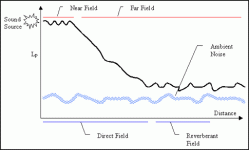
The further away you from what you want to record, then the relative strengths of the signals of what you want get weaker vs what you don't want becomes relatively stronger.

This is why you aim to place the mic a few inches away, and not place it a kilometer away.
 
Your unconscious mind is getting it. Keep going :)

But are you getting it? The further away you are the lower the signal you want! (which means relatively speaking, the higher the signal you do NOT want)

Yet you seem to believe that the distance you are from source doesn't matter, or so you've expressed on these forums before.
 
But are you getting it? The further away you are the lower the signal you want! (which means relatively speaking, the higher the signal you do NOT want)

Yet you seem to believe that the distance you are from source doesn't matter, or so you've expressed on these forums before.

http://www.dvxuser.com/V6/showthrea...camera&p=1986744603&viewfull=1#post1986744603 :
The issue is signal to noise ratio, which is related to other (unwanted) sounds and reflections

Sometimes near field recording won't help you:
https://www.youtube.com/watch?v=UzqObkcYyKM

Sometimes far field recording won't hurt you:
https://www.youtube.com/watch?v=vX9-Esh-eqE

It's not about distance mattering or not: it's about signal to noise ratio and the intended sound for the recording.

Why limit your thinking? If one believes that only near field recording is valid, then said limiting belief reduces creativity, adaptability, and recording capabilities.
 
Sometimes near field recording won't help you

In the video you posted it really looks like the audio is from an on-camera mic that is way too far away from the presenter, and it appears to be picking up audio from the entire room. So I would NOT call this near-field recording. Stick a cardioid or hyper-cardioid on a boom above the presenters head, just out of frame, and it would sound significantly better.

Sometimes far field recording won't hurt you:

This works because the guitars that are not close to the mic are amplified, so the loud amps are placed far from the mic so they don't overload it. The same goes for the drum set. The drums put out relatively loud sounds, so placing them far from the mic works much like the guitar amps do. If you swapped the acoustic-guitar/vocalist with one of the electric guitarists in the back of the room, you would barely hear his vocals or the acoustic guitar.

Why limit your thinking? If one believes that only near field recording is valid, then said limiting belief reduces creativity, adaptability, and recording capabilities.

Total agreement here, but recording narration in an anechoic sound chamber with a cardioid mic set 10 feet away is going to sound much worse than placing the same mic 18 inches from the same speaker. The audio qualities of the speaker's voice are very different when your mic is close-up, compared to placing it 10 feet away. It's a lot more than just the signal to noise ratio...
 
In the video you posted it really looks like the audio is from an on-camera mic that is way too far away from the presenter, and it appears to be picking up audio from the entire room. So I would NOT call this near-field recording. Stick a cardioid or hyper-cardioid on a boom above the presenters head, just out of frame, and it would sound significantly better.

This works because the guitars that are not close to the mic are amplified, so the loud amps are placed far from the mic so they don't overload it. The same goes for the drum set. The drums put out relatively loud sounds, so placing them far from the mic works much like the guitar amps do. If you swapped the acoustic-guitar/vocalist with one of the electric guitarists in the back of the room, you would barely hear his vocals or the acoustic guitar.

Total agreement here, but recording narration in an anechoic sound chamber with a cardioid mic set 10 feet away is going to sound much worse than placing the same mic 18 inches from the same speaker. The audio qualities of the speaker's voice are very different when your mic is close-up, compared to placing it 10 feet away. It's a lot more than just the signal to noise ratio...

I'll let the sound engineer who recorded the first video describe how he made the recording. The answer may surprise you.

In the second video, distance is used to control mix level, and sound quality is still acceptable?

It's true that the proximity effect will affect sound character due to interactions between the mic and the sound source. Some mics have a pronounced proximity effect, some do not. Once away from the near field (no proximity effects), sound level gradually lowers, and sound quality is maintained as long as ambient noise and/or reflections are relatively low. Isn't that why the AEA ribbon far field recordings work so well? (Blumlein pair)

http://www.ni.com/white-paper/264/en/
22c53ee89.gif

Isn't it true that some voices sound better with proximity effect microphones/recordings and some sound worse? Have you been in an anechoic room?
 
I'll let the sound engineer who recorded the first video describe how he made the recording. The answer may surprise you.

I think you forgot the link...

In the second video, distance is used to control mix level, and sound quality is still acceptable?

And the distance is relative to the loudness of each instrument/amplifier.

Isn't it true that some voices sound better with proximity effect microphones/recordings and some sound worse? Have you been in an anechoic room?

Yes, which is why most narration or dialog is recorded with close-in microphones that deliver some degree of proximity. One of first "rules" for audio podcast recording is to find the best mic for your voice, which can be quite different for each person.

I haven't been in an anechoic chamber, but I've been in some professional voice-over booths that are very very "dead" sounding, to the point where you first think something is wrong with your ears because there are virtually no audio reflections in the booth and it's dead quiet when the door is closed.
 
I think you forgot the link...

There's a good chance he'll reply in this thread.

TheDingo said:
And the distance is relative to the loudness of each instrument/amplifier.

Right... final mix sound OK?

TheDingo said:
Yes, which is why most narration or dialog is recorded with close-in microphones that deliver some degree of proximity. One of first "rules" for audio podcast recording is to find the best mic for your voice, which can be quite different for each person.

Isn't is best to experiment with distance based on the speaker's voice, how loud they'll be (whispering, talking, singing, yelling etc.), and how the proximity effect changes the character? What if the recording is supposed to sound like a person is in a specific place, vs. narration?

TheDingo said:
I haven't been in an anechoic chamber, but I've been in some professional voice-over booths that are very very "dead" sounding, to the point where you first think something is wrong with your ears because there are virtually no audio reflections in the booth and it's dead quiet when the door is closed.

A sound booth should be close enough: have you tried recording at various distances to see how it changes the character (proximity) and once far enough away so proximity no longer has an effect, what happens when the mic is moved even farther away? The AEA music demo provides a clue.
 
I think ribbon mics are totally cool; loved working with them way way way back when I was a tape op and assistant in recording studios. And the mics AEA makes look and sound totally awesome.

But I can't envision a situation where I'd debate whether a ribbon mic or a Sanken CS-M1 was more appropriate.

And just so it's handy here on page 4 of this discussion:

CS-M1
CLEAR SOUND
LIGHTWEIGHT
4″ LONG
SHORT SUPER CARDIOID SHOTGUN
http://www.sankenmicrophones.com/production/shotguns/cs-m1/

Looks like they're scheduled to be available within a month or so. I'm looking forward to hearing (more about) it then.
 
Right... final mix sound OK?

Yes, but I can't imagine micing things this way on a regular basis. ( ...would it automatically eliminate the phasing issues you might have when recording with multiple mics ? )

Isn't is best to experiment with distance based on the speaker's voice, how loud they'll be (whispering, talking, singing, yelling etc.), and how the proximity effect changes the character? What if the recording is supposed to sound like a person is in a specific place, vs. narration?

If there's no sync'd video component, then you could treat micing like a foley artist does and just experiment with a variety of techniques to alter how the mic sounds.
 
In the video you posted it really looks like the audio is from an on-camera mic that is way too far away from the presenter, and it appears to be picking up audio from the entire room. So I would NOT call this near-field recording. Stick a cardioid or hyper-cardioid on a boom above the presenters head, just out of frame, and it would sound significantly better.

Actually that was the set up... just it was also an extremely bad location, basically the most echoey one I could have picked :-P But hey, it was also the most convenient location for me! Often laziness rules with my vlog, I'd rather create content and put it out there, than procrastinate and never do it.

And placing the mic further away, would only have made the sound even worse. That shouldn't even be a matter for debate.

I own a Sanken CS-1 seven inch cardioid shotgun, so I'm curious to see how it compares with this new super short shotgun.

Same, I've got the CS-1 just recently myself, used it for the first time yesterday!

But I can't envision a situation where I'd debate whether a ribbon mic or a Sanken CS-M1 was more appropriate.

Indeed
 
Last edited:
I think ribbon mics are totally cool; loved working with them way way way back when I was a tape op and assistant in recording studios. And the mics AEA makes look and sound totally awesome.

But I can't envision a situation where I'd debate whether a ribbon mic or a Sanken CS-M1 was more appropriate.

And just so it's handy here on page 4 of this discussion:

CS-M1
CLEAR SOUND
LIGHTWEIGHT
4″ LONG
SHORT SUPER CARDIOID SHOTGUN
http://www.sankenmicrophones.com/production/shotguns/cs-m1/

Looks like they're scheduled to be available within a month or so. I'm looking forward to hearing (more about) it then.

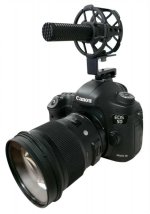
Apparently Sanken didn't get the memo ;)

CS-M1_DSLR_02_1000.jpg
 
Anyone tried the Sanken CS-M1 as an on-camera mick? Looking for a lightweight alternative to 416 for indoor filming with a C70.
 
I dunno what my mic is maybe CS3 ? Anyway Ive noted my work sounding better than the Senny crowd. I never noticed that until I was listening to the two sets of interviews side by side. Sanken rock :)
 
Anyone tried the Sanken CS-M1 as an on-camera mick? Looking for a lightweight alternative to 416 for indoor filming with a C70.

I’ve been using it on my F55 for probably about two years now(whenever it came out). It’s almost cartoonishly small. Sounds really good. I’ve even had one of my audio guys use it for a plant in a vehicle on a commercial and another used it for some off-cam voice stuff(we had talent asking questions to athletes who were on-cam). It doesn’t have as much low-end as the 3e, but still sounds good.

For some reason, I usually can’t post pics from my iPad, otherwise I’d show it on my 55.
 
Back
Top