New Panasonic Single Sensor B4 camera - AJ-CX4000GJ

puredrifting

Major Contributor
Hmm...this just came across my feeds. Interesting, a B4 mount P2 4K camera. All the copy says it contains is a "large-sized"sensor. Wonder which size to work properly with a B4 lens in 4K? Anyone know?
This form factor is so superior to any of our digital cinema camera messes, it's intrguing. Can shoot P2 Xpress P2 or SDCX cards too. Wonder what it costs?

Record high quality images supporting 4K and HDR with high-efficiency 10-bit HEVC CODEC. Supports IP (NDI|HX) connectivity and HD live streaming

Wiesbaden, DE. 11 September 2019 – Panasonic will showcase its new AJ-CX4000GJ broadcast shoulder mount 4K camera at IBC 2019. The product, which will launch in December 2019, follows the handheld-type AG-CX350 as the new “CX” Series lineup of 4K camera recorders.

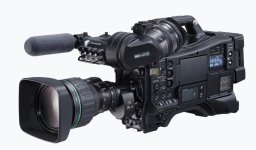
The AJ-CX4000GJ is a B4 lens mount, interchangeable lens camera recorder that is typical for broadcast use. It is equipped with a large-sized 11MP image sensor and enables high quality 4K (UHD) image recording with a horizontal resolution of 2000 TV lines. It is also compatible with HDR, compliant with BT.2100 and BT.2020.

The high efficiency and high image quality “HEVC” CODEC is adopted for the recording of 4K images. Long time recording with 4K/10-bit high image quality is possible whilst keeping bitrate and storage size under control. The high speed transfer and reliable “expressP2” card or the low running cost “microP2” card (SDXC memory card can also be used) can be selected for recording media. It also supports the recording of the “AVC-ULTRA” CODEC (HD) from the conventional P2HD Series. UHD 60p/50p 10-bit 4:2:2 output via a 12G-SDI output is also possible.

Additionally, it offers an innovative network solution. Images can be distributed in HD mode to internet live streaming services using the “Direct Streaming” function, compatible with RTSP, RTMP and RTMPS. The LAN terminal, equipped with a lock mechanism (1000BASE-T compatibility), supports NDI|HX connectivity. Transmission and camera control is possible with an IP connection and can be linked to a recording/distribution system combined with Panasonic’s remote camera.

For sports events and documentary recording, this camera offers the high-quality 4K images that are required for the broadcasting industry.
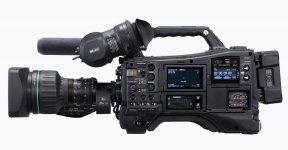
AJ-CX4000 profile.jpg

AJ-CX4000 three quarter.jpg
 
Does it need special lenses that cover the larger than 2/3 inch sensor? Obviously if it is using the "standard" b4 lenses, the image circle is pretty small, and the sensor is pretty deep in the mount.
 
You know those optical adapters that allow B4 lenses to be used on larger sensor cameras? That type of technology is built into this camera. Because it's native to the design and built right up in front of the chip, it is of a higher quality than any of the standard add-on optical adapters. It allows us to use the advances in our larger sensor designs with our 2/3" shouldermount P2 clients. It's quite impressive.
 
Does it need special lenses that cover the larger than 2/3 inch sensor? Obviously if it is using the "standard" b4 lenses, the image circle is pretty small, and the sensor is pretty deep in the mount.

Thats what I found intriguing, B4, 4K and large sensor dont all add up together. Mitch? Can you advise how large the sensor is even though I know this isn't your groups camera, is it? Also, my press release had no indication of price, do you know or can you share yet?
 
Well, that's interesting.

And since it is going from a smaller image circle, to a larger image circle, it must "lose" light. And depending on how much larger it needs to go, it may "lose" a lot of light. My wild guess would be at least 2/3 of a stop "lost", guessing it is at least a 1" sensor but could be bigger.

Now with a big sensor, and "small" pixel count (11mp), they may have some really big photosites which may mean that the ability to gather those photos is better and there may be little to no light "lost" as an end result. Would be nice to compare to other cameras and see what the net change really is, so many places to refine the process with the sensor and DSP technology that we have today. I'm guessing that through some sort of wizardry that you'll see a camera that uses good old B4 lenses and is still more light sensitive than 2/3 inch cameras from a couple of years ago.

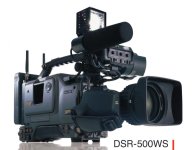
I thought about these same things. Combined with the superior form factor (My C200 rigged up for shoulder is SUCH mess compared to this), the fact that it can also shoot to SDXC or XPress P2 cards, the fact that there a boatload of good B4 lenses out there for DIRT cheap that used to cost $30K or more makes this camera very interesting to me, as long as the cost is reasonable and the 4K looks good and you can get a little better than 2/3" imager DOF and FOV. If it's a $50K or $70K camera I wouldn't be interested in it. But at C500 MKII prices, it becomes interesting for a lot of things. Or of course, as a rental. There is no scale provided but those Gold Mounts in the back of the Panasonic image look like the new generation tiny ones. As I've written several times, my Sony DSR500-WS, back in the day was one of my all time favorite cameras and I LOVED the 2/3 of a Betacam size and weight.

If it's a modernized, 4K version Panasonic version of this with good low light and enough DOF control, it becomes quite an intriguing camera. I made sooo much money with the DSR500WS, shot with it for three years, it paid for itself on two jobs and then was an $850.00 per shoot day ATM for me for years. So reliable, such a pleasure to shoot with handheld, shoulder, jib, to fly with, I miss it.

DSR500WS Memories.jpg
 
Last edited:
For me it's not the depth of field so much as the look of most smaller sensor cameras. Limited dynamic range, and just a flat ugly look to them that never looks nice. If they can figure out how to give a cinema look (which doesn't mean shallow depth of field), then these cameras would be more appealing. I mean, a cinema camera shooting with a deep depth of field typically looks way better to me than a broadcast camera shooting at the exact same depth of field.
 
FWIW, most of the time all we're seeing from these cameras is 30p footage with baked-in REC709 color profiles with in-camera sharpening.

Even a simple LOG curve with no sharpening in 24p would help. The sensor size isn't the problem.
 
FWIW, most of the time all we're seeing from these cameras is 30p footage with baked-in REC709 color profiles with in-camera sharpening.

Even a simple LOG curve with no sharpening in 24p would help. The sensor size isn't the problem.

I don't know many people shooting 30P. I'm either shooting 60P(59.94P) or 24(23.98P). For the most part, everyone shooting "video" is either shooting 59.94P or 59.94i. I can count the times on one hand with fingers left over that I've been asked for 30P. If you're watching live sports or basically anything live, it's 60(59.94). One of the locals around here was doing 1080/30P(don't know if they still are. I can't watch them) and it looked HORRIBLE. I actually can't believe someone approved them to go on the air thinking that it looked good.
 
It's not as uncommon as you might think it is.

But whether it's 30p or 60p or 60i, there is more opportunity for a variety than with cinema cameras.
 
I don't know many people shooting 30P. I'm either shooting 60P(59.94P) or 24(23.98P). For the most part, everyone shooting "video" is either shooting 59.94P or 59.94i. I can count the times on one hand with fingers left over that I've been asked for 30P. If you're watching live sports or basically anything live, it's 60(59.94). One of the locals around here was doing 1080/30P(don't know if they still are. I can't watch them) and it looked HORRIBLE. I actually can't believe someone approved them to go on the air thinking that it looked good.
I did a three day shoot for Good Morning America on ABC, somehow the field producers seemed pretty inexperienced; I asked them, "What frame rate do you want?" They said, "I don't know. What do you recommend?" I said, "Would you like to check with your editor?" They said, "Just whatever you think is good." I said, "Well TV is often at 30, so I guess we'll go with that." So we shot at 30.

I get asked for 30 perhaps 10% of the time, often for TV applications. For corporate videos and docs, it's typically 24p. I very rarely shoot 60p except for slow motion.
 
Thats what I found intriguing, B4, 4K and large sensor dont all add up together. Mitch? Can you advise how large the sensor is even though I know this isn't your groups camera, is it? Also, my press release had no indication of price, do you know or can you share yet?

I’m not sure of all the details and also not sure of what I can share, so that’s all for now. I honestly don’t know the price but that will be out there soon enough I’m sure.
 
Mitch, are there any stops lost like on the traditional adapters?


You can’t really call it a stop loss if it’s built into the design, can you? The optics aren’t removable, they are locked to the sensor. That’s what makes them so high quality and also so efficient. I don’t have the specs on sensitivity, but I can tell you that it’s generally at least on par with our other B4 mount cameras.
 
For me it's not the depth of field so much as the look of most smaller sensor cameras. Limited dynamic range, and just a flat ugly look to them that never looks nice. If they can figure out how to give a cinema look (which doesn't mean shallow depth of field), then these cameras would be more appealing. I mean, a cinema camera shooting with a deep depth of field typically looks way better to me than a broadcast camera shooting at the exact same depth of field.

The larger sensor in the camera means that it shares some of the qualities of the sensor development we’ve enjoyed in our cinema cameras. Wide dynamic range, expansive color gamut.
 
I thought about these same things. Combined with the superior form factor (My C200 rigged up for shoulder is SUCH mess compared to this), the fact that it can also shoot to SDXC or XPress P2 cards, the fact that there a boatload of good B4 lenses out there for DIRT cheap that used to cost $30K or more makes this camera very interesting to me, as long as the cost is reasonable and the 4K looks good and you can get a little better than 2/3" imager DOF and FOV. If it's a $50K or $70K camera I wouldn't be interested in it. But at C500 MKII prices, it becomes interesting for a lot of things. Or of course, as a rental. There is no scale provided but those Gold Mounts in the back of the Panasonic image look like the new generation tiny ones. As I've written several times, my Sony DSR500-WS, back in the day was one of my all time favorite cameras and I LOVED the 2/3 of a Betacam size and weight.

If it's a modernized, 4K version Panasonic version of this with good low light and enough DOF control, it becomes quite an intriguing camera. I made sooo much money with the DSR500WS, shot with it for three years, it paid for itself on two jobs and then was an $850.00 per shoot day ATM for me for years. So reliable, such a pleasure to shoot with handheld, shoulder, jib, to fly with, I miss it.

View attachment 136842

I don’t know what brand battery is pictured on the back of our camera, but it’s a standard sized Gold mount and the camera is a standard sized 2/3” shoulder mount design with excellent balance and control placement.
 
Back
Top