need blimp / zep recommendations

i'll chime in and say honestly my RODE blimp sucks. I read alot of reveiws and luved Matt's own especially...however i ordered mine from dvestore and when it came it was busted crap. Meaning it was missing a bolt, the lever that adjusts the slide thingy snapped like it was brittle...the xlr jack would not stay in the handle so during shots it would slip out and hit againts the boompole. the bolt thing that u screw the boompole into would not stay in...Just crap. So i had to to get it replaced (not an cheap thing when u live where i do) and the new one still has that xlr problem.

But did the replacement function better? Sounds like you got an anomalous dud the first time. I have a RODE blimp and it holds up very, very well. The XLR cable doesn't work itself out easily, either. You might try wrapping some plumber's tape around it to tuck it back in. It needs to be able to come out for repairs, but you should be able to get it to stick in there.
 
Just to add yet another option.
Even though I have 5 blimps, I rarely actually use them.
I always seem to use softies (Rycote and Ktek).

Its easy to slip on and off, it's less expensive, it's light, its small to carry, and personally I
find that I MUCH prefer the sound of a mic in a softie compared to a blimp.
Obviously just my opinion.
 
so a blimp indoors offers no improvement at all?

It offers wind protection from boom swings. Sonically, the only impact it will have is slight absorption of high frequencies... nothing to worry about. But if the mic it is protecting is not right for the room, adding a blimp will not improve the sound.
 
this thread is moving quick.
Matt and c2v – I'm still digesting all the content of your earlier posts so forgive me if I have not responded
 
so a blimp indoors offers no improvement at all?
No. A hypercardiod for interior shots and shotguns for exterior shots. The blimp itself is strickly for wind protection, mainly out doors. Although you may on occasion find yourself on a shoot where you are filming indoors under an AC vent that you can't turn off and a blimp or bbg will be useful in that type of situation.
 
But did the replacement function better? Sounds like you got an anomalous dud the first time. I have a RODE blimp and it holds up very, very well. The XLR cable doesn't work itself out easily, either. You might try wrapping some plumber's tape around it to tuck it back in. It needs to be able to come out for repairs, but you should be able to get it to stick in there.


the 2nd one has the xlr prob...i will try what u suggested. but honestly (and i'm no audio pro) i dont think the suspension system is is all that good. I still hear small bumpsand rattles ...but maybe i should get it in the hands of a pro before i cast judgement. There is one other issue with the new one...i cant remember now...but it can work around. the boompole is darn annoying though. All in all i ended up paying almost double the cost of the blimp to have it replaced. for that price i could have gotten a better one ...sigh.
 
Last edited:
did a shoot yesterday using my rode blimp, gota say it holds up well. you might have gotten a lemon, or just one that didn't hit the QC checkpoint perhaps? besides being heavy it does a great job.
 
the 2nd one has the xlr prob...i will try what u suggested. but honestly (and i'm no audio pro) i dont think the suspension system is is all that good. I still hear small bumpsand rattles ...but maybe i should get it in the hands of a pro before i cast judgement. There is one other issue with the new one...i cant remember now...but it can work around. the boompole is darn annoying though. All in all i ended up paying almost double the cost of the blimp to have it replaced. for that price i could have gotten a better one ...sigh.

The suspension is a copy of the old Rycote one, but missing bits that are essential to the design.

Rycote dropped this suspension type when they invented and patented the new "Lyre" design which is much better than rubber or silicon rings.

The Rycote S-series is around the same price as the Rode, I understand.
 
You have probably seen my posts scattered about this forum, giving my advice and opinion whether people want it or not, and I'm sure I've pissed off as many people as I've helped.
Often I am dishing out rather than asking for help, so this being a thread where I need help and advice – I first wanted to say thank you.

Earlier in this thread I referred to a 12x15 ft room and I just want to expand on that.

The reason for this thread is that I feel the weakest part of my latest film is the audio. In particular the ratio of room tone to dialog on INT: Apartment.
More about this recently completed film is at this thread LINK. Note there is a thread index on post 2, a trailer on post 67 and in the trailer you can hear
some of the room tone/dialog ratio that I am referring to.

On very small shoots I handle sound myself. I set up on a boom arm, get in tight, set levels on the MM1, then return to my camera and I'm alright with the audio quality.
This recently completed film however, was a bigger project. I paid fellow film makers to form a 'do everything' crew, then hired PA's when available to help with extra stuff.
I then could run camera and give direction to my actors (we had already rehearsed bigtime). Before you ask – there was not enough budget for a dedicated sound person.
Instead I had my most trusted crew on sound whenever possible and overall the dialog on the film is acceptable but not as good as if I had done it myself like
when I am on my one man shoots.

If my next project has a bigger budget I will of course hire a dedicated sound person. However it is likely that the next project could be a repeat scenario so there are elements
from this thread that I am taking to heart. No more 1' to 3' distance with a NTG2 / MM1 for INT: Apartment. I will be making a point to remind crew to get mics in tight
on the picture frame and I will be investing in a hypercardoid.

On the subject of hypers. In an earlier post c2v linked to the Oktava Bella Nero (link here) and I have also read about the OctavaMod MK012 (link here).
So now I'm wondering, which one is better? Are they the same thing?

Earlier Matt suggested I step up from the MM1 to a Mixpre. Actually I have a strong urge to go straight to 702 and ditch the zoom h4. That would be nice, right?
But probably its a pipe dream as I break down my budgets more realistically. Either way its on my mind Matt.

Some further thoughts … Blimp vs Softie?
I know this is getting away from INT: Apartment but since I mentioned blimps at the start of this thread I shall return to it.
Keep in mind that most of my outdoor shooting situations would not be in extreme weather conditions (narrative shoots are hard enough without battling the weather).
I am also very aware of how tiring it can be when holding a boom take after take – so the comfort of my boom op is not something I forget during my shoots.
For this reason a heavy blimp is no go. I have never owned a blimp and I'm asking myself – do I really need to? What improvement will a blimp give me over a softie?

Anyway, I'll bring this long rambling post to a close. I await your response fellow audiophiles.
 
Last edited:
I would have to be SERIOUSLY convinced to get an oktava mod vs. the standard "bello nero" from soundroom. That discussion is an old one... and somewhat emotional... as a member on here said he knew the guy who was doing the mods... and was vouching for him.

The issue on that however... is that everybody on that end of things is still enjoying how slow information actually moves. In the audio world... for whatever reason... people REALLY like to hang on to subjective ideas. What that means is one guy can say "this sounds a LOT better"... and then you may hear it and think it sounds the same or worse. I stopped subscribing to Stereophile and The Absolute Sound years ago because of this... and yet, a lot of people still feel moved by descriptions of "much fuller... more open sounding... the strings positively come ALIVE with this _______".

I hate crap like that. If you want to make points in that way you gotta' back it up. Show me charts and graphs that clearly support your point... or a real polar pattern... OR an audio/visual test where I can decide for myself. That guy has sound clips on his site for this model Oktava, but the clips compare totally different mics, from totally different companies... I highly doubt you'll EVER hear a direct comparison between one of Paul's Oktavas... and one of his with "premium electronics"... but yet you're paying over 50% more. "Look how much redder the apple is then the orange" ;-)

Even if you didn't want to disclose any of your technical process... it would be easy to do a before and after self-noise + on-axis/off-axis frequency response test... but the problem is the guy who bought the mic can easily do that himself by plugging in his MKH60 or whatever... and then plugging in his modded "whatever" and comparing the noise floor on his computer. (i.e. suddenly you are subjected to possible returns, liability, etc. if what you're selling doesn't do what you said it does... vs. "You say the strings did NOT come alive? Hmm, well, that's your opinion.")

The thing about the Oktava... is in the early days the Russian factory was notoriously careless about QC... you'd find different capacitors and things in the mic, from one to the next. Well... eventually Scott Dorsey from Recording magazine decided to just really fix the guts of the average Oktava... upgrading caps, resistors, and FET... just to see how good he could make the mic sound.

Cut to nearly 10 years later... and Oktava got the message... they began selling the MK012 as standard... with (as best I can tell by opening one and comparing it) all the upgrades. All they hadn't done... from the one I opened about 5 years ago... is change out the FET... but it was still acceptable... as you can hear by listening for yourself.

People used to get occasional "stinkers" with the Oktava... it was a case of "will I get a golden sample, an average mic, or a lemon?"... So when you bought an Oktava you went with your favorite headphones and kindly asked the salesman to bring out the entire stock... (or at least 3, so you could compare).

So... cut to Paul from SoundRoom... Paul owns a mom and pop sound shop... and he brings in a bunch of Oktavas... which he then performs this service in advance... for his customers. If he has any that weren't impressive... he sent 'em back. This is why I initially liked this guy... I felt like he "got it" when it came to what I wanted from a business... and a microphone. Paul then followed up this initial attention to detail with good customer service... and that's why I became such a big fan of his store... and have recommended him for those mics ever since. (He was also very helpful and responsive and worked with Oktava on some ideas that I offered to him, but that's another long story.)

The guy from Oktava mod... understandably so... won't explain what he's specifically doing to mod the mics. I don't mean he's not giving an exact parts list... that I could understand... but he won't even say what "general" parts he's changing out. When I sent an email offering to be totally open-minded on this (since we had a somewhat impassioned discussion about his company on here)... he said it was not in his interests to pursue that discussion whatsoever.

Bottom line... I figure he's probably changing out that last FET... or who knows what (perhaps nothing?)... and going back to what has worked for so many years when it comes to audio... overly dramatic descriptions of the subjective reality.

The "standard" Oktava that you'll get from Paul WILL sound great... and you've been able to bank on that for the past 6+ years.


Now... to answer your other question... the ratio of dialog to room is a multiple of mic-to-mouth distance... as with light... it's the inverse square law. Every INCH closer the mic is to the speaker's mouth... will matter. When you're talking FEET of distance... you can lose quality in a big way... really quick.

Most non-sound-guys... most amateurs... can never really wrap their mind around this... OR they simply don't care. What you're paying a boom op for, mostly, is his/her constant attention and tenacity to maintain that distance. Most PAs... or whoever... will be much more concerned about "not pissing anybody off" by dropping the boom in the shot... OR... if you're lucky... they'll start off doing an OK job... but good booming is hard... I get a work-out on a long day and by the end I'm really tired (and I'm a reasonably fit 200lbs dude). Some guy that's not really invested in your project is going to get sloppy after the first hour.

So that's it... mic to mouth distance. Maintain it. If you can't get close then you need a mic that can (boom becomes lav).
 
Some further thoughts … Blimp vs Softie?
I know this is getting away from INT: Apartment but since I mentioned blimps at the start of this thread I shall return to it.
Keep in mind that most of my outdoor shooting situations would not be in extreme weather conditions (narrative shoots are hard enough without battling the weather).
I am also very aware of how tiring it can be when holding a boom take after take – so the comfort of my boom op is not something I forget during my shoots.
For this reason a heavy blimp is no go. I have never owned a blimp and I'm asking myself – do I really need to? What improvement will a blimp give me over a softie?

Wind protection is achieved by the volume of still air trapped round the microphone.

A basket windshield system does this best.

So a full Rycote basket windshield system is the best for this (a stereo windshield even better).

Next best is the Rycote S-series, but pretty close.

Actually the Rycote Miniscreen with windjammer is actually slightly better than a Softie - there are internal reflections and refractions inside a foam windshield that affect the sound.
 
I've got several softies and a couple blimps, including Rycote and Rode.

I do appreciate the light-weight of the Rycote... and it's got an "industry standard" type of construction about it... (mine is older, NOT lyre system)... whereas the Rode is pretty(?) but also heavier... and I wish Rode's fur was more wispy, although it still does what it's supposed to do.

A blimp (from either company) is going to be twice as effective in wind as a softie... and a softie is over twice as effective as a regular foam screen. A softie gets it's "apparent" dead-air space by using really open celled foam, which looks almost exactly like the filter media used in a pool/pond filter... it's like a really open web of soft-plastic fibers that make up the structure of the softie... and a hole down the middle of it is where your mic sits. This really open material supports your mic in the middle of that "apparent" dead-air space, but this is definitely not as good as any real blimp, that truly supports the mic within a dead-air space, because no mechanical action of air striking the blimp makes it to the mic itself... and the extra volume of dead-air allows the wind to be dispersed around the mic quickly... i.e. the wind energy is absorbed by the dead-air space. Since the softie has less dead-air space (because it's filled with fibers) and the outer structure of the softie is directly connected to the microphone at thousands(?) of tiny points... more of the wind's energy can be transferred to the mic in the form of direct wind, or rumble from the softie itself.

The thing is... a softie is easy, durable, and very light-weight. You can leave a softie on a mic 80% of the time and just never give it another thought. There will be times where the wind-rumble is totally acceptable as long as you see other things in the shot to justify the sound. That's why most ENG news crews simply use softies... you don't often see a full blimp in a gang-bang (turn on the news tonight... when a politician or celebrity has a crowd of ENG crews around him... look at all the softies.) But you'll see blimps all the time in dramatic work.
 
... A softie gets it's "apparent" dead-air space by using really open celled foam, which looks almost exactly like the filter media used in a pool/pond filter... it's like a really open web of soft-plastic fibers that make up the structure of the softie... and a hole down the middle of it is where your mic sits. This really open material supports your mic in the middle of that "apparent" dead-air space, but this is definitely not as good as any real blimp, that truly supports the mic within a dead-air space, because no mechanical action of air striking the blimp makes it to the mic itself... and the extra volume of dead-air allows the wind to be dispersed around the mic quickly... i.e. the wind energy is absorbed by the dead-air space. Since the softie has less dead-air space (because it's filled with fibers) and the outer structure of the softie is directly connected to the microphone at thousands(?) of tiny points... more of the wind's energy can be transferred to the mic in the form of direct wind, or rumble from the softie itself.

This is why I said the Rycote MiniScreen with windjammer is better than a Softie - the MiniScreen is a small basket that gors over the mic. like a Softie does. It is cheaper than a Softie and slightly better.
 
Interesting discussion with lots of good info.
pardon me if this is off topic...
Just received a Rode Blimp and it has a mentioned ability to change the suspension band orientation by moving the 4 mount screws and bands from "low and wide configuration" to "tall and narrow configuration" Does anyone know what determines when configuration is better than another?

Also..
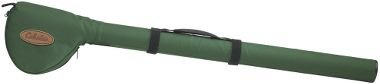
Has anyone found a good carrying case for the Blimp and a typical pole?
 
Last edited:
Gweilo66: When I had the Rode blimp I figured out that the only time I had to change the suspension bands was when I used a heavy mic, like the Rode NT-4, in order to put more tension on the bands. As for a carrying case: I used a lightweight toolbox for the blimp & a fishing pole holder for the rod. If you have a Cabella's close to you check out their Bargain Cave- I've found the perfect length pole holders for both of my booms for $10 each! I found that I can leave my Rycote Lyre suspension on the tube with the type below, normally used for a fly rod with reel attached.

You can find their whole assortment here:http://www.cabelas.com/catalog/browse.cmd?N=1102356
 

Attachments

  • rodtube1.jpg
    rodtube1.jpg
    4.1 KB · Views: 0
My dream case would allow the loaded blimp/mount to travel attached on the collapsed pole. But that would be pretty large overall or very uniquely designed..like the trod holders you listed but with a larger bulbous portion for the blimp. Ah well...

So you're saying use the "tall and narrow" arrangement for heavier mics?

Funny you mention the rycote. I'm considering gertting the lyre/invision mount without the other rycote windscreens for lightweight indoor use. If I understand it properly, the mount is only about $60. Maybe load that with an Oktava hyper and ball gag. I could switch out to the full Rode setup for outdoor shotgun situations.
 
Back
Top