Need advice on shooting food for six commercials

maranfilms

Veteran
I recently booked a job that will entail shooting food, mainly vegetables, herbs, chicken, pork chops, etc.. It's for a product line pertaining six different sauces that can be used on or as a marinade. Looking for advice, tips on the subject. I've never shot food before. I will be using gh4's, a full set of rokinon primes ( 10mm, 12mm,16mm,24mm,35mm,50mm,85mm,135mm,) on this, it's not a huge budget. Will be in a gourmet kitchen with wood burning stove, along with other top of the line commercial cook tops, ovens, etc. Large space, with some really nice overhead, but suspended practical lighting instruments, granite counters. I think it will film nicely. For those of you that have filmed food, what advice would you give to a newbie in the subject, besides casting a bombshell eating the food in a Victoria secret get-up? :-)
 
Last edited:
If you can afford it, try and get a food-stylist to advise on food-prep. Most food prepared for the camera is not made to be eaten ( i.e. it's not fully cooked, but looks fully cooked ), and this is where a professional food-stylist makes a HUGE difference in the finished results.
 
If you can afford it, try and get a food-stylist to advise on food-prep. Most food prepared for the camera is not made to be eaten ( i.e. it's not fully cooked, but looks fully cooked ), and this is where a professional food-stylist makes a HUGE difference in the finished results.

This is exactly the kind of advice i'm looking for, I didn't know such a position exist, it certainly makes a lot of sense. Thanks Dingo, I appreciate the post! I will look into it.
 
Last edited:
Old stills trick was to lightly brush a coating of vegetable oil on the raw vegetables, gives them a nice shine. Think like waxing a car and I think you'll get it. But as mentioned, if you have the budget, hire a specialist to prepare the products.
 
Old stills trick was to lightly brush a coating of vegetable oil on the raw vegetables, gives them a nice shine. Think like waxing a car and I think you'll get it. But as mentioned, if you have the budget, hire a specialist to prepare the products.
Thanks Greg-_E, I thought of that very thing today when brainstorming on how to get a nice shine. I'm thinking of some nice macro shots in there as well. My other issue is the mixed lighting, lots of windows in the area along with several different color temps to contend with. I just want to get great looking skin tones when the chef is in frame.
 
Thanks Paul, I'm about to delve into the article now
@Greg, same page again, I'm heading back over in the next day or so to take some readings and get some measurements on the windows. I think the nd will be a must due to the wood oven is next to a large window, I don't want to compete with that light, hopefully I can time it to get those shots either late afternoon or sundown if I can maintain schedule. It's going to be a small crew, you know how that goes, lol
 
if you can get a display turntable to shoot the food on that can be nice, they sell them on ebay. The one I got rotates very slowly and is good for adding a bit of movement to a product shot. If you used your 85 mm prime I think it would look good.
 
if you can get a display turntable to shoot the food on that can be nice, they sell them on ebay. The one I got rotates very slowly and is good for adding a bit of movement to a product shot. If you used your 85 mm prime I think it would look good.

Great Idea! I have a lazy susan that would work well for that. Thanks for the input
 
Do as much prep as you can within the budget and come up with your desired looks in advanced. That way you have a pretty good idea which lenses you will use, any diopters, lighting style. Put together a shot list. Include stills of shots for a refresher if needed. Also be ready to punt and move on to plan B or C if needed. Things change. Be ready to keep things moving forward. Even when everything you were ready to do just got thrown out the window. Also shoot different angles and setups to further the footage down the line. Yes its nice to have all money shots, but I would rather have more than not enough.
 

Attachments

  • JonesFood.jpg
    JonesFood.jpg
    49.6 KB · Views: 0
  • JonesFood02.jpg
    JonesFood02.jpg
    50.1 KB · Views: 0
  • JonesFood030.jpg
    JonesFood030.jpg
    48.4 KB · Views: 0
Last edited:
Forget fashion, forget product.... food photography is that hardest skill to master.

But the secret is pretty easy, soft backlight with minimal fill or bounce ( with not too much horsepower)
 
But the secret is pretty easy, soft backlight with minimal fill or bounce ( with not too much horsepower)

...I haven't shot food photographs in 20+ years, but it seems like the lighting has gotten a lot worse than when we shot things on large-format sheet film.

I rarely see anybody using hard cross-light to bring up textures or edges, so some of the current shots look kind of dull in comparison. ( like shooting outside with an overcast sky )
 
Food is texture ! I learned on large format stuff as well then moved into film/tv. Its not so much the hard/diffusion of light but the angle ( lower to subject ) that reveals texture.

Most people usually front/side light, blowing away color, subtlety and texture creating that wonderfull dead look.

P.S. A food stylist is invaluable and worth every cent.

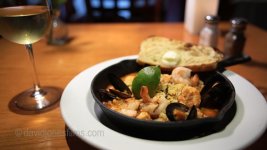
P.S.S shooting white plates can compromises exposure ...though Dave's shot above handled white plates with black mussels well.
 
Last edited:
So I will chime in with the crowd for a food stylist. A good food stylist along with the chef will get you food on dishes with accessories that is a joy to shoot. I did food television for PBS and Food TV for many many years, among the shows a James Beard award for best food tv series. All our food in all the shows was edible, prepared on site and designed by food stylist and chef. On the odd shot the propane torch came out for a little extra char and maybe an atomizer with spring water or a touch of canola oil but rarely. Our lighting was almost always large and I mean large soft boxes usually built on site from Rosco diffusion and duvateen and suspended directly over head and then the food was hit with kicks. There is a big difference in shooting food for video and shooting food for print or hi rez stills. You can try to emulate what a stills guy/gal will do with a plate of food in a few hours but they never seem to allow that kind of time for video unless its a prime time spot.
Good luck!
 
Big soft back source - big soft 3/4 front source - snooted fresnels as fill & high lites
mirrors - camera wedges - dots & fingers - white cards - dimmers - boom arms -
multiple monitors for viewing - 35, 50, 85mm primes - Dana dolly
thats the basics for me -
 
And if you can't afford that food stylist on the low budget, and doing close-ups, then be sure you have at least a spray bottle and marinade brush with oil/water to keep food looking moist & fresh.
 
For those of you that have filmed food, what advice would you give to a newbie in the subject...

My advice is to not take this casually. Shooting food is not at all easy. If you've never tried it you have no idea. At all. So, hire yourself a food stylist. Yes, for real. Yes, I saw "not a huge budget". Spend the money. A reasonably good food stylist will save you all kinds of time and trouble and vastly increase the quality of your footage.

But you aren't going to do that are you? Newbies almost always think they can just wing it. Rude awakening, that is. Been there, done that, been punished for it. Advise you not follow in my footsteps.
Drogar-Thinking%28DBG%29.gif


Oh, yes, bring a full set of lights and lighting controls (flags, reflectors, dots and fingers, lots of c-stands [using flags as negative fill works well with food]). Relying on practicals is going to make it very difficult if not impossible to make the food look good. Don't believe me, ask your food stylist. They've been there and done that too.

And what are you going to do for plates, bowls, props? Think about how to show visually the concept of "appetizing". Don't know what I'm talking about? Grab yourself some decent cook books and start looking at the photography. Not just the food, but the lights, the shadows, the plates, the props, contrast, texture, etc. And spend an evening watching TV. Just about every commercial break has at least one food spot. These are some of the most highly produced commercials. Watch the movement (lots of slo-mo), watch the lighting, watch the shadows and the highlights, watch the contrast and the textures. You can learn a lot once you learn how to watch everything *but* the food.
 
Last edited:
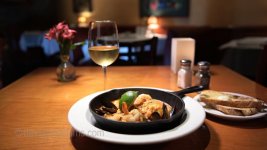
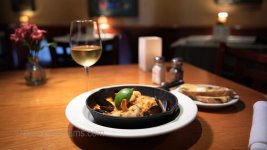
The above stills were from a shoot that was very well planned out. I knew in advance which cameras I was going to use, lens selection, diopters, lights & modifiers, Dana Dolly, Jib, everything. When I arrived for the shoot, the location area that was pre planned for was now off limits, the stylist was not happening, and in her place a still photog was now going to be working along side using my setups for still shots. We were relegated to an area which was very small and against a wall, so my setup went from multi-cams down to a single cam on a slider. My gear also seemed to overwhelm them, and all of a sudden became too much, as well as the amount of time I was taking to setup an area which was completely different than what was planned for. I ended up lighting the food with a Kino Flo Barfly 200, a Dedolight with projector & breakup, a Mini Mole with projector & breakup, and a 1x1 LED for a back wall wash. Which was about all I could fit into this small area since this was not a closed set and the place was full of customers. Power was also at a premium with only one outlet available. In my prep lighting setup I used 8 lights, 2 reflectors, 2 fingers, 1 dot, 4 flags, 2 floppies, 2 silent Grid Cloth, just for the food. I also couldn't modify any of the foods since they were going to be taken home and eaten after the shoot, and the plate color was going to be white and nothing else. You know sometimes these places have experience, but a lot of times its with a TV shooter just turning on their on-camera light and doing a spray job. So they can't understand why you just rolled up with a truck full of gear and are wanting to take 2 hours of prep to make a restaurant and its food look national, when in their mind some guy with a shoulder cam can do it in 10 minutes.

In the above stills I believe the bottom one was my original wide shot where 2 couples should be sitting in the background.
The middle shot was the producers call on the wide shot.
The top was my adjusted shot based on the lack of background extras.

Bottomline.... You may have a truck full of lights, mirrors, flags, dots & fingers and everything needed to do national looking food shots. But sometimes what is really needed, is a good backup plan.

All the best!

Dave
 
Last edited:
Back
Top