
I wrote the following as a response to a question about which Canon DSLR to buy and thought I'd share it here. I'm trying to write more these days and thinking about starting a blog to share my camera musings, so consider this practice.
Which Canon HDSLR?
I've been forced to shoot HD with Canon DSLRs (yes, I was forced to at first) for about two years now, and I've become somewhat of a minimalist with them - not that I'm not familiar with bigger gear. My thoughts on the options with regards to HD video (still photography not considered here), which are not at all the conventional wisdom:
5D2: Focusing is harder (already the most difficult aspect of HDSLR shooting for many) - in order to get more than one thing in focus (a necessity when making actual narrative films, rather than youtube "camera tests" featuring your cat) you have to stop down to the point that any fullframe lowlight advantage disappears. Fullframe zooms are heavier and more expensive. Few cinema lenses will cover the sensor, if you happen to like cine glass. The sensor is just too damn big, in my opinion - super35 is perfect. About to be replaced, so resale value will drop.
7D: More prone to overheating. No Magic Lantern support (a HUGE disadvantage). Exact same video quality as Rebels which cost less than half as much. Only recommended if you will be using an external monitor extensively (which I hate doing with these cameras, too clunky) as it's the only Canon DSLR that doesn't drop resolution on the HDMI output while recording. Probably will be replaced soon so resale value will drop.
I recommend the T2i with Magic Lantern if you are recording audio in camera (better preamps), or the T3i with Magic Lantern if you are recording audio separately (HD zoom mode at 3x is very useful and aliasing free). 60D is nice but I like a smaller, cheaper camera in this market segment.
For lenses, I use my old Nikkor primes (20, 24, 35, 50, 85, 105, 180, 300) when I have the time, but I like to move fast and stay light with these cameras so I often stay on the zooms: Tokina 11-16 and Tamron 17-50 non-VC (non-VC is key, the newer VC version is crap, but the older non-VC is a great lens for video and happens to be rehoused and sold by Red for $6000). The lightweight Angenieuxs work great with an adapter when someone else is paying the bill, but add a layer of complexity that I don't like - might as well be on a real movie camera at that point. The good Canon lenses are all full-frame - too big and heavy for my taste, and have annoying infinitely rotating focus rings. Unfortunately their 70-200L is the best choice I've found for a long zoom.
I would never put a mattebox on a DSLR, I find the hoods that come with the lenses and screw on filters to be adequate.
I pull focus on the barrel when operating (Magic Lantern focus peaking), have never bothered using a manual follow focus on a DSLR. Single channel Prestons can work well when needed for special situations.
Of course, if you care about "looking" like a pro you might not like the smaller cameras and my approach. I need no reassurance about my professionalism - I just want the best tool for the job.


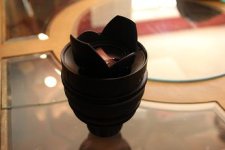

 Canon EF-S 17-55 IS might as well be the greatest all-purpose lens every event cameraman needs. (Even the new 24-70L, all around lens designed for 5DMark2 lacks an IS) Also any full frame lens used on a crop sensor will perform even better. {many know why}


