My Experience shooting a Music Video on the C300

Nuno Dias

Carbonite Member
As soon as I was aware that I could have the C300 for a day, I postponed a music video shoot I had so that I could use the camera. I'm a director, not a DP so my experience is not first hand, although I did spend a lot of time with the camera, testing it before the shoot.

From an aesthetic standpoint, this camera has an amazing image quality, superb range in luminance and color. The Canon-Log profile really is a beast, most like the Alexa's C-Log, yes, is that powerful!

The ergonomics is great, so tiny and light, you forget you're getting such an amazing image from such a tiny camera. From my point of view, it was a joy to use, my DP also liked it, although he was very suspicious of the camera, as no one knew it very well. Also because, the camera seems to read light very differently from other cameras and light meters, often his light meter was reading say a 1.4, whilst the (Zeiss) lens was on a 2.8 (two stops under) and it wasn't underexposed at all! This camera can literally see in the dark! Same thing with highlights, it can go all the way up and not clip or create any CA, and always keeping a smooth tonal transition.

Unfortunately our focus puller 'hated' the camera. And I can understand why. From her point of view, this camera really is not user friendly. It has endless menus and endless buttons, that in the midst of her fast-paced workflow, it can quickly became chaotic. She kept pressing the wrong buttons... We were shooting in a quite darkly lit room, so her job was all the more complicated trying to figure out what button to press at any given time.

In this respect, the C300 is a video camera in the worst sense of the word, its a complicated electronic device, and this is something that doesn't go down well on a film set, where the crews need/want/like simple and plain tools, much like a film camera, with a minimal menu for frame rates and a big red button, nothing else!

We all know this is a different beast, but I have too admit, the only thing that I didn't particularly like about the C300 was its endless, complicated menu system.

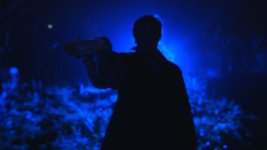
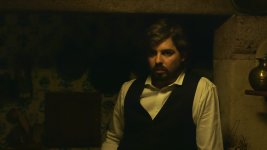
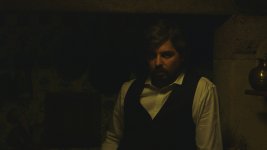
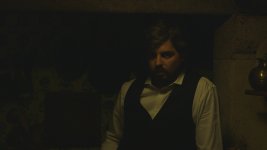
Anyways, here are some ungraded, untouched frame grands. Once I finish editing, I will post the finished film.

Offline_01.Still001.jpg Offline_01.Still003.jpg
Offline_01.Still004.jpg Offline_01.Still008.jpg Offline_01.Still012.jpg
 
as no one knew it very well. Also because, the camera seems to read light very differently from other cameras and light meters, often his light meter was reading say a 1.4, whilst the (Zeiss) lens was on a 2.8 (two stops under) and it wasn't underexposed at all! This camera can literally see in the dark! Same thing with highlights, it can go all the way up and not clip or create any CA, and always keeping a smooth tonal transition.

Unfortunately our focus puller 'hated' the camera. And I can understand why. From her point of view, this camera really is not user friendly. It has endless menus and endless buttons, that in the midst of her fast-paced workflow, it can quickly became chaotic. She kept pressing the wrong buttons... We were shooting in a quite darkly lit room, so her job was all the more complicated trying to figure out what button to press at any given time.


View attachment 48842 View attachment 48843
View attachment 48844 View attachment 48845 View attachment 48846

I have to say that DP did it all wrong then, you should NEVER use a light meter for digital work, it will always be completely wrong. Waveform is the only way to get correct exposures with any digital system. I agree with McGeedigital, those look pretty underexposed.

I usually dont like to bash any camera, but I personally hate the C300, its over priced and underpowered. It also still has a videoish type feel to it, something not filmick about it. Much more like a DSLR than cinema camera. Its also too small, list goes on.

I would suggest if having a digital system, to use a DP who knows how to light and meter for digital work. A lot of good FILM dps try to jump into digital cinema, only to do everything "wrong" with the camera. They need to learn its a different animal, and that exposure is not traditional. Any DP who uses a meter to try and light with a digital cinema camera is really asking for trouble.
 
Filmdude, wit all due respect, we actually knew what we were doing. Any sensible DP will not only use the waveform, but also the vectorscope and the lightmeter. A sensible DP will want to know where his base exposure will be (hence the light meter), so he can design not one shot but an entire scene. the Dp's I work with are way pass the 'get the exposure right' mentality, we are actually doing a certain 'look', and that requires a lot more than just get the right exposure by looking at a waveform... just sayin'

And yes, if these shots look underexpose, that's because we wanted them that way. I can quickly grade them back up with a simple color corrector in Premier Pro:

Offline_01.Still017b.jpg Offline_01.Still017ca.jpg

But this is not the look we want for this scene. We want it dark, underexposed.

More like this:

1.jpg 2.jpg

I believe this camera is the best digital camera I have worked with besides the Alexa, although I still have to shoot with both the Epic and the Scarlet. But for €12 000 this camera is just fine for me. Sure, it's expensive, but I don't ever plan on buying one, (any camera will be outdated in a year). I can rent a C300 for €150/day. That makes more sense to me.
 
Last edited:
I have to say that DP did it all wrong then,
I usually dont like to bash any camera, but I personally hate the C300, its over priced and underpowered.

Lovely, just lovely. Had to chime in and say I personally LOVE the C300. I've had cameras costing 3 times this, and have never been more satisfied. Just finished a 3 day shoot in Melbourne, Australia where it delivered the goods. The latitude is just sic.
 
i'll pipe in and say that i too truly love working with this camera. It just looks great, and is relatively easy to work with. Sure, there are a few things i would change, but overall i'm so far very satisfied.
 
First, love the shots, for being ungraded the coloring is just really nice. I find it kind of amusing how people like to keep pointing out the exposure of an image is wrong. Do you actually watch movies? I see tons of scenes that are exposed at this level. Heck, I just watched cowboys versus aliens and there is a whole scene inside the upside down paddle boat that is even darker than this. It's a style. There are many times I shoot under/over exposed on purpose because that's the look I want. I personally prefer to shoot as close as possible to what I want in post with an 8-bit camera.

Pertaining to the buttons, I think this is a time of use issue as well. When I first started shooting with my FS100, I was so used to the AF100 I was having a hard time finding anything. But now that I've shot with it a bunch, I can hit most of the buttons without even thinking about it. That said, I think the button ergonomics on the FS100/AF100 aren't the greatest. Try changing the ISO quickly on the AF/FS if you don't have it set to a preset. I've not used the C300 but I imagine with my mind already trained for other cameras, I will be just like your focus puller for awhile.

All that said, I have to say, I think the C300 is fantastic looking. I've been one of the biggest complainers about the cost, but at 1080p24, I really do think it looks fantastic. Makes me excited to see what comes down the line from Canon after this. Canon is on the right track.
 
Well, as they say, opinions are like a**holes - we've all got them, and they all stink. Everyone is certainly entitled to their own. On that subject, I actually think the frame grabs are really nice. I tend to underexpose a bit when shooting narrative, especially skintones. I like the look, the richness and slight bit of... i don't know... "mystery" it imparts? I think for certain dramatic situations, it can really draw you into the seen - almost like it's making you look closer and deeper into the frame. Maybe I'm just making it all up in my head. I just know I like it, and it's a useful strategy when the situation calls for it. I can't imagine how boring cinema would be if every white person was 70 IRE ;)
 
I started underexposing more on the AF100 myself. For me it's looking at what is happening with the curves. I spent so much time with the 7D, when I switched to the AF100, I felt the midtones were pushed down a bit, but I was still trying to shoot the same. The over/under exposure range is just not the same camera to camera.

I also think, looking at the brought up shots shows that they still look great after the underexposure was compensated for (even though that was not the look going for).
 
I usually dont like to bash any camera, but I personally hate the C300, its over priced and underpowered. It also still has a videoish type feel to it, something not filmick about it. Much more like a DSLR than cinema camera. Its also too small, list goes on.

Too small? How big should it be?
 
I like the images and can see the low-light mood.
The C300 looks great in pretty much every setting I have seen so far.

I understand a focus puller can get overwhelmed, but if you are used to 2 buttons you can just put red stickers on the 2 that you need or better, just set the buttons to your liking, since the C300 allows you to adjust them. Then add some stickers and forget the rest of the buttons ;-)
 
Most of our shoot was done at base ISO of 850, in tests this seemed to increase the dynamic range substantially compared to other ISO's (judging by the waveform). Now, I can see some noise in the dark areas, areas where very little light was hitting the sensor, but this doesn't concern me as I hope this noise will disappear once the footage is graded and the blacks are leveled into place.

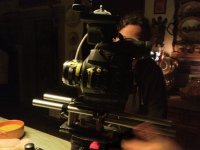
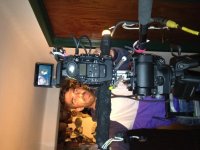
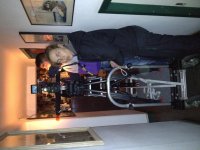
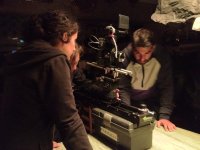
Here are some behind the scenes photos:

IMG_0210.jpg IMG_0213.jpg


Our state of the art dolly... and yes, that's a first aid box serving as a cineslider base...

IMG_0212.jpg IMG_0209.jpg


All in all, the camera performed extremely well, there was never an issue with it, as it performed to our aesthetic and technical needs all the time, considering this is a new camera and no one was familiar with it, it entered our 'world' very nicely indeed.

Now I just hope there is not any nasty surprises in post, so far, editing as been smooth, easy and fast workflow.
 
Last edited:
I have to say that DP did it all wrong then, you should NEVER use a light meter for digital work, it will always be completely wrong. Waveform is the only way to get correct exposures with any digital system. I agree with McGeedigital, those look pretty underexposed.

I usually dont like to bash any camera, but I personally hate the C300, its over priced and underpowered. It also still has a videoish type feel to it, something not filmick about it. Much more like a DSLR than cinema camera. Its also too small, list goes on.

I would suggest if having a digital system, to use a DP who knows how to light and meter for digital work. A lot of good FILM dps try to jump into digital cinema, only to do everything "wrong" with the camera. They need to learn its a different animal, and that exposure is not traditional. Any DP who uses a meter to try and light with a digital cinema camera is really asking for trouble.
I light meter is used for many more things than basing exposure. Most experienced lighting designers use them to "LIGHT" and confirm. As for the underexposed comments, silly.... I would term them "mood" lighting and exposure. There is an old saying, "garbage in garbage out". Meaning, light and expose as close as possible according to the mood and end result. The more you edit an image the more you degrade it.
 
I light meter is used for many more things than basing exposure. Most experienced lighting designers use them to "LIGHT" and confirm. As for the underexposed comments, silly.... I would term them "mood" lighting and exposure. There is an old saying, "garbage in garbage out". Meaning, light and expose as close as possible according to the mood and end result. The more you edit an image the more you degrade it.

Yes, that's right Dusty. Also, I choose to shoot this music video as a narrative piece, instead of having the regular format of the band playing. They liked the idea, so this music video is more of a short film, with the story based on the lyrics. The 'actors' are the band members themselves.

Light and exposure are one of the main tools of storytelling, by underexposing a certain character, you are making a statement about the emotional state of that character, as you are by exposing other characters in a different exposure/light/mood. Or by the direction of the light, in this case I used top light, as so to create a powerful, elegant mood for the main character. If I had chosen, say, a low light motif, backlight or side light, I would be portraying a slightly different visual/emotional state of these characters. For this, me and my DP, opted for top light, a darkly lit room, and characters dressed in black and white only.

The scene from the screen grabs, needs a certain dynamic between the three characters, so I needed to use the light to convey that dynamic between them, that's why some of them are 'less' lit, as they are being threatened by the other character. The so-called 'film look', has to do with mood, rather than getting 'the right exposure'. If you light all characters the same way, you're not really giving them a chance to be viewed differently, so that they can each play a part in the story. It would be almost like shooting an entire film with the same sized shot, say, all medium shots, it wouldn't work, would it? Same thing with light. I love being creative with light to help me tell my story.

But hey, the good news is, you can choose whatever you want to do on your own film.
 
Last edited:
I'm fascinated by the objections to using light meter versus waveform/vector scope. If the camera's iso's are calibrated according to ISO spec, and the meter is accurate, then it's a great way to judge where specific areas of the scene are falling on the DR (tonal scale) of a given lighting set up (oh and yes, you should adjust your lighting to match the design of the shot . You cannot judge the curve (aka DLogE) with a meter except in post (moot) but you can shoot merrily - exposing for your highlights and mid tones precisely. In fact, I'll take an accurate spot meter over anything inside a camera. After all, the 'evaluative' brilliance in lighting and exposure is in my head no in camera canned profiles can beat that ;) . Thank You Ansel Adams.
 
I'm fascinated by the objections to using light meter versus waveform/vector scope. If the camera's iso's are calibrated according to ISO spec, and the meter is accurate, then it's a great way to judge where specific areas of the scene are falling on the DR (tonal scale) of a given lighting set up (oh and yes, you should adjust your lighting to match the design of the shot . You cannot judge the curve (aka DLogE) with a meter except in post (moot) but you can shoot merrily - exposing for your highlights and mid tones precisely. In fact, I'll take an accurate spot meter over anything inside a camera. After all, the 'evaluative' brilliance in lighting and exposure is in my head no in camera canned profiles can beat that ;) . Thank You Ansel Adams.

Absolutely. And with light meters such as a Sekonic L-758 Cine, you can calibrate it with any given camera. A light meter is still the most reliable way to shoot. A curve is a curve, how can anyone 'design' a lighting pattern around a histogram, beats me...

And yes, Ansel Adams IS THE MAN!
 
I would think the combination of the light meter AND the waveforms is the best. It's fine knowing what you are feeding the camera, but you do need to see what the camera sees as well to understand what it's going to do with it. Just look at all the tests at different ISO settings and how the range above and below a fixed IRE fluctuates.

ISO settings look different in every camera, so what exactly is ISO a measurement of in digital in terms of what's going to happen to your footage? It looks to me there are a variety of different methods you can use to determine what ISO is on a digital sensor.

With a meter, you can at least understand what is going in the camera which a waveform cannot tell you, only how the data coming in is being interpreted.

Both would seem VERY valuable to me.
 
I sold my light meter, since I found out, that I get the same results much faster with false color.But to each his own.
 
Roger Deakins, did 'In Time' with his old Gossen Luna Pro meter, as he is as well doing with the new James Bond film, both on the Alexa. I believe that if anyone knows what they are doing, he really knows what he's doing. If he believes a meter it's still the best way to expose the sensor, then I take his word for it.

I'm not a DP, but I can't begin to understand how will a DP maintain a consistent 'look' throughout a film, using only false color or vectorscope or waveforms. If in a scene he reads a 2.8 on the protagonist, and he wants to darken the background by two stops in order to keep just a few details visible, but then, on the reverse shot, he wants to light the femme fatale at 1.8, but expose the background even darker, how will he make sense of all this without a meter? How will anyone make a sensible, clear judgment on a waveform monitor, or on Red's false color? Those seem to be sensible only for a shot to shot basis, not to design and structure an entire film.

Unless the Dp is planning on doing the second half of his job in post, grading shots up and down... but then again, why was he at the shoot? Why didn't a camera assistant exposed the shots aligning the false color on the monitor or keeping everything in the numbers in the waveform? Only to have the DP finally came in to do his job in the grading suite?

Strange way of working this...

I'm with Rick, both are equally important. Makes no sense to me leaving out one or the other.

But hey, that's right, to each his own.
 
Last edited:
Back
Top