More Newb questions

yoclay

Veteran
I shoot mostly narrative stuff and light advertising.

As I am considering getting a new F3 from a store that was liquidated in Europe, it is impossible for the moment to determine if S-Log was automatically included in the camera menus or not. Obviously, if it wasn't (which is likely the case in my opinion) then I suppose I will download the new firmware.

Questions:

1) Are there any differences between the paid and unpaid versions of S-Log and if so what are they?

2) Does an S-Log clip outputted to a 10 bit 422 recorder like the Samurai take a hit in terms of DR, noise or any other aspects aside from the extra Chroma information of a 444 image coming from say, a Gemini for instance? I know obviously that there is more info to play around with in post, but as both would be 10 bit anyway I am wondering if a well exposed base image is not going to look too different anyway? Guess what I am asking myself is would the new Ki Pro Quad (444) recorder really be worth it compared to a less expensive 10 bit 422 recorder instead?

3) I have heard some stuff about the importance of the camera being RGB enabled. What is this referring to exactly?

4) Looking at $10,200 for this new F3 with 0 hours. However, probably no warranty as it is a liquidated model. Seems like a decent deal anyhow because here in Europe the actual price is about 20% higher than the US (13,600 EUR = $17,600 USD), but I am a little concerned that the F3 is starting to get a bit long in the tooth, considering that many productions are starting to move towards higher resolution. Is the fact that it doesn't produce a 2K image a limitation which users here have been coming up against lately?

Decisions. Decisions.
 
Last edited:
Hopefully, other people will give their opinions on this too.

1) Are there any differences between the paid and unpaid versions of S-Log and if so what are they?

The only differences that I note is that the paid for S-Log picks some 'optimum' menu choices for you. The gamma list lets you pick more things from the menu, but often they are lesser choices. The exception is you can custom white balance from gamma S-Log.

2) Does an S-Log clip outputted to a 10 bit 422 recorder like the Samurai take a hit in terms of DR, noise or any other aspects aside from the extra Chroma information of a 444 image coming from say, a Gemini for instance?

A hit for dynamic range, no. There is an oddity for noise. S-Log seems to put the camera at a higher ISO, but the camera has such a low noise output its still really clean. And the lesser color data is virtually indistinguishable.

I know obviously that there is more info to play around with in post, but as both would be 10 bit anyway I am wondering if a well exposed base image is not going to look too different anyway? Guess what I am asking myself is would the new Ki Pro Quad (444) recorder really be worth it compared to a less expensive 10 bit 422 recorder instead?

It depends on your clients and what you're doing with the recordings. Even 4.2.0 and 35Mbps from the card is indistinguishable in many situations. Video from the card falls apart with enough motion overwhelming the codec. Video on a Samurai or KPM will handle that at the highest bit rates. If you're doing lots of greenscreen, or otherwise need pixel for pixel matching in color and image then 4.4.4 becomes a necessity. (The reality is that 4.2.2 composites and chroma-keys work very well too.)

3) I have heard some stuff about the importance of the camera being RGB enabled. What is this referring to exactly?

Not quite sure of your question. S-Log enables RGB from the dual-link.

4) Looking at $10,200 for this new F3 with 0 hours. However, probably no warranty as it is a liquidated model. Seems like a decent deal anyhow because here in Europe the actual price is about 20% higher than the US (13,600 EUR = $17,600 USD), but I am a little concerned that the F3 is starting to get a bit long in the tooth, considering that many productions are starting to move towards higher resolution. Is the fact that it doesn't produce a 2K image a limitation which users here have been coming up against lately?

Again, it depends on your clients. Usually the discussion isn't between 2k and 1080p. Usually its between 1080p and 4k.

I tell my clients that most of the award winning major motion pictures were shot in 1080p. (Star Wars, Benjamin Button, Slum Dog Millionaire, Avitar, etc to name a few.) Award winners in 4k. I can't think of any. (Maybe the Hobbit will finally give them one.) Also, the need to budget for 4k workflow often dissuades them.

Decisions. Decisions.

A new F3 for $10k sounds like a good decision to me. The warranty would be from Sony. I don't know for sure but I think with a receipt from a store they would honor it. Do you really think they'll look into the exact date a store was liquidated?
 
Others may have a more complete thorough response to this, but I'll make a run at it:

1. Yes, there's a difference. Paid does 4:4:4 (dual link) and LUT'd outputs, while the free 1.4 firmware version does not.

2. 4:4:4 has each of the three Y'Bc'Cr components at the same sample rate, while 4:2:2 have the two chroma components samples at half the rate of the luma: the horizontral chroma resolution is halved, reducing the bandwidth by one third. So, in theory, while 4:4:4 is superior in data-rate, there's little visual difference for the file size penalty. Depending upon what you do, unless it's green-screen, VFx work, I doubt you'd notice the difference.

3. RGB is another advantage of SLOG (I think paid version only) which doesn't have any chroma-subsampling at all. (dual link or bust!)

4. This is where the towns-folk come up the mountain path with torches to hang me (but I own both so have some "entitlement" here). If I were seeking a camera today in your suggested price range, I'd certainly consider Scarlet. Here's why: You get 4K (5K sorta) internal recording, higher data-rate, raw files (ever compare your still camera's JPGs to RAW files?) Also, Red's promising an upgrade path to Dragon sensor (like we really need it anyway!?). Saying all of that, it does have a more laborious/time-consuming workflow--nothing's free. So, it frame size and/or ultimate quality is your goal (seemingly if talking 4:4:4, it must be) Red seems like a valid choice. If fast-production, ProRes is your requirement, F3 is logical. (yes, you can record to an external recorder via SDI with Scarlet/Epic, but it makes no sense as a primary workflow since all the power is recording internally.) For the Sony fanboys (yes, I love my F3 too) the F3 is stellar in low-light and is virtually noiseless, which is not the case with Epic/Scarlet. Both are awesome tools and are more camera than I am operator! :shocked:
 
1) Are there any differences between the paid and unpaid versions of S-Log and if so what are they?

As others have said the paid RGB SLOG gives you the ability to record 444, apply LUTs... and it also gives you exposure index. Its also worth noting you have no white balance option in RGB SLOG but you do with the V1.4 firmware SLOG (access via picture profile),

To make the picture profile SLOG the "same" as the paid SLOG in terms of "look" you'll additionally need to turn off matrix and lower the detail.

2) Does an S-Log clip outputted to a 10 bit 422 recorder like the Samurai take a hit in terms of DR, noise or any other aspects aside from the extra Chroma information of a 444 image coming from say, a Gemini for instance? I know obviously that there is more info to play around with in post, but as both would be 10 bit anyway I am wondering if a well exposed base image is not going to look too different anyway? Guess what I am asking myself is would the new Ki Pro Quad (444) recorder really be worth it compared to a less expensive 10 bit 422 recorder instead?

If you talk to colorists/graders on this forum who do it for a living they will surely swear by 444 and following that 422 because they always want to start with the highest quality possible. It is however also possible to grade 8-bit 420 with satisfactory results. I can't imagine for some advertising and narrative you're going to exceed and exploit the potential of even 8-bit 420 so I think 10-bit 422 would definitely be suitable for you. 444 is really more for effects work, green screen, feature film work, and quite overkill for most things.

Below are some older samples of my 8-bit 420 graded images. Recently I've also been grading SLOG in 8-bit 420 and find it holds up well.

8037705523_75dcb79393_n.jpg
7094338095_171358832c_n.jpg
6632880493_18616c7850_n.jpg
8086261182_f4c5f4ae34_n.jpg
8086264101_d1e0d28137_n.jpg
8086928854_9dca9dbb2c_n.jpg


3) I have heard some stuff about the importance of the camera being RGB enabled. What is this referring to exactly?

RGB enabled probably means it has the paid SLOG, and hence 444 out via dual link.

) Looking at $10,200 for this new F3 with 0 hours. However, probably no warranty as it is a liquidated model. Seems like a decent deal anyhow because here in Europe the actual price is about 20% higher than the US (13,600 EUR = $17,600 USD), but I am a little concerned that the F3 is starting to get a bit long in the tooth, considering that many productions are starting to move towards higher resolution. Is the fact that it doesn't produce a 2K image a limitation which users here have been coming up against lately?

If you can get a used F3 for $10,000 USD in Europe that's an excellent deal. As for F3 vs RED I've been down that road already and decided that the flexibility of the F3 (incuding ability to record legal signals and hand footage over to someone, easy post workflow, and KILLER low-light king compared to all cams) outweigh 4k that RED offers. When I need 4k, I will rent it or borrow, or buy at that time. For me at least, the F3 has more "everday" use.
 
Last edited:
Its also been discussed that prores clips white at 100 or so whereas the F3 maps part of its overall range above that - so you may want to consider the recorder you choose based on codec options.
 
Its also been discussed that prores clips white at 100 or so whereas the F3 maps part of its overall range above that - so you may want to consider the recorder you choose based on codec options.

The ProRes clipping issue is a bit more complicated - the data up to 110% is there, but quicktime clips at 104%, so if you transcode without bringing it into legal, you'll destroy the superwhite data that does exist in the original file.
 
^ good tip for sure. I think SLOG only goes up to 104 whereas CineGammas 1,3, & 4 go up to 109. Cinegamma 2 goes to 100. REC709 goes to 104.

As for codec options for devices:

Samurai = Apple ProRes or Avid DNxHD
Cinedeck = Apple ProRes formats, including 4444, all Avid DNxHD formats, CineForm Digital Intermediate, and uncompressed
Pix240 = Apple ProRes or Avid DNxHD
BlackMagic = DNxHD
Ki Pro Mini = Apple ProRes and Avid DNxHD
 
Last edited:
Its also been discussed that prores clips white at 100 or so whereas the F3 maps part of its overall range above that - so you may want to consider the recorder you choose based on codec options.
Minor correction on the wording. ProRes is not the one that clips. Your external recorder or the program used to edit that clips it.

I use the KiPro Mini and it doesn't clip it. I have no idea what ProRes recorder does, but I know that in Color I have allow in the settings not to clip.
 
First, I want to say how much I appreciate the time all of you have spent to answer my questions. This is very generous of all of you.

In terms of the warranty question I was not clear enough however. The camera purchase is the result of an auctioned sale from a liquidated business and the third party who won the auction. The bill is then from the auction house and the third party, not from the business which has been liquidated. Even Sony is not clear if the actual camera is covered as a simple transfer of sale or must come from an authorized vendor directly. Grey area. However, to date I have not seen this camera go for less than $10K, even used in Europe, and especially not with 0 hours on it.

On the technical side, a lot of things have been cleared up for me. It doesn't seem that I am going to need 444 from a Gemini or KP Quad. I agree that even grading a well exposed 8 bit 420 image has a lot more room than most people think. I have done a lot of grading in Resolve, Speedgrade, Color, etc. and I am very comfortable with it, to the point where I actually grade for others on occasion for a bit of extra cash. Dynamic Range and low noise does matter in many ways more to me, so I think 10 bit 422 will do just fine.

The other thing that I have gathered from the responses is that the F3 is great for lowlight compared to the RED (though I don't know how it would compare with the C300, which is pretty amazing), so that for me holds a lot of weight. This is one place too where I think the BMCC falls down a little bit (not to mention rolling shutter and moire). So the choice of the F3 is looking more attractive to me.

What is not clear to me is how the superwhite issues play out with S-Log and Prores:

If I understand correctly S-LOG generally provides greater dynamic range by pushing more of the superwhite values (which are invisible) down into the visible spectrum before post, whereas the gammas 1,3 and 4 can be pushed down later in post at the risk of crushing the blacks or the baked in look.

However:
1) if I shoot prores and S-Log, I am apparently baking in 104 IRE, however if I shoot uncompressed and S-Log I supposedly have 109 IRE to play with?
Doesn't quite jibe logically to me, unless my understanding of S-LOG (stated above) is not correct....

2) If the latter is then the case, then the only choice I have for a recorder (beyond the Cinedeck) to have expanded DR and 109 IRE is the Blackmagic Hyperdeck which shoots uncompressed and DNxHD?

Cheers,
Clayton
 
Last edited:
What is not clear to me is how the superwhite issues play out with S-Log and Prores:

If I understand correctly S-LOG generally provides greater dynamic range by pushing more of the superwhite values (which are invisible) down into the visible spectrum before post, whereas the gammas 1,3 and 4 can be pushed down later in post at the risk of crushing the blacks or the baked in look.

However:
1) if I shoot prores and S-Log, I am apparently baking in 104 IRE, however if I shoot uncompressed and S-Log I supposedly have 109 IRE to play with?
Doesn't quite jibe logically to me, unless my understanding of S-LOG (stated above) is not correct....

The F3 is the king of low light.

Your interpretation of S-Log and ProRes is off.

ProRes has the extra data, its just certain (Apple) applications that don't display it correctly. Quick time only displays 102-104 IRE as I recall. If you are going to display your vids on TV you'll have to adjust your upper and lower levels to fit into the allowable 100 IRE.

Just like gamma curves it can be pushed down in post. This is where 10 bit comes in handy. If you try to push 8 bit to far you'll get banding on solid color surfaces like walls and the sky because of limited color choises. 10 bit gives enough room to work with that.
 
The ProRes clipping issue is a bit more complicated - the data up to 110% is there, but quicktime clips at 104%, so if you transcode without bringing it into legal, you'll destroy the superwhite data that does exist in the original file.

Yes looks like its a QuickTime issue - not ProRes itself. Here was the intersting post started by MacGregor on the whole fiascle: http://www.dvxuser.com/V6/showthrea...is-clipping-the-signal/page2&highlight=prores

First, I want to say how much I appreciate the time all of you have spent to answer my questions. This is very generous of all of you.

In terms of the warranty question I was not clear enough however. The camera purchase is the result of an auctioned sale from a liquidated business and the third party who won the auction. The bill is then from the auction house and the third party, not from the business which has been liquidated. Even Sony is not clear if the actual camera is covered as a simple transfer of sale or must come from an authorized vendor directly. Grey area. However, to date I have not seen this camera go for less than $10K, even used in Europe, and especially not with 0 hours on it.

No moving parts on the F3 and I'd say even if something breaks and you end up having to pay to fix it, I think you would still be better off in the long run.

On the technical side, a lot of things have been cleared up for me. It doesn't seem that I am going to need 444 from a Gemini or KP Quad. I agree that even grading a well exposed 8 bit 420 image has a lot more room than most people think. I have done a lot of grading in Resolve, Speedgrade, Color, etc. and I am very comfortable with it, to the point where I actually grade for others on occasion for a bit of extra cash. Dynamic Range and low noise does matter in many ways more to me, so I think 10 bit 422 will do just fine.

It's great to hear another testament to 8-bit 420 vs 10-bit 422/444 when in the right hands. I recently matched some 8-bit 420 SLOG clips over exposed by 2 stops to properly exposed cinegamma4 footage and will be writing and posting examples in my F3 blog soon. I'm not saying 10-bit isn't better, of course it is, but most people who use it don't need it but I guess that's up to them to decide. I'm not against 10-bit don't get me wrong.

What is not clear to me is how the superwhite issues play out with S-Log and Prores:

If I understand correctly S-LOG generally provides greater dynamic range by pushing more of the superwhite values (which are invisible) down into the visible spectrum before post, whereas the gammas 1,3 and 4 can be pushed down later in post at the risk of crushing the blacks or the baked in look.

However:
1) if I shoot prores and S-Log, I am apparently baking in 104 IRE, however if I shoot uncompressed and S-Log I supposedly have 109 IRE to play with?
Doesn't quite jibe logically to me, unless my understanding of S-LOG (stated above) is not correct....

2) If the latter is then the case, then the only choice I have for a recorder (beyond the Cinedeck) to have expanded DR and 109 IRE is the Blackmagic Hyperdeck which shoots uncompressed and DNxHD?

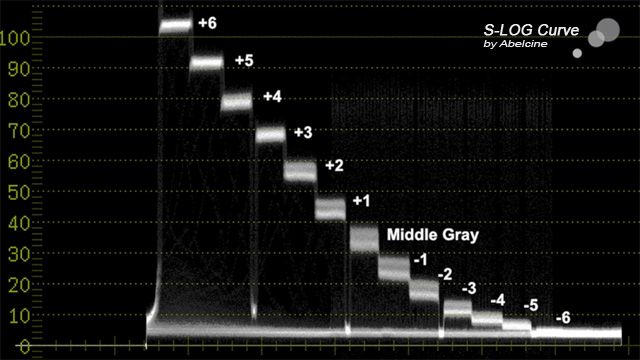
I like to sit on both sides of the fence, or swing both ways (however the proper saying goes) when it comes to SLOG vs non-SLOG but more and more I don't believe SLOG is really all that special. YES it will offer 1 extra stop of dynamic range, but because middle grey sits so low on it (ie. 38%) obviously 6 stops over middle grey is going to inherently give you some highlight protection. You can underexpose REC709 or cinegamma4 then push it in post and end up with the same thing in my honest opinion.

I read the white paper and SLOG was originally developed to optimize the performance of the CCD/sensor which A.) results in better signal to noise ratios, and B.) improves overall sensor dynamic range. So arguabley SLOG is "cleaner" but like film it will increase in noise when pushed, but decrease when pulled in post so again what you might gain upfront "might" also be lost later anyway depending on your original exposure.

Abelcine-SLOG-curve.jpg


As for IRE I've been discussing it with Alister Chapman from the UK who explains that dynamic range is dynamic range - regardless of how it's mapped and to what IRE it is recorded to. I agree with this. Forget 104, 109, 100.... the dynamic range of the F3 doesn't change in the different gamma modes, except in SLOG it does increase by one stop.
 
Last edited:
So from the standpoint of taking advantage of all that dynamic range is there any benefit from shooting uncompressed into the Hyperdeck shuttle vs 10 bit Prores 422 on a Samurai?

Got the camera by the way. :cheesy:
 
So from the standpoint of taking advantage of all that dynamic range is there any benefit from shooting uncompressed into the Hyperdeck shuttle vs 10 bit Prores 422 on a Samurai?

Got the camera by the way. :cheesy:

You won't get any additional DR, or colour information with uncompressed 4:2:2 output - you will get zero compression artifacts though, which can be handy at times when you have to capture every last bit of detail in a scene.

To be honest though, 10-bit 4:2:2 ProRes and DNxHD are such high-quality codecs that you're simply not going to run into limitations with them in 95% of shooting scenarios.
 
Two things,

- The full dynamic range of the camera is captured and preserved whether its recorded in 8-bit, 10-bit, 12-bit, uncompresed or via some codec. The differences lie in the potential banding due to bit depth or artifacting due to codec (where images particularly fall apart during a lot of motion or complex scene). 8-bit has 4 times less steps from white to black as 10-bit so obviously 10-bit will be more resistant to banding but personally I have not seen any banding in my 8-bit images out of the F3 I've been shooting so far.

- Taking advantage of dynamic range can mean different things. Some DOP's will establish a working contrast ratio say for example 5-8 stops that for them will give enough tonal separation to produce a pleasing image or allow good grading - plus leave enough room in the highlights so they appear smooth. Others might work with higher contrast ratios and it will still get recorded no problem. In the end it will be hard to see the difference between uncompressed vs. say 10-bit prores 422 but where you will see the benefits of uncompressed would be for example if you were really pushing or pulling the images by several stops in post, or even certain areas of the image.


Others may have a different perspective than mine.
 
Last edited:
A lot of this depends upon what/how you're shooting and weather you intend to use SLOG and/or grade your footage. 8-bit vs. 10-bit in grading, makes a world of difference.
In my experience, and opinion, shooting uncompressed is overkill due to the post-production monster you'll create. Unless you have a very specific and necessary reason to do so, don't!

I wish someone would've beaten me over the head with this advice early on: forget all the recorders, bits, color-space, stops, dynamic range, and locate and purchase some excellent glass. It will pay continuing dividends no matter what you do/increase behind it. :love4: If I had the chance to start over, I'd put all my money into lenses and lights and rent a camera when I need it!

I often hear that advice, and I believe there is an element of truth to it. But I also believe it is half right. Not the advice to give to less experienced people. Its the realization you had after you were experienced and busy.

Less experienced people need their own camera to:

a) experiment with all the settings and controls.
b) practice whenever they get a spare moment.
c) really get to know the camera they are going to be using down to minute details.

After all, you are never going to really know the matrix and detail controls in a two week rental. Especially if you're trying to shoot something at the same time.

Those of us that started with an HV20 or something similar had a heck of a time wrestling with the consumer controls trying to make the camera do something it was never really intended to do. Professional controls make you learn a lot more.

That being said, great glass will last a lifetime. Maybe mid-way in your career you start to justify a Cooke zoom, or a set of Zeiss primes. By then you are busy enough. After all, before that you can rent the glass too.

I found that an EX1 was a great trade off of price, a good lens, and learning the controls.
 
I wish someone would've beaten me over the head with this advice early on: forget all the recorders, bits, color-space, stops, dynamic range, and locate and purchase some excellent glass. It will pay continuing dividends no matter what you do/increase behind it. :love4: If I had the chance to start over, I'd put all my money into lenses and lights and rent a camera when I need it!

I actually have more than 35 lenses, including 6 Contax Zeiss lenses. Granted they are still lenses, but glass is not a worry right now. I traditionally use my 35/50/85 (all f1.4) set, and an Olympus 21mm F2. Probably need to pick up a Tokina 11-16 for super-wides though. For PL, I rent, for the rest I am pretty much covered.
 
Back
Top