GH4 Matching The GH4 To The C100

Erik Naso

Veteran
I've started my attempt at matching the GH4 to the C100 in C log first. So far I'm getting pretty good results. I'm updating this blog post as I go.

I need to do a multi cam setup in a few months and since the GH4 is pretty impressive and much cheaper than buying another C100, and I actually have one this is my first choice. Always nice to save a few grand!
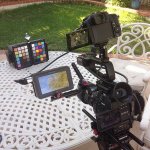
C100-and-GH4-Stacked.jpg

I set up a Datacolor color chart in flat lighting and framed it up with both cameras. The GH4 on the hot shoe of the C100. Yes it was kind of scary up there. If you're not familiar with Datacolor and the new SpyderHD monitor calibration system product you should check them out.

Here are my initial settings.
  • Cinelike D
  • Contrast to – 5
  • Sharpness to -3
  • Saturation to -2
  • Hue 0
  • Highlights and Shadows Set To -5 highlights and +2 shadows
  • Luminance Levels 0-255
I got pretty close but still needs some work. Check out the post for more side by side samples and updates.

Below is the last test settings I did and these are getting even closer.
  • Cinelike D
  • Contrast to – 2
  • Sharpness to -3
  • Saturation to -4
  • Hue +2
  • Highlights and Shadows Set To -5 highlights and +2 shadows
  • Luminance Levels 0-255 - Wider Luminance gives more color. (Not available in MP4 or AVCHD)
Last night I made a few changes that seem to help. I decided to not use the Highlight and Shadows feature. It does something very unnatural to the image. It looks like it smooths out the skin almost like what noise reduction does so I set it back to 0 and now messing with the Master Pedestal to boost the shadows. Here are the latest settings that I haven't tested these settings yet with my Datacolor chart but I feel the Contrast and Master Pedestal settings is whats going to get the image where I want it. I was surprised that the color is pretty close with the two cameras. That sure makes matching them easier. the GH4 tends to have more red in the skin tones. Using Colorista and the skin tone tool I desaturated and pushed the skin tones toward yellow a tad it looked really good. Thats why I backed off the Hue to 0. It's a good start and by no way done yet but I figured I would share my little journey with you.

Here are my latest settings. (Untested)

  • Cinelike D
  • Contrast to – 5
  • Sharpness to -5
  • Saturation to -4
  • Hue 0
  • Highlights and Shadows Set To 0
  • Mater Pedestal +5
  • Luminance Levels 0-255 - Wider Luminance gives more color. (Not available in MP4 or AVCHD)
Next I want to match up WIDE DR. I do think that would be a better match for the GH4 since less grading would be needed.
 
Last edited:
Now THIS is a very useful I.Q. test.
The Canons (C100, 5DIII, etc...) are so common out there that this really helps with interacting with them.

Thanks a ton for doing it this way, and so meticulously, Erik.
 
My sincere apologies for hijacking this thread.
Erik, I see you are using a Ninja Blade there. Have you recorded external audio in to it? How does that compare with the GH4?
I can't find any info on that.
 
Thanks for sharing, a "Canon" profile is cool. If you raise the pedestal, doesn't that introduce noise?

I've been shooting CineV because its not at flat as D, I like the results much better.
 
Thanks for sharing, a "Canon" profile is cool. If you raise the pedestal, doesn't that introduce noise?

I've been shooting CineV because its not at flat as D, I like the results much better.

Maybe. Need to see. I think CineV could work too to get close to WIDE DR profile of the C100.
 
Thanks for sharing, a "Canon" profile is cool. If you raise the pedestal, doesn't that introduce noise?

I've been shooting CineV because its not at flat as D, I like the results much better.

What do people think 'raising the pedestal' do?

Last time I looked at a video wave form, the 'pedestal' was the lowest 'signal' level, and below that was the sync pulse.

In other words no 'video image signal' was lower than the 'pedestal'. There was the bit about US TV having a 7.5 IRE 'pedestal' and Japan having a 0 vs 7.5 IRE pedestal,
but essentially that sets 'black'.

Now if there is 'noise' from the camera that is above the pedestal, 'raising the pedestal' will bring those noise values 'up' and be more 'noticeable', and hence would appear to increase noise, but in fact, it would be there anyway, just 'unknoticed'.

So, from my 'gedankenexperiment', 'raising the pedestal' would just produce a 'dark grey' with noise, as opposed to 'black + noise'...

There was a Film film technique of 'pre-flashing' the film, which would 'raise the pedestal', but would put very low values somewhere further up on the density curve, and while it was always seen as a 'bandaid', especially for news events that were world shattering, it was just that a 'bandaid', and not used unless there was absolutely no other way to get an image from things that were that dark.
 
What do people think 'raising the pedestal' do?
There was a Film film technique of 'pre-flashing' the film, which would 'raise the pedestal', but would put very low values somewhere further up on the density curve, and while it was always seen as a 'bandaid', especially for news events that were world shattering, it was just that a 'bandaid', and not used unless there was absolutely no other way to get an image from things that were that dark.

I agree. Flashing was also used consciously as a low-contrast look by Vilmos Zsigmond in Robert Altman films like "McCabe and Mrs. Miller". This, in conjunction with diffusion filters gave the film the look of an old photograph. A similar process to pre-flashing the negative was the Lightflex, which was a device attached in front of the lens, much like a teleprompter, that flashed a certain amount light into the lens, thereby lifting the blacks. Freddie Francis did this in the desert scenes of David Lynch's "Dune" to reduce contrast.

So if you know what you are doing, or are going for a deliberate low contrast look, then, by all means, lift the Master Pedestal. But it is incorrect to assume that it will give you more dynamic range, lower noise, or make your image more gradeable.
 
There was the bit about US TV having a 7.5 IRE 'pedestal' and Japan having a 0 vs 7.5 IRE pedestal,
but essentially that sets 'black'.
That 7.5 IRE adjustment was present only in analog NTSC signals broadcast in the USA. As you pointed out, it was not added to NTSC signals broadcast in Japan. It's an obsolete distinction at this point, since analog NTSC broadcasts were terminated years ago. Sometimes that analog pedestal adjustment is confused with the 16-235 digital Studio Swing range, but they are two separate factors.

On previous GH-series cameras, the pedestal was not adjustable, and it was set low enough to clip some of the darkest shadows and low-level noise to black. When I attempted to match the AF100 to the GH2, I had to set the AF100's pedestal to the bottom of its range to mimic the GH2's shadow behavior. I don't have a GH4, so I'm not sure what its "neutral" pedestal setting would be. As with the AF100, I'd expect the GH4's pedestal adjustment to be of most use in matching the shadow behavior of other cameras.
 
Thanks Erik. I arrived at the same conclusions as you just messing around, so it's nice to see you did it with a bunch of testing. :) The only thing I didn't do was touch the master pedestal, but I have a profile that is testing just that now.

I am looking to sell my C100 (I have a C300 as well, and frankly every shooter I hire around me has a C100 or C300 or similar so why do I need both?). I however do like a B-cam for interviews and event coverage, and assuming decent light the GH4 seems to hold it's own. The two cameras cut together surprisingly well.

I'm trying to figure out what I can do. I have a need for a three camera setup this fall and I would like to have three C100's but the budget wont allow that. If I can get the GH4 to work I'll get another one and use the C100 for main with audio and two GH4's as B and C cams. I do wish I can push the GH4 past ISO 800. Even at 800 it;s a bit to noisy but in 4K and not reframing it's doable. Reframe to 100% and boy does the noise get bigger. I would probably shoot in 4K and not do big reframing. The noise seems to be more present in the dark tones. Color seems to hide it well.
 
Flashing was not a band aid: flashing stimulated the emulsion's ability to respond to low light, and helped reduce the effects of reciprocity failure. Reciprocity failure is the key here. Flashing was applied before the exposure was made, and the small amount of light introduced a density that was only noticeable in the extreme low values, but the important thing is that flashing also stimulated the emulsion's ability to capture exteme low light values and details. Raising the pedestal seems more akin to fogging an emulsion, adding density to the shadows after the fact in order to bring them up the curve to show what detail resides there, rather than providing a means with which to capture more detail/light values.
 
I do wish I can push the GH4 past ISO 800. Even at 800 it;s a bit to noisy but in 4K and not reframing it's doable. Reframe to 100% and boy does the noise get bigger. I would probably shoot in 4K and not do big reframing. The noise seems to be more present in the dark tones. Color seems to hide it well.
Noisy shadows past ISO 800? That's very disheartening to hear, I was hoping the GH4 could handle ISO 1600 at least. For live stage events, ISO 800 would force me to shoot at f2.0 with an Olympus 35-100mm, and without OIS I'd be stuck on a tripod. With a Nikon, I can shoot on a monopod in APS-C at f2.8 with IS and get away with ISO 3200 in a pinch. But alas, no 4K yet :(
 
Noisy shadows past ISO 800? That's very disheartening to hear, I was hoping the GH4 could handle ISO 1600 at least. For live stage events, ISO 800 would force me to shoot at f2.0 with an Olympus 35-100mm, and without OIS I'd be stuck on a tripod. With a Nikon, I can shoot on a monopod in APS-C at f2.8 with IS and get away with ISO 3200 in a pinch. But alas, no 4K yet :(
It's is disheartening. Noise is the single thing I dislike the most about the GH4. I can live with pretty much all the perceived shortcomings of the GH4 but noise is a big one for me and ISO 1600 would be pushing it. Not saying it isn't usable but I like to have a little extra and I think that ISO 1600 wouldn't be a good place to shoot at a lot. Coming from a C100 that is hard to swallow.
 
* Very nice thread.
* I also have a DataColor SpyderCheckr, and it is a very useful tool indeed.
* Could you post a couple of framegrabs showing the results from each camera? (edit: forget it, I see they are already in the blog post)
* My biggest concern would be matching DR. Any comments on that? A side-by-side test like this one would be very welcome...
 
Last edited:
You da man Eric! I've been watching your YouTube, Vimeo, and reading your website for a while now. Your news promos are stellar and you create informative content for the topics I care the most about. *Huge fan here*

My boss and I just got two GH4s after selling our soft Canon lenses and muddy looking 7D. We're a huge fan of the Canon Cinema line, particularly the look of the C100. It's just a bit too expensive for our needs. When I did a random search for "match gh4 to c100" I was thinking I would find a random post on Personal View arguing which profiles match the most. Nope. Erik Naso's name comes up once again. I can't wait to see the final outcome and I'm already shooting with your latest recommended settings. Can't wait for more! :)
 
Back
Top