FEATURE: Love, Outlaw (An Icelandic bollywood film)

MG_4242-smaller1.jpg

[TABLE="width: 700"]
[TR]
[TD]Title[/TD]
[TD]Love, Outlaw (en) / गैर कानूनी इश्क (hindi)[/TD]
[/TR]
[TR]
[TD]Status[/TD]
[TD]Development[/TD]
[/TR]
[TR]
[TD]Logline[/TD]
[TD]A young widow abandons a privileged life to unite with her outlaw lover. Together, they seek refuge in the wilderness, pursued by the authorities.[/TD]
[/TR]
[TR]
[TD]Description[/TD]
[TD]This is to become the first Icelandic Hindi language film ("bollywood"). It is based on an old Icelandic folk tale (Fjalla-Eyvindur), and is planned to be shot in the highlands of Iceland around mid-2013.[/TD]
[/TR]
[TR]
[TD]Website[/TD]
[TD]http://www.loveoutlaw.com/[/TD]
[/TR]
[/TABLE]

Where are we at now?
Script is in treatment stage. We've shot a concept trailer to develop the look and feel of the two worlds (inspired by India as well as Iceland) merging together. Would like to use this to share the story of the process in case it becomes useful/interesting to others. Any ideas or feedback most welcome.
 

This is a concept trailer we made. Both for ourselves - to explore possibilities - and then also to help transmit how we'd like the film to come out.
 
sketches.jpg

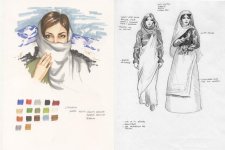
Costume sketches and colour palette. Ideas by designer/illustrator Íris Auður Jónsdóttir. Colour palette is quite different from typical turkish blue / pink /curry yellow palette typically seen in Indian films. More "Icelandic", i.e. deeper red, blue, green, etc. Design of dresses is inspired by both typical Indian and old Icelandic wear - using silk - but more rough than typically in India, and using rough wool as well - which fits better with the surrounding in the sub-arctic highlands.
 
From the look of the landscape, you could have shot this in the Indian Himalayas. I'm trying to wrap my head around what does one buy by having this happen in Iceland. I mean, it can't be the landscape - because that's available in India (Himalayas). The story? It's a story that could happen anywhere. In any such marriage of elements, you try to have the whole to be greater than the sum of its parts. Does that happen here, or is it in fact exactly the sum of these two elements and nothing extra? Interesting. Hope to see more of this as it progresses! Best of luck.
 
Hi OldCorpse. That's a good question.

For someone in LA - you are probably right. It could be shot in the Himalayas, where I'm sure there is a lot of beautiful places. But for an Icelandic audience - who is used to thinking of this story as something very particular to their own folklore and traditions, that fact that it is being shot in Iceland is very significant (and they'd know). You are right that the story could happen everywhere - and I suppose that is part of the point of the project - to re-contextualize something thought of as Icelandic or thought of as Indian it in this way.

That being said, I would certainly not rule out shooting it in the Himalayas. But at the moment, the production is more based in Iceland than India (although that could change) and shooting in Iceland, for now, is not necessarily more difficult or expensive than the Himalayas based on our current knowledge and access.
 
In any such marriage of elements, you try to have the whole to be greater than the sum of its parts. Does that happen here, or is it in fact exactly the sum of these two elements and nothing extra?

I think I sort of get what you mean. In this case - here's a centuries old love story from a sub-arctic nation far away from monsoons and saris. Yet - I think there are methods and tools from the Hind film tradition that are actually more fitting to tell the story than the usual Icelandic or European art house cinema does it. I also hope that, by being in Hindi and hinting at Bolly-style elements, it invites Icelanders to see it in a different way - and perhaps also invites a broader audience to discover it, that wouldn't have come across it had it been a typical Icelandic language film. Weather this is successful, of course, depends on how well you do it and how true and honest you are to the elements you are using.
 
Fair enough. I've been to Iceland and I've spent a lot of time in the Indian Himalayas (including 2 years in Mussoori), and I suspect that I could duplicate one place for another, within limits! That is, from what I've seen of the trailer - that's important. Because yes, there are features of the Icelandic landscape that are very unique and easily recognizable, and you would not be able to find it in the Himalayas (coastal, hot springs etc.), but nothing I saw in the trailer. Of course, a full feature is a different issue and you are 100% right, especially once you get into buildings and the like.

Anyhow, I hear you wrt. contextualization. I'm looking forward to more. Keep us posted. Interesting project!
 

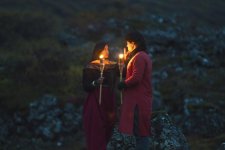
Snapshots from a location scout we did in the highlands of Iceland, some of the shots are from places where the real life 18th century people who originally inspired the folk-tale resided as outlaws.
 
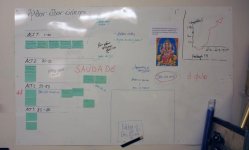
My white board at the moment:
script.jpg

I'm working on developing the script. I've put scenes and divided them into acts up on a board - an idea promoted in a pretty helpful book Save the cat. It's a pretty simplistic book - and schematic, which makes it easy to follow. This might put some off - but I kind of enjoy it, and I think the author writes it with some irony as well - exaggerating the mathematics to film script writing some times to the point of satire.

The scripts structure is fairly western. It's looking like an 80-90 min film at the moment. I came a cross a fairly good and interesting post on the differences between bollywood and western script structure.
 
Good article on bollywood/hollywood :)

Whiteboard - can't you do all that on a computer? A whiteboard is useful during production/pre when many people need to see the same thing at the same time and a computer is just not suited. But we're moving to more and more digital - these days it's easy to throw the same pictures and files onto everyone's iPad and it's an instant reference. Of course, some people like the physical aspect and are never at home with digital - one friend of mine writes his scripts in longhand (as does Tarantino!).
 
I can, and to be honest I've sort of migrated already into Celtx - which conveniently has an index card feature that you can then link to the scenes in your script. This dual view (scenes and index cards) is very handy to keep track of the big picture of your story, while at the same time working on details such as dialogue or descriptions.

But regarding the physical aspect of putting up index cards. Blake Snyder, the author of that book I got the idea from, actually makes a point of stressing the importance of the time that it takes to put them up: "while you're doing all this seemingly ridiculous, time-wasting work, your story is seeping into your subconscious in a whole other way" - he specifically recommends "Pens, index cards, pushpins. All things you can touch, and see, and play with at will".

It was interesting to try this physical approach. It's bigger and different to look at than a computer screen - and it stands there in the office, even while I'm not working on it. It then catches the eyes of people who come to the office and provokes chats and exchange of thoughts. Also, maintaining focus on computers can be difficult, with facebook, e-mail, and of course things like dvxuser :)

In the end though, it's getting messy - and I'm not neat or patient enough with my hands to keep it organized. And I can't take it with me out of the office. Interesting exercise though - recommend it.
 
Yeah, I'm a big believer in unintended consequences. For example, most people (99.999%) think it's obvious that you should write a screenplay/novel on a computer in a special dedicated software - it's just so much easier to edit and so on. But there are a few holdouts who prefer the typewriter (and more prefer writing longhand), not out of nostalgia, but precisely because it's harder to edit and make changes, it alters the way you write - you think much more carefully about what you're going to type up, because it's a hassle to re-type or use whiteout or whatnot. Many claim that you can see how screenplays written in the old days - up to the 70's and even early 80's - were subtly different IN CONTENT due to the tools used (typewriter vs computer). The typewriter promoted careful thought and planning, the computer promotes more wild experiments "let's see what sticks". There may be something to it.

Personally, I use a computer, but here may be something to this notion of tools influencing outcome.
 
Yes - best analogy for us filmmakers perhaps is the film / video. The feeling of hearing the purr in the film mag and knowing that you've pulled the trigger on something your going to have to stand by when you roll the camera. The digital world is non-linear, open into all ends and constantly morphing. Of course it's great. But sometimes you can get paralyzed with all the choices and possibilities - craving for something linear, structured and centred to go by - until you want to hit ctrl-z :)
 
Okay so some update. I'll be going to Mumbai in two weeks and stay until end of Jan. Will be networking and setting up a few things - as well as continuing general development of the project. Any members from Mumbai or India welcome to be in touch :)
 
I've now been in Mumbai (Bombay) for a whole month. I've met a lot of great film makers and artists and been able to bounce of ideas and thoughts regarding the project. I've answered some tough questions, and gotten a much clearer sense of what the possibilities there are and the ways I'd like to go forward with this. I'm keeping a little blog of my thoughts as I go along:
http://arnarfjodur.tumblr.com/

Warning: It's a mix of very theoretical and person ramblings - mostly written for my self, probably not very reader-friendly :)

There's a little less than a month to go now, and I'm figuring out how to make the most of my stay here.
 
Back
Top