Longer lens or center crop FX9/FS7

LennyLevy

Veteran
I’m on an FX 9 and an FS7 and shooting a music concert that requires a long lens - up to 400 mm . It’s being shot in HD though. Does it make a difference whether I shoot with a rented sony 100-400 in S35 mode or say use my 18-200 in center crop or whatever its called on each camera - S16-2K on the FX9? The 18-200 would give me much wider zoom range and enough stop . Is 100-400 a much better lens to begin with if I’m using the 18-200 @ f6.3 ? But would center crop be appreciably softer or more prone to artifacting . Is center crop the same on FS7 and FX9 ? BTW - final is for the web.
 
Last edited:
The 100-400 is a better lens than the 18-200 if both the lenses you are referring to are Sony lenses. Especially if the 100-400 is the current G Master. The S16 crop on the Sonys is exactly that, an HD crop. I use it fairly often. Being a crop though not a downsample it's not quite as sharp or quiet as an HD downsample from the full sensor. I think if you are happy to work with a lens going to F/6.3 like the 1Sony 8-200 you would be far better off shooting S35 on both cameras and grabbing if you can get one the new Tamron 18-300 APSC lens in E-Mount. It's streets ahead of both models of the Sony 18-200s The Tamron is very clean, sharp works extremely well with Sony's latest AF and exhibits virtually zero breathing. Surprisingly close to parfocal as well. I think it's using the same sort of electronic "parfocalness" trickery that Sony uses on the 28-135 and the 18-110. I'm finding lots of uses for it both on the cine/video cams and in crop mode on the a7 mirrorless.

Chris Young

 
FS7.. I reckon sensor crop is a bit sketchy. This could be because you are hitting the LPI limit of a typical FF35 lens (and maybe the oplf)

(rememer the f5 having 4k and hd oplf.. porbably for a reason too)

but then google fs7 crop mode and the 'hurtlocker' s16 canon zoom and there are good things.

this ponits towards my thought that you need a sharp lens and ff lense may not offer enough LPI for crop mode.

LPI is not the total resolution of a lens but resolution per chip area.

by sharp I mean lines per inch.. not how many inches are covered which is not many in crop mode.

what are you saying sam?

Crop mode and a super sharpl lens designed for a small chip like an s16 zoom or maybe doubled 2/3 lens = good
Crop mode and FF35 lens = bad
FF mode and FF lens = good
FF mode, FF lens, speedbooster = best

do some tests and probably stick with full frame!


S

The crop is fine with the OLPF, no line skipping its 1 to 1 crop into the sensor .. its just a big crop factor ..
 
My post stated it was about the fs7 which I have exeperience of.

with the s35 sensor you usr halfvthe image circle of a ff lens- enter crop mode and you are using 1/4 of the iMage circle.
say the lens resolves 5k it will only deliver 1,25k of resolution to the crop area of the sensor which is way less than the required 2k

a ff35 lens of 5k total res should deliver 2.5 to half of the fx9 sensor which is enough for hd.

I don’t know if the fx9 crops to half of its origins size or down to mft or s16 size- either Be a problem with a ff lens that can resolve 5000 line pairs!
 
Alister , Are there significant quality differences between FF 6K , FF 5K , S35 and S16 – 2K ? As I understand it S35 is more like the resolution of an FS7 , but what about FF 5K and especially S16 2K ? Is S16 resolution, artifacting and image size the same as Center Scan on FS7?​


There are quality differences. The higher the sampling resolution the better the final image, sample higher and noise is reduced, clarity and resolution improved. FF5K is marginally better than S35 4K and S35 4K is quite a bit better than S16 2K. Consider that the luma resolution delivered by a bayer sensor is approx 70% of the pixel count. So the luma resolution when using 2K S16 will be less than HD, approx 1.5K (and chroma resolution is even lower). But sample at S35 4K and both the HD luma and chroma resolution will be full HD and there will be less noise. The only modes with real artifact issues are the sub sampled FF 2K and S35 2K scan modes.

Kind of answers my question . 100-400 at S35 will beat 18-200 at S16 2K. regardless of which is the better lens.
 
LLevy.. "the luma resolution when using 2K S16 will be less than HD"
SMM.. " (lens) resolution to the crop area of the sensor which is way less than the required 2k"

IMO its obvious using with no crop is the winner.

cropping in post or camera is a different chat.
 
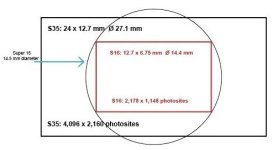
This S16 topic was discussed some time back, years back in fact. Way back AbelCine did some tests on the S16 Crop on the Sonys and came up with the following. The FS7/F5 sensor is a Super 35 sensor of 24mm x 12.7mm with a diameter of 27.1mm. The Center Crop on this sensor is a Super16 crop, NOT an HD crop. The S16 crop is 12.7mm x 6.75mm with a diameter of 14.4mm. As most would know an HD sensor has a diameter of 11mm. The S16 crop photosite count is 2,178 x 1,148 for a pixel count of 2,500,344. 2.5K in other words. The scanned area is actually 30.9% larger than an HD sensor scan. This S16 scan is then downsampled from 2.5K to HD. Given that the Sony sensor Debayer resolution loss has been measured at around 20% the final Debayered resolution comes out at around 2,000,275. Not a full 2K (2048) but totally ample for HD as the Sony S16 crop will deliver a true HD resolution of greater 1920.

It was Doug Jensen's S16 Center Crop tests with the Sony F55 eight years ago that convinced me that the S16 crop was a useable feature. Check out his video where he has direct comparisons of the HD from the full S35 sensor readout, which we know is downsampled from 4K and the HD from the S16 Center Crop. Since those days way back I have used the S16 Center Crop very successfully using B4 lenses and the MTF B4 to S16 optical adapter for many live to air shows and never a word against it. In fact, the opposite, compliments because when set up correctly the FS7 was delivering better dynamic range images than the PDW-700 and 800s we were using back then for football in our harsh sunny weather.

Chris Young

AbelCine chart

super16chart.jpg - Click image for larger version  Name:	super16chart.jpg Views:	0 Size:	22.0 KB ID:	5686363

Albeit on the F55 but I've found my results on the FS7and on an F5 are in agreement with DJ's F55 Center Crop tests which can be seen here:

 
Chris..
Nothing in your post mentions the signal arriving at the sensor. If using a full frame lens capable of resolving 5k lines over the FF35 area only 1.25k lines will be arriving at the small area of the sensor so howver wonderful your sensor OPLF combi is you will only ever be able to resolve 5k lines in ff mode or 1.25 lines in s16 mode.

Much therefore has to do with the taking lens, its resolution, image circle and if it is used with a subsequent element such s a speed booster.

A subsequent element booster will up the LPI and doubler or 1.4 converter will lower the LPI, One is only likeley to be using a doubler if expanding an 2/3 lens to cover S16.

A modern full frame 'dslr' lens may resolve about 6k over the FF35 area, (2k over the s16 area)
A vintage full frame 'dslr lens' may resove about 4k over the FF35 area (1.25k over the s16 area)
A vintage super 16 zoom may not cover the ff image are but may resolve 2-3k over the S16 area
An hd '4k' eng lens might resolve 4k over the 2/3 in area, but not cover the s16 area.

Consideration of signal arriving at the sensor is relevant.

My 1983 nikkor 50-300 is amazing on the fs7 with a speedbooster shooting s35 and total garbage in crop mode without the booster. (when configured to give maximum reach of '600mm ff equiv)
That is eminent ly logical as I would guess the bootse s35 area is about 3.5k and the crop, no booster option is about 1.2k
 
MM. Re the signal arriving at the sensor. If it is corrected for that sensor size, as I mentioned with MTF's S16 optical array the image can be of a decent resolution and with an MTF often higher than the adapted lens was originally designed to deliver.

I'm really not swayed by the purely technical aspects of the math in these sorts of discussions nor am I arguing against your math as I know where you are coming from. On paper, one cannot argue with your statements. In general, I agree with your math if using FF lenses on smaller than FF sensors without optical/adaption correction for that sensor size. As you point out a lens that is optically corrected to fit a particular sensor size will deliver the best results. As per your example of the Nikkor with a Speed Booster. One can discuss the finer point of resolution until the cows come home. What I can't argue against though is what actually gets delivered out of the camera or to the file when recorded regardless of how it gets there. If it is plenty good enough for production and almost indistinguishable from the full-frame downsampled image visually, as DJ's Vimeo example demonstrated then who am I to argue with the result. I get paid for the result. If the clients are happy with the results I'm happy. I don't overthink this stuff. If the results are more than okay then they are fine by me regardless of, as I said how they got there. That's why I pointed out that the S16 Center Crop is not to be sneezed at when used with an optical lens array that adapts a smaller lens' image circle and corrects for any inherent aberrations when it is to be used on a S16 sensor size. A similar process to a Speed Booster but with a 1.3 enlargement rather than a 1.5 reduction. Much like Angenieux are now offering with their interchangeable Super35/FF/VistaVision Rear Lens Groups for their EZ-1 and EZ-2 zooms to enlarge the image from S35 to FF. Perfectly good results when optically matched to the sensor size you intend to use.

Chris Young
 
Fair point that numbers mean nothing. Maybe leads me to repeat my advice that 'OP should do thier own tests' and to expand or repeat my experience of the Nikkor 50-300 used without a booster and in crop mode leads to a poor image that one may of seen on my 'handgrenade explodes' and 'F35 flys' footage. The two shoots where I was highly reliant on extreme telephoto.

To waffle on about my experiences seems irrelevant, the audience is not interested in me... ive extrapolated to make more general observations but maybe it is simpler to say something like.. my experience is that not all lenses work well in this mode.

what is 'MTF's S16 optical array' ?
 
Albeit on the F55 but I've found my results on the FS7and on an F5 are in agreement with DJ's F55 Center Crop tests which can be seen here:

Talk about a blast from the past, I don't know what led you to dredge it up, but I don't even remember making that video.
 
Thanks guys . Very interesting discussion and I guess you're disagreeing with Alister about the downsample resolution not being HD quality?
Wonder about using a speed boster with a full frame or a "digital" APS-C lens to squeeze its resolution to the S16 size? You would lose some of the longer lens advantage but still be somewhat ahead of the game. It might be an interesting solution also to the fact that the S16 frame is apparently better for higher speed slo mo on the FX9 . Maybe I should hold on to my speed booster after all? (Though I've already dumped most of my EF and Nikon lenses for E mt AF)
 
Talk about a blast from the past...

Getting forgetful in your old age eh! It may be that DJ, a blast from the past but it is what was what made me think that the S16 mode with v3.00 on the FS7 may make it useable with a decent B4. Plus of course the versatility you demonstrated with prime lenses. I often use a couple of FS7s with the MTF B4-S16 adapters with great success with 18 and 22 x B4 lenses for broadcast sport. Combined with a Speed Booster for FF lenses it made the FS7 a very economical commercial package that could basically cover everything from shallow DOF type interviews to sports and event coverage when you needed B4 type lens reach in HD. You are to blame :)

Chris Young
 
what is 'MTF's S16 optical array' ?

MTF makes a B4 to S16 adapter which comprises of a five element group of lens in an array. This adapter uses the lens grouping to converge the the B4 three sensor RGB lens focus points to converge correctly on a single sensor. This is essential as a B4 lens is designed to work through a prism to focus the RGB channels at three different focus points. MTF also brought out a B4 to S16 for the Canon EF mount cine cams. The basic principles of how these adapters work can be seen in the MTF Canon video below.

Chris Young


https://www.bhphotovideo.com/c/prod...td_mtb4s16sem_b4_2_3_to_super16.html/overview
 
Last edited:
Wonder about using a speed booster with a full frame..."

That is obviously a possibility. But without a Speed Booster you could check what was the original "kit" lens for the FS7. Which was the FF FE SELP28-135 F/4.0 OSS G lens. Using that on a Sony S35 sensor size it becomes a 44.52mm to 214.65mm lens. Why? Because because the Sony S35 sensor diagonal is 27.1mm which results in a crop factor of 1.59 in round figures. If this 28-135 lens is then used with the S16 Center Crop mode selected it then basically becomes a parfocal constant aperture F/4.0 89-429mm lens. And still delivers pretty acceptable in results HD. Test it for yourself. I think you may be surprised at what it can deliver in S16 HD.

On the FX6 and FX9 with their upgraded AF the 28-135 works surprisingly well in HD crop mode on the FX6 and in both S35 and S16 mode on the FX9. There are many shooters on this forum who have used the FF SELP28-135 F/4.0 with their S35 FS7 cameras to pretty good effect. I know a number of shooters who have now moved on to the FX6 and FX9, A7SIII, FX3 and A7IV, me being one of them and who now find the 28-135 has been given a new lease of life in all modes on these cameras. I own both the cheap and cheerful Sony FE 28-135 and the S35 18-110 and use them both in various modes on FF and S35/APSC/S16 with more than satisfactory results in HD in 99% of cases. Sure there are other better solutions out there but for decent results in HD on any of the above cameras the 28-135mm servo zoom works quite well. It's biggest drawback is that the zoom ring in manual mode is not mechanically connected, so forget snap zooms are they are very laggy. Not so with the S35 18-110 as it is mechanically connected. Also don't forget that both the 28-135 and 18-110 will communicate with the lens correction circuits on the above cameras with regards to distortion correction, CA, vignetting and stabilization, if required. Not that I would go crazy over the stabilisation on the FX6 and 9 but both lenses work pretty well in conjunction with the IBIS on the A7 cams.

Chris Young

 
The idea of resolution lines per unit of surface area only works for comparing sensor areas that are the same size. For example, lens testing will use line pairs per millimeter to compare lenses that are tested on the same Canon 5DMKIII, and as long as all are tested that way, you get a valid comparison. But here, this topic seems all about different crop areas, FF, S35, S-16, B4 and speed boosters. Going up or down on the image circle affects the transmittance, but not the resolving power because the light is refocused to the image plane with each lens or speed booster change. So, while the measurement number for line pairs per millimeter changes with the image circle, it only has relevance when comparing for same sized image circles. The relevant number for resolving power that works for all sensor sizes, all crop sizes is line pairs per picture height. As the image circle shrinks, the number of line pairs per millimeter goes up the, but the number of line pairs per picture height stays the same because the picture height shrinks along with the image circle. You don't have to fear losing resolution just by the nature of changing the size of the image circle or using FF lenses on S35 sensors. You are however losing light transmittance in the form of light spillage that doesn't hit the sensor.
 
The idea of resolution lines per unit of surface area only works for comparing sensor areas that are the same size. For example, lens testing will use line pairs per millimeter to compare lenses that are tested on the same Canon 5DMKIII, and as long as all are tested that way, you get a valid comparison. But here, this topic seems all about different crop areas, FF, S35, S-16, B4 and speed boosters. Going up or down on the image circle affects the transmittance, but not the resolving power because the light is refocused to the image plane with each lens or speed booster change. So, while the measurement number for line pairs per millimeter changes with the image circle, it only has relevance when comparing for same sized image circles. The relevant number for resolving power that works for all sensor sizes, all crop sizes is line pairs per picture height. As the image circle shrinks, the number of line pairs per millimeter goes up the, but the number of line pairs per picture height stays the same because the picture height shrinks along with the image circle. You don't have to fear losing resolution just by the nature of changing the size of the image circle or using FF lenses on S35 sensors. You are however losing light transmittance in the form of light spillage that doesn't hit the sensor.

Well explained TR.

Chris Young
 
Back
Top