Local TV News Station switches to Panasonic Consumer Camcorders for reporting

LanceOregon

Well-known member
I've been quite amazed at recent local events to see that our our largest and most popular local TV news station, ABC affiliate KEZI, has switched to having their reporters use small Panasonic Consumer HD AVCHD camcorders for their reporting. While other local stations still have staff carrying big, heavy Panasonic and Sony pro camcorders and big heavy tripods, KEZI is now using these tiny consumer Panasonics mounted on a real lightweight tripod.

Now some of their news reporters are petite, small women. But certainly that cannot be the main reason behind making such a dramatic shift, can it?? It is just such a huge contrast in the size and weight of equipment, that it really is a stark comparison to see.

The really amazing thing is that the video quality looks really good. They broadcast in HD, and I watch them on Comcast, and the image really looks fine. You would never suspect that a cheap consumer camcorder was used.

They also publish in 720p on a YouTube channel. If you would like to see a report that they shot just yesterday, checkout the video below.

Are you also shocked that they are using a $500 consumer camcorder to do professional news reporting? Or do you think that this is a smart business move on their part??


Last edited:
This is not unexpected, and is happening all over the country. Journalists and news photographers are being replaced by "multi media journalists," who are expected to do it all, and do it cheaper.
As the cameras get smaller, with better quality and cheaper costs, the next step is to eliminate the pure camera operators altogether.

For run and gun news operations, this is acceptable. I'm an old school news photog so I'm not thrilled about this trend, but it is what it is. News stations have to make budget in the world of cable and satellite TV, and this is one way to do it. It's happening in my city. I've seen young journalists turning a small camera on themselves to do a stand-up.

Back in my day, a Betacam news camera could cost around $60,000, with lens and batteries. They were big and power hungry. It was very unlikely one person could do it all, at least on a daily basis. Now, for the price of one old Beta camera, you can equip a whole news operation with video cameras, and throw in some NLEs as well. And the little home HD video cameras of today can produce images we could only dream about back then.

Technology marches on.
 
Yes, I have noticed this trend too. I used to often see a dedicated cameraman working at events with a reporter. Now that seems to be a rarity. It appears that in most instances the reporter is now responsible for being their own cameraman too.

Still, it was a bit shocking to see a $500 consumer camcorder being used. I've noticed some smaller and lighter professional model Sony and Panasonic camcorders in use the last couple of years. But if reporters are now having to do their own video work, it would make sense that consumer camcorders could become popular. For the reporter's technical training in shooting video may be rather limited.

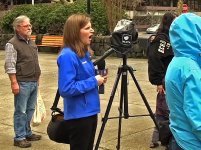
Here is a screen grab of this reporter and her gear, from the video that I shot at the event yesterday. There was some very light rain, so she unfortunately put Kata rain protection over it. She had it on a carbon fiber tripod, so her entire setup was extremely lightweight.

It was a rather boring and long-winded event. So that accounts for the big yawn the reporter had. :)


nHEaI6L.jpg
 
I agree with Van, small cameras have gotten to the point where they can deliver fully adequate quality for broadcast, mainly because distribution technology is lagging. Do you really need a razor sharp lens, 1080p chips and 4:2:2 100mbps codec? Heck no, that s*%t is going down a sausage compressor, and will be aired as 720p with YouTube levels of compression.

As much as I continue to drool over the latest and greatest, the fact is that a 1/3" cam like an HPX250 or XF300 is easily enough for 95% of PJ use. Had the HPX250 actually been available when I was in the market for a camera, I would have gotten it over a 370.
I'm a 6'2" guy and have big hands, but a smaller / lighter camera is never a bad thing, if it doesn't significantly impair ergonomics.
 
Looks like they do their own hair and makeup to, If anything this affiliate needs to invest in some new anchors, I found both to be amatuer in their delivery, As far as consumer cams go, sure, why not? as long as there's adaquite light, they perform pretty well. Are they still shooting interlaced these days, or do they shoot progressive then convert for broadcast? Seems like it would be more beneficial to shoot progressive, but what do I know.
 
Which $500 Panasonic model is being used?

Could determine that in the new footage or did I miss it in the posts?


I could not determine the exact model. I saw it earlier at the event before it started raining, and could easily make out the Panasonic name on the hand strap. It was definitely a smaller model, not one of the upper tier consumer camcorders with the 5.1 channel microphone above the lens. So I am estimating that at the very most it cost $500

It could possibly have even been a cheaper model than that.
 
The ones I've seen were not $500 consumer camcorders, they were in the $2,000 and slightly under prosumer category like this one. I've seen only one local affiliate using it, the others still carry the boat anchors.


The $500 figure is more of an estimated maximum possible cost for the camcorder that I saw. I could not identify the exact model, so it very easily could have been a $400 or $300 model.
 
Looks like they do their own hair and makeup to, If anything this affiliate needs to invest in some new anchors, I found both to be amatuer in their delivery, As far as consumer cams go, sure, why not? as long as there's adaquite light, they perform pretty well.


This station used to have a real veteran team, but they were pretty much let go in a massacre some years ago. Two of the weathermen have experience, and one of the anchors has been around for awhile. But everyone else is quite new. All of the reporters look like they are fresh out of college.

In fact, I just checked the bio on this particular reporter, and it says that she graduated from the Missouri School of Journalism in December 2012 with a B.A. in Journalism, and that she was just hired by the station less than two months ago.

So maybe she does not have any extensive training or experience from college in shooting video? I just checked the Missouri School of Journalism curriculum, and while I found a lot of classes on photojournalism, I could not find much of anything at all related to video.
 
Last edited:
I covered a stage event promo last week and my AG-AC160A recording made it to the national TV network here in Montreal. I have done other local events and had my videos posted.

For this particular event, the network did not seem to have a videographer in attendance but they did send reporters who did audio interviews.


http://www.cbc.ca/allinaweekend/television/2013/03/03/oklahoma-at-hudson-village-theatre/

The direct link to my Vimeo video is "(Click . . . .to see a preview of the Hudson production.) "

Check it out please and let me know if you like the quality. I had a partial feed from the venue's sound board - several mics for lead singers but nothing at all except my Rode on-camera mic for the background singers. Opening night is this week and I expect lighting and sound to be good quality such that all I will have to worry about is my camera recording.

I see news/TV picking up recordings made by anyone who is willing to submit them - this does not mean these organizations plan to get rid of their staff, it's just that they cannot be all places at all times.
 
Last edited:
The station I worked as news photog at three years ago (SPX800's with a pants load of 4gb P2) switched to AC160's with Manfrotto 755/701 combo sticks last year. Even back with the SPX cams, many of the reporters were one person bands... I'm not sure why, it's not like we photogs cost them very much.
 
mcbob.. this is a bit off topic but tell me please how sensitive was the focus on the Manfrotto 755/701 ?

I had a 502FI and found it rather sensitive.

Looking now for a remote where the pots are mult-turn.

I find it very difficult to set the camera to an exact distance via the remotes I have been using.
 
This is fast becoming the model across the country. Let your higher paid more experienced shooters go, and replace them with young underpaid MMJ's who will do the work of 3 people for less than the pay of one. We just had a local station lay of 40 people.
 
I'm guessing many advertisers are putting their money into online ads, it used to be a hot spot, getting your commercial on during the six oclock news, So many now don't bother watching, they get news online. I can't remember the last time I watched television news. I'm guessing it was severl years ago. If these news stations are trimming fat, I can't see any other reason why.
 
So maybe she does not have any extensive training or experience from college in shooting video?
See, that's probably more of the reason right there. The auto mode on consumer cameras has gotten surprisingly good; the "iAuto" on the AC90 is really very good. So if you are a struggling station with a fresh-out-of-college unskilled reporter and you want to send them out as a one-woman band, do you send them with a $30,000 rig they have no idea how to operate? Or do you just send 'em out with a consumer cam flipped in "auto" mode and hope for the best?

If they've made the decision to go cheap in the first place, I'm not surprised that they're using consumer camcorders and, probably, it's the right choice in this scenario. An untrained operator on a pro rig isn't going to get any better results than an untrained operator on a consumer rig, and likely the auto mode of the consumer rig will result in overall higher quality than the untrained operator would get by messing up the manual controls of the pro rig...
 
The new Panasonic HC-X920K with three very large CMOS sensor may be a game changer for many stations.

Three (3) 1/2.3" back side illuminated MOS sensors.

We have one on order, and it has some interesting features.
 
An untrained operator on a pro rig isn't going to get any better results than an untrained operator on a consumer rig, and likely the auto mode of the consumer rig will result in overall higher quality than the untrained operator would get by messing up the manual controls of the pro rig...


Funny that you should mention that Barry, as our local NBC affiliate, KMTR, also had a young lady reporter ( who also appears to be brand new to their staff ) covering the same event. I guess all of the new hires get to work on weekends. LOL! Anyway, she had one of the smaller professional Sony camcorders. I really could not identify the model, and I think that it may have been an older camcorder, and not something at all new. But it was definitely a professional type camcorder with multiple control rings on the lens.

The funny thing is, the footage from her report ended up looking far INFERIOR to that produced by the KEZI reporter with the tiny Panasonic consumer cam. This is true for both the online versions, as well as how they both looked on cable TV. And certainly any layman just looking at the two camcorders would get the impression that output from the tiny Panasonic could not possibly rival that of the pro Sony. In fact, if one compares the overall quality of each report, they are like night and day. The KEZI reporter got a wide variety of interesting shots, including interviews with both the lead organizer of the rally, and a leader of the counter-protesters present. She also got great close-ups of the key speaker. The KMTR reporter took shots of a bunch of signs ( so boring ), and did not even hang around for the main speeches. So she ended up misrepresenting in her report what actually was talked about. And when you compare the sharpness, the color, and the exposure, the quality of the video from the consumer Panasonic wins hands down.

Now perhaps KEZI had a much better person back in the studio editing and producing the video?? Still, I have to think that this real world example totally bears out what you said as being absolutely true.

If you would like to compare the KMTR report to the KEZI one, here is a link below to the KMTR video. I think that you will agree that it is inferior in every way. And I think that you might get a kick out of the fact that it sure would seem to validate your point completely. :D


http://www.kmtr.com/news/local/story/Ceasefire-Oregon-rallies-in-Eugene/682QA7CwsEqo1Owv3CAm-g.cspx
 
Last edited:
The new Panasonic HC-X920K with three very large CMOS sensor may be a game changer for many stations.

Three (3) 1/2.3" back side illuminated MOS sensors.
This is sooooooooo wrong on so many levels. Jan says there is no benefit to 1/2" chips in cameras and here they advertise how much better it is with 1/2. and to add insult to injury they put 1/2 chips (3 NO LESS) in a consumer level camera but not pro level cameras.

Now back on track. My friend's work was doing exactly what you described. (at least until the TV station layed-off half their staff) He did a news story solo and even has to edit it himself. Glad I never worked for minimum wage at the those TV stations.
 
It is wrong, but not for your Jan-bashing. I think it is wrong because - it just has to be wrong. The smallest 3-chip 1/2" camera on the market is the EX1R. This camera is probably 1/4 the EX1R's size! It just cannot actually be three 1/2.3" chips.

I am betting that the printed spec is wrong. I am saying that this unit has the same 1/4" block as the AC90. It has the same iris, same zoom range, same wide angle, same stabilizer... I cannot imagine how this is anything other than a consumer version of the AC90... And that means 1/4" chips.

The printed spec is wrong. It is the only explanation that makes sense.
 
I should make myself more clear - what Jan said was based on what she was told from her employer. I didn't mean to put the weight of the issue on Jan's shoulders.
 
Back
Top