Lighting with a single match

David W. Richardson

Chapelgrove Films
Okay, not literally. But I have several shots that need to APPEAR as if there is absolute pitch black darkness and the person in the shot is being lit by the light of a single match -- or, in the case of other characters in other locations, lit only by the light of their cell phone screen.

The character lit by a single match will be standing outside in the wide open -- nothing else will be lit around her, only her face and whatever upper body would fall within the light of the match. The other characters will be in various locations, mostly indoors -- so there will be walls, furniture, etc. that may be visible in the supposed glow of the cell phone screens. Otherwise, for the purposes of the story, it needs to be absolutely pitch black dark.

I'm shooting on a Sony FDR-AX33. For lights I have 2 Lowel DP's 1000-watts each) with barndoors, and a Smith-Victor 710 (600-watts) with barndoors.

I know that HD has a real problem with actual low light. So my question is -- can I get the shot I need with what I have? If not, what will it take to get the shot?
 
David,

Will these shots be CU, Mids or Wides?

Also, how big are your interior locations?

Lastly, will you have access to flags and grip? ...or just the light fixtures with stands?
 
A diffused source from a distance far greater than what the light was designed for will give enough light to appear pitch black (on AX-33). With Ax-33, a twilight shot can look like pitch-black too and will avail you with a wider angle. Otherwise, one is confined to a tight face framing.

In any case, I'd do a trick shot here. Zoom onto a smart phone as a cut-in, then substitute it for a small camera light in the 20-30 bead realm. (hold the light out of the camera view) Make some cheap carton barndoors, so you don't get too much of a spill and can concentrate the light on an actor's face.
 
DLD, you might have something there. Let me explain the scene...

This is a Christmas movie being produced by my church. The story involves a little girl who is continually frustrated because she sees less and less of Christ reflected in her town's Christmas -- in the decorations, etc. At one point the town erects its usual nativity scene in the town square, which gives her some encouragement. But then the town abruptly removes the nativity and replaces it with a big Santa display, all because of a single complaint. Upset, she and her friends build their own nativity scene, which pleases many in the town. But one night she discovers that vandals have destroyed her nativity. Her discovery is being streamed live on social networking by one of her friends. (Which is where the cell phone screen might come into play for that character.)

Very upset, she begins talking about the importance of Jesus' birthday, and followers all over town are watching on cell phones and other devices. At one point she says, "Imagine that the whole world is completely dark and cold and empty....", and suddenly there is a blackout in the town. (Although it doesn't affect the Internet and wifi, for inexplicable reasons.) People are plunged into absolute darkness, including the little girl standing in front of her vandalized nativity. But she continues talking, as people all over town are sitting in pitch black rooms glued to their phones.

"....then in the darkness comes a single light...." She lights a match. Now the light from the match is the only light illuminating the little girl. And it's the only light people can see on their cell phone screens.

There's more that she says, but basically she uses the match to light a candle that had been set in front of the nativity. Then another candle. And another. And with each candle lit, the small light in the pitch darkness becomes bigger and bigger. It's metaphorical, obviously. People begin to come to the nativity bringing their own candles, lighting them from the ones that are there, and the glow gets bigger and bigger until it lights up the whole area around it.

That's what I'm going for. It's crucial, to my mind, that the darkness be absolute -- not just a blue light that implies 'night time', but an all-enveloping darkness.

Of course, pitch blackness is easy. Just have no video image at all. But people sitting in pitch blackness looking at their cell phone screens -- that's harder. Pitch blackness with a single match light -- even harder.

What I'm afraid of is that black areas surrounding the subjects may get noisy due to the lack of light. I can pour a lot of light on the face, and then adjust exposure in the camera or in editing. But the blackness surrounding the faces -- that's what I worry about.
 
The cell phone illumination scenes shouldn't be that difficult. Cell phones, particularly the larger-sized phones, can be pretty bright. Likely enough for your FDR-AX33.

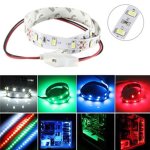
If you are able to hide the wiring from camera you can supplant the cell phone's own illumination with something like this:

s-l1600.jpg

http://www.ebay.com/itm/50CM-SMD-5630-LED-Flexible-Strip-Light-PC-Computer-Case-Adhesive-Lamp-12V/222209410450?_trksid=p2045573.c100508.m3226&_trkparms=aid%3D555017%26algo%3DPL.CASSINI%26ao%3D 1%26asc%3D20150817211856%26meid%3D308a09c8873942b6 acebb9bdc4443b7a%26pid%3D100508%26rk%3D1%26rkt%3D1 %26


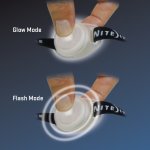
Or, more simply, something like this product:

DomeLitModes.jpg

http://www.theledlight.com/ledDomeLights.html


The match is a bigger challenge. The initial flare of the lit match will be plenty of light for your camera but the light from only the flame probably won't be of sufficient level to illuminate the individual's face. For that you might be able to use something as simple as a 60w incandescent bulb wrapped in black cinefoil or "Black wrap" forming a "snoot", the gag being positioned just out of frame and lighting the individual from the same angle as the lit match. But if the artificial light illuminates the back of the hand holding the match it may "give away" the gag to an extent that is unacceptable. You'll also want a means of having the incandescent bulb "flicker" slightly to match any naturally occurring flicker of the match flame. Wind / breeze / moving air is going to be a challenge.

There is this flickering LED light that has a warm color temp to emulate flame-light:

https://www.amazon.com/Advanced-Flickering-Multi-functional--General-Lighting-Emulation/dp/B01LD167WO/ref=sr_1_1?ie=UTF8&qid=1474212427&sr=8-1&keywords=led+flickering+lamp+lakes


Here is a video clip of that light in action, illuminating the face of a person ( pretty much just as you want for your shoot! ):


There is also this bulb. It is substantially more in cost:


http://www.flamebulb.com/product/flamebulb/


I am jealous of what fun you are going to have! These are exactly the sort of challenges that make the craft of Lighting and photography so interesting and, if successful, rewarding.

Good luck and please report back with samples of how it all worked out for you!
 
Take a look at this.


I'm not completely convinced he didn't use some additional lighting besides the candle -- his face looks a lot redder than I would expect. Still, the background is relatively clean and free from noise. The question is, can I achieve something similar with what I have to work with?

I mean, it's not important that the candle or match actually BE the sole source of the light on the face. I'm fine with using additional light to create the effect. My concern is with the dark areas. Can I get them clean and free of noise?
 
If you crush the dark areas to black they will be clean. you can make any shot clean with darkening in post.

But do you actually want your location black?

I shoot whole films where nothing goes true black in the grade but hovers at 10.

Is it dark where you are? you might do a test.. !
 
Don't know how practical this would work in your scene, but might consider having the candles custom made with triple-wicks for additional illumination.
 
Maybe I can condense my concern down to a single question.

If I can get my character's face lit with a tight spot brightly enough that the AX33 will record IT without video noise, then will the black background surrounding it also have no video noise? (This assumes I go tight on the face to get my exposure set, then lock the exposure in before pulling back for the wider shot.)
 
If you crush the dark areas to black they will be clean. you can make any shot clean with darkening in post.

But do you actually want your location black?

I shoot whole films where nothing goes true black in the grade but hovers at 10.

Is it dark where you are? you might do a test.. !

I've never really known what 'crushing blacks' means in post. But yes, it's important to me to get to what will appear on-screen as absolute black. Whether or not it actually IS true black doesn't matter. It needs to convey the impression of a pitch dark world, in which there is but a single tiny light.
 
Don't know how practical this would work in your scene, but might consider having the candles custom made with triple-wicks for additional illumination.

Interesting idea. But again, my concern isn't the light on the face -- it's the potential for video noise in the pitch black darkness that surrounds her. I could conceivably pour 1000 watts or more of light onto her face, making sure none of it spills onto anything else in the shot. I just need the pitch black background to be clean and noise-free.
 
It's likely you'll get noise in your blacks. And while you can crush it in post, it will dance a bit where the black meets a light area...which can mittigated a bit by noise reduction in post again.

For interiors I'd consider using a spherical lantern to bring the ambient level out of your noise floor. Then your you use a fill light that is bright enough allowing you to hold some detail in the flame, and your key will be the direct flame (likely specular highlights on the skin from the reflection of the flame itself. And the match will provide the flicker to sell the illusion that it's all match light. In post, because you lifted your ambience off of the noise floor, you can bring it back down and still retain some detail if you wish. As long as you don't clip the skin and hold enough of the flame, you can do highlight recovery on the flame and it won't look weird as you bring the levels down.

For CU, use dim lights very close to the actor, so that the inverse square law keeps light off of your background and then you don't have to flag spill.

For exteriors, I'd do it at dusk, instead of at night time. Again, so that your ambience or background is off of your noise floor, and the candles won't be as bright by comparison--allowing you to hold as much of the flame as possible.

Double-wick candles are much brighter than regular candles, but will blow out more if visible in the frame...like you see in Barry Lindon. You may also test a low-con filter, to help lift blacks or hold highlights depending on your needs.
 
I'd also suggest testing the matches, some burn brighter than others. And assuming you will need to strike the match, better test to see how easy it is to get them to light.

The hard part is going to be keeping the flame from blowing out (video level) while getting decent light on your actor, the dynamic range may be very large.
 
The match shot is likely to be the CU on the match - at least, there you can do several takes.

Putting the face and the match in one frame will be tough. It's one thing to have a top crew and the high end equipment, as in those YouTube clips, it's another to use AX-33 and a relatively inexperienced actress. The first thing I'd do is a shot list and see if you can get the isolated frames, not involving the actors, done first or separately. If your script requires having the actor/actress and the candle in a single shot, you'll probably need a lot of candles and a lot of takes and time to get a passable one.

PS. A high end production might even do a split-screen take that would look like a continuous shot. That way, a flickering flame will take half a screen and the actor the other. The actor can then react to the LED 'flame' that is off screen. But those will still ave to be synchronized. On a low budget shoot, it just might be easier to live with minor imperfections.
 
David- Do you not have access to the camera? Seems like this should be pretty simple to test. Having a friend would help but you could perform the test solo. Just light a candle in a room, turn out all other lights, frame up the candle and expose for the flame, then look at your blacks in a monitor on on a computer screen after transferring the files.

Or just record 30 seconds with the lens cap on the camera and then look at how black the resulting video. Play with it in post.
 
David, there are two things to note here:

1) You're going to want to overlight and then drop the exposure. This will help with the blacks, but will also bring the flame of the match down so that you get some detail and don't just see a glowing blob.

2) With the smaller chip (1/2.3"), your camera wants more light anyway in order to avoid noise.

Is there AC close by? I'd look at something like a small-ish tungsten light that's focused. Cut it with a snoot or barn doors, and add some opal or frost to soften it. Place a squeezer inline and have someone "perform" the flicker of the flame, which in this case won't be as dramatic as one would play when mimicking a TV or a fireplace.

You may be able to get away with something as simpe as a Lowell Pro (250W), for which both barn doors and a snoot are available.

A China ball with a squeezer may also work, but won't be as cut down in coverage area as a focus flood with barn doors/snoot.
 
Since I don't know that camera, let's assume for a moment that one candle or one match is enough light... Could you frame such that a hard or grad half ND filter could be used to reduce the DR between flame and actor?
 
David, there are two things to note here:

1) You're going to want to overlight and then drop the exposure. This will help with the blacks, but will also bring the flame of the match down so that you get some detail and don't just see a glowing blob.

2) With the smaller chip (1/2.3"), your camera wants more light anyway in order to avoid noise.

Is there AC close by? I'd look at something like a small-ish tungsten light that's focused. Cut it with a snoot or barn doors, and add some opal or frost to soften it. Place a squeezer inline and have someone "perform" the flicker of the flame, which in this case won't be as dramatic as one would play when mimicking a TV or a fireplace.

You may be able to get away with something as simpe as a Lowell Pro (250W), for which both barn doors and a snoot are available.

A China ball with a squeezer may also work, but won't be as cut down in coverage area as a focus flood with barn doors/snoot.

I have a Smith-Victor 710, which is a 600-watt focusable halogen with barn doors. I can fashion a snoot out of Cinefoil. That should help even out the illumination on the actress. I'll have to do tests. I'm just hopeful that the blacks will stay clean.
 
Back
Top