lighting someone sleeping by moonlight.

Soldier

Well-known member
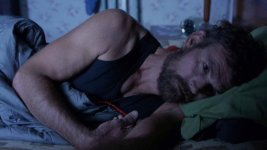
How would one go about lighting a simple situation like this: talent sleeping in bed (faintly illuminated (motivated by moonlight). Talent wakes then rolls over and switches on a bedside lamp. I figure a blue gelled 200 watt bulb in a china ball for moonlight - flagged so it falls on his body and face. Set white balance to the tungsten bedside lamp. That would give me an even bluer moonlight - which i'd desaturate in post. Does this sound about right? Would I be wanting to cut the moonlight when the bedside lamp is switched on? He'll be very close to the lamp - probably.

thanks, Glen
 
You've got it. The China ball will work fine although it's a pain to gel a bulb inside. In thinking about your white balance, let's guess the bedside lamp is 2700K. You might want to dial in 3000 K to 3200 K so you get the believable warmth from that source instead of a clean white. Your blue will still look like moonlight and I wouldn't worry about cutting the China ball when the table lamp goes on, whatever happens will look right.

I personally like those night scenes with both some warm incandescent and some blue in the scene. I also like it when the moonlight comes in only a little above level instead of from a high angle. You get that from windows most of the time anyway.

Interesting to note that moonlight's appearing blue is a result of the physiology of our eye, the Purkinje shift or effect, not the physics, because moonlight is reflected sunlight.

The Moody Blues knew:

Cold hearted orb, rules the night
Removes the colours from our sight
Red is gray and yellow, white
But we decide which is right
And which is an illusion
​
 
Is the bedside lamp going to actually be in the shot? If so, you'll have to have another light so that you can expose the talent but not have the lamp be overexposed, or if he's far away enough from it, completely blown out. On the other hand, If all you need is that household incandescent light to light him up once it's turned on in the scene, I might suggest using a 3/4 CTB for the moonlight rather than a full one. That should give you a good enough difference in color temp. This will also give you more light to work with, considering you're only starting out with 200w and you have a china ball diffusing it, causing a loss of maybe a stop right off the bat.

That said, what's the reason for using a china ball for the moonlight (both of you)? I shot a project earlier this year with a shot of someone lying in bed, but I just had hard light coming from a low angle. That seems more realistic than soft light, considering that the moon is a hard source.

The suggestion to use less blue CC is a good one. The 200W does seem underpowered but it all has to do with how close the China ball is, right? As for hard or soft, I like soft light on sleeping people and would probably do this shot with a diffused 2' Kino, but a China ball should work as well.

As for the moon being hard, that might be true but rarely is a person illuminated directly by the moon, it's usually bouncing around before coming through the window, being diffused by blinds or curtains, etc., so the real source is comparatively large.

But there is never a single way to accomplish anything in lighting and rarely one right way to light. I believe you completely when you say your hard light looked good.
 
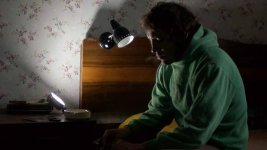
I also like soft light on sleeping people - as if filtered through net curtains. I'd use less diffusion if I was lighting someone outside under moonlight. I think maybe 1/2 ctb is probably better on second thought - it's easy enough to blue it up in post. Below are the framings I'd imagine (test shots - without proper lighting). The one with the guy sitting on the bed is how I imagine the scene to end. I want the talent to have a rim of light along his face - how it is in the screengrab. I was thinking about using the light attached to the bed head. (the source of light in the picture is just a camera light I had with me, and late afternoon light coming through a window on the right hand side of the frame). If I used this lamp, it would be a very hard light. He is going to light up a cigarette, so I think the smoke would look good curling through the hard light. I'd need a fill light, so he's not completely silhouetted, but I want to deemphasize the wallpaper because it's too bright for my taste.

shot 2.jpgframe one.jpg
 
Last edited:
Good thread. I'm going to shoot something like this later this year and this gives me good ideas. thanks!
 
I'll tell you a secret... real moonlight isn't blue at all, it actually has a slight green tint so a modern cheap household 'energy lamp' (aka fluorescent in a bulb) will do a fine job inside that china ball.
 
I'll tell you a secret... real moonlight isn't blue at all, it actually has a slight green tint so a modern cheap household 'energy lamp' (aka fluorescent in a bulb) will do a fine job inside that china ball.

Yea, it's interesting how the blue moonlight paradigm came about as an understood standard in film.
 
I read an article with a famous DP on shooting a night scene - the Director questioned the motivation of the light and said "where will the audience think the light is coming from?"

The DP answered, "same place as the music I guess"...
 
I read an article with a famous DP on shooting a night scene - the Director questioned the motivation of the light and said "where will the audience think the light is coming from?"

The DP answered, "same place as the music I guess"...

Haha --- classic!
 
Me too and I have shamelessly stolen it and quoted it numerous times for great laughs on set.

But the point is an excellent one. As a gaffer I sometimes work with people who get all carried away about motivation when we never establish the room geography and so can put the sources where they work best for us.

Recently, we were shooting in a large living room with windows on one side and in a night shoot we wanted a bunch of blue moonlight streaming in. The director and DP were adamant about not shooting towards the windows because of what was outside and we were about 2 1/2 stories up and couldn't afford to put my HMIs on a Condor out there so I convinced them it would be 100 times more convenient if we "declared" that the "windows" and the "moonlight" were coming from the opposite side of the room because we could make use of a high ledge and bounce on that side.

Worked great and only we knew we had "reversed" the room but it's interesting how hard it was to get the actual room layout out of their heads at first.
 
Not quite lighting related but we were shooting a short which needed a room set. When the work crew started, the director and I stepped out to talk about things and when we came back, the set was built in reverse. The director was all ready to have them tear down the set, costing hours of work for everybody, when I said "why does it need to be the other way?". We talked about it and since their was no reference to the outside world, it didn't matter at all and we shot the scenes with the room reversed.
 
Back
Top